



This season’s Washington Wizards are better than the previous editions. They’re 4-6, the vets have been good, a couple young guys look close to being good-to-really-good, and with the exception of the absolute dud against Oklahoma City, they’ve been fun to watch this season.
“The vets” in this case refers to Anthony Davis and Trae Young. While I have quibbles with how each of them are playing, it’s more in the realm of nitpicking than major critiques. They’ve both been about as good as the Wizards
could have reasonably expected.

Davis has anchored an improved defense — upgraded as much by his stellar communication as his rim protection capabilities. When he’s on the floor, the team seems well organized and solid on the defensive end. In the two games he’s missed, the Wizards defense essentially collapsed. That could partly be due to a step up in opponent quality, but I suspect not having Davis on the back line calling out actions is a big reason why.
Note: this is not a criticism directed at Alex Sarr, who has at times reminded me of Davis — in terms of positioning and movement — or even of Deandre Ayton. To say they’re not as good as Davis at communicating on defense feels the stuff of Captain Obvious. Davis is an all-time defender, who has excelled at that aspect of a big man’s defensive chores. In the case of Sarr, he’s getting a crash course in being great on defense, and he has appeared more vocal than he was in previous seasons when Davis has been off the floor.
With Davis, my chief concern (aside from health) is on the offensive end, and it’s really more about how they’re using him than it is about Davis himself. Specifically, Davis leads the NBA in post-ups, and a hot game on the block got him all the way to 47th percentile in efficiency. The last time Davis was above average in post-up efficiency was 2023-24.
While I think it’s possible to have a high-efficiency offense that leans heavily on a big man posting up — yes, even in this economy — I think that big man needs to be both efficient at scoring the ball and an effective passer. I don’t think that description fits Davis.
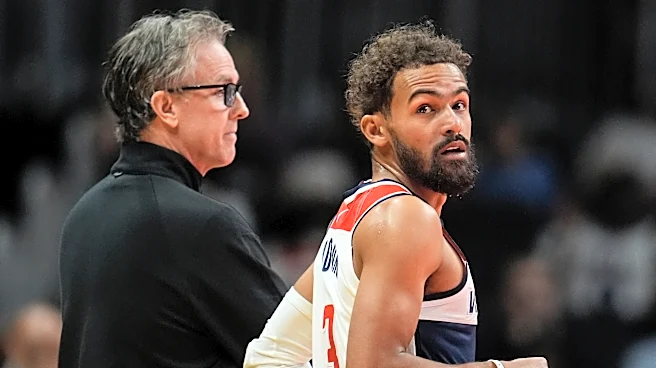
As for Young, he’s been a little above average in offensive efficiency despite shooting just 28.6% on threes so far this season. He’s been a stellar set up man, and the combination of Young and Davis has helped make Washington a league leader in free throw attempts. Trips to the free throw line are second only to rim attempts in overall efficiency.
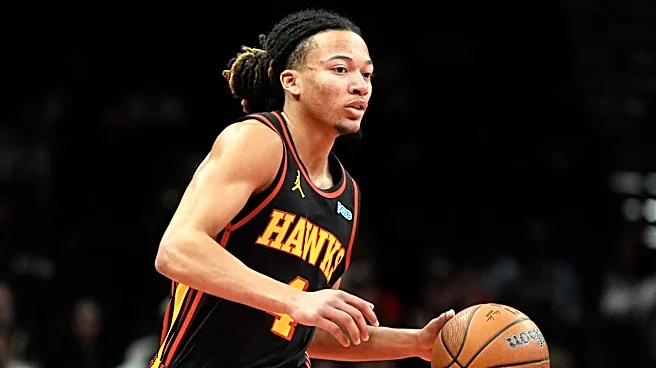
One of the good things about Young has been his defensive effort, which is dramatically improved from his days with the Atlanta Hawks. He still has lapses, and he’ll always be a target because of his lack of size and strength, but he’s competing on that end, and he’s contributing with a handful of steals, deflections or well-timed traps per game.
Had I been writing an article like this after six games, I’d have been fretting about how none of the young guys looked like they were making The Leap. A couple terrific games from Kyshawn George gives Washington a candidate. He’s still undermining his own value with rampant turnovers and excessive fouling, but he’s big, physical, tough, competitive, and skilled. And he plays crazy hard, which is at once a strength and a potential weakness (to the extent that it leads to turnovers and fouls).
While I’ve had a vaguely disappointed feeling about Sarr’s performance this season, the reality is he’s been fine — about the same overall level of production as last season. That’s not bad considering he missed most of the offseason with a broken foot and feels like he still needs some conditioning work.
Justin Champagnie was off to a terrific start before his foot injury. The Wizards definitely should want him to come back and stabilize their forward rotation before the postseason.
After missing the first four games with an ankle injury sustained in the preseason finale, AJ Dybantsa has been everything the Wizards could have hoped for. He’s defended with intensity, and played with aggression on offense. One of my favorite plays from him so far this season was when he waved Davis out of the post so he could attack a mismatch.
Putting on my Shot Doctor coat, I think there’s something off with Dybantsa’s three-point shooting stroke, though I could be reaching. He hasn’t hit threes yet, and his two-point percentage has been subpar, but both of those things are normal for rookies — even when they’re going to be great in the future. He’s shooting 79.3% from the free throw line, which suggests his shot isn’t exactly broken.
The rest of the Wizards have varied between fine (Ayton) and not-so-good (Bub Carrington, Bilal Coulibaly, Tre Johnson, Will Riley, Khris Middleton). Brian Keefe and the coaching staff wisely dropped Middleton from the rotation.
Carrington has hit half his threes so far, and his defense is a lot better. He’s also shot 2-12 on twos, and his non-three-point shooting contributions have been pretty minimal.
Coulibaly is a stellar defender who has utterly disappeared on offense. Teams are happy to let him shoot threes — they routinely leave him alone. So far this season, he’s rewarded them with bricks. Last season, it seemed like he had an emergent driving game. Opposing defenders were having a tough time staying in front of him, even when they gave him a cushion. This season, he doesn’t attack, even when he has a matchup advantage.
The most worrisome Coulibaly-related play of the year t0 my eye was when he got the ball in the dunker spot with Atlanta’s CJ McCollum guarding him. Coulibaly was in great position, and he had a height and athleticism advantage on McCollum. He never looked to attack — just passed it back to Young on the perimeter. The possession cratered and the Wizards ended up with a turnover instead of a close-in shot in a mismatch.
My biggest concern is that the early returns suggest that the Wizards are weaker than their record indicates. The best indicator of relative team strength is strength of schedule adjusted scoring margin. The Wizards currently rank 27th in this metric. They ranked 24th before they got blown out by Oklahoma City.
So far this season, Wizards opponents have been outscored by 6.7 points per game. That group of opponents has outscored Washington by 4.7 points per game. That’s not good.
For benchmarking purposes, here’s where Washington ranks through 10 games in key statistical measures:
- Offensive rating (points scored per 100 possessions): 22
- Defensive rating (points allowed per 100 possessions): 18
- Effective field goal percentage: 24
- Turnover percentage: 10
- Offensive rebound percentage: 28
- Free throws made / field goal attempts: 11
- Defensive efg%: 8
- Defensive tov%: 27
- Defensive rebounding percentage: 27
- Defensive FTM/FGA: 2
On the offensive end, Washington is not shooting or rebounding well, but they’re doing a good job avoiding turnovers and getting to the free throw line.
On defense, opponents are missing shots, which is the foundation of a good defensive team in the NBA. The Wizards are also doing a good job overall of not fouling. They’re also not forcing turnovers, and they’re getting beat on the boards.
One other key stat: 24.6. That’s the Wizards’ minutes-weighted average age so far this season — second lowest in the NBA this season.
Player Production Average
Below is a first look at season-to-date scores in my Player Production Average metric. PPA accounts for each player’s statistical contributions — each category weighted by how much it contributes to winning and losing. PPA is a per possession metric, which includes accounting for position, quality of competition while on the floor, and defensive impact. In PPA, 100 is average, higher is better, and replacement level is 45.
In most seasons, a PPA of 150 would put a player at least in the All-Star conversation. All-NBA level performances are typically 170 and above. It typically takes a score of 200 or better to merit MVP consideration.
ORTG is offensive rating — individual points produced per possession x 100. League average so far this season is 113.1.