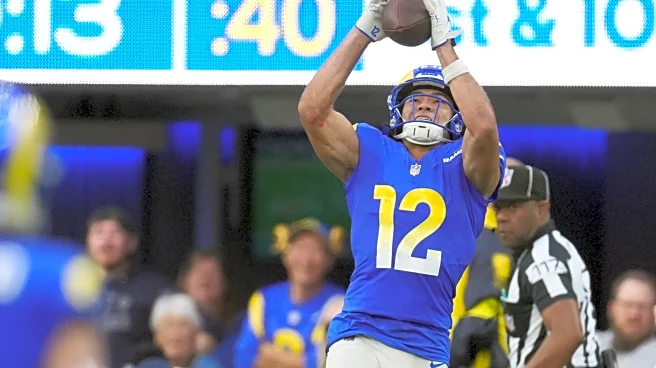




For a few brief moments—when Aidan Hutchinson’s red-zone interception immediately turned into a Jared Goff strike to Amon-Ra St. Brown on the very next play, or when Goff hit Jameson Williams for a 31-yard touchdown to briefly take a 24–14 lead late in the second quarter—it finally felt like this Lions team had rediscovered its identity. They looked ready for their close-up again in La La Land. For a fleeting stretch, they resembled the 2023 and 2024 versions of themselves.
But it dissipated just
as quickly.
Soon after, the Lions looked more like the team that hasn’t won consecutive games since Weeks 4–5. And while they still are very likely to make the playoffs if they win out, the reality is Dan Campbell’s team has been a below-.500 football team for the better part of two and a half months.
The unraveling began when Detroit allowed the Rams to steal a field goal in the final 30 seconds of the first half. That moment snowballed into 20 unanswered Rams points over a 15-minute span of game time, a 17-point third-quarter hole, and eventually a 27–3 run by the Super Bowl-favorite Rams. After the Lions landed their best punch and held their own early, Los Angeles looked like an entirely different caliber of team.
Offensively, Detroit became rudderless to open the second half, sinking into a three-drive quicksand stretch of three-and-outs—just nine plays for -4 yards—and just like that, the game slipped away.
A handful of Lions stepped up enough to give Detroit a chance against the NFC’s current No. 1 seed. But too many others underwhelmed, and the collective result was another sobering reminder of where this team currently stands—and a stock report that leans heavily toward down.
Stock down: D.J. Reed, CB & DJ Reader, NT
D.J. Reed made a few tackles of Kyren Williams and Blake Corum, often after they had already gained 5 yards, which was admirable, but otherwise, it was another disappointing outing. He was beaten early on the Rams’ first drive by Davante Adams on a jump ball along the sideline, and then repeatedly overmatched by Puka Nacua—first on the Rams’ initial fourth-down conversion, then on a 30+ yard deep ball setting up their second touchdown, and again on a 30+ yard deep ball down the right sideline at the end of the first half. Nacua consistently won their matchups in some of the game’s most pivotal moments. While the weight on Reed’s shoulders was immense—without Brian Branch, Kerby Joseph, and Terrion Arnold—the Lions needed a more consistent performance.
DJ Reader was unable to make an impact as a pass rusher, which is unsurprising given he has zero sacks and three QB hits this season. What was more concerning was his play against the run. Tasked with holding the point of attack, Reader was repeatedly controlled or cut off by Rams center Coleman Shelton, a player the Rams had originally let walk after 2023 and whom the Bears sought to upgrade from this offseason. On one play where he stacked properly, he allowed Kyren Williams to bounce outside, turning a potential tackle for loss into a 6-yard gain. Reader also struggled against Kevin Dotson on multiple plays.
Reader was the Lions’ high-priced free agent acquisition in March 2024, while Reed joined on a high-priced deal in March 2025. Holmes acquired Reader on an injury discount and Reed on a height-weight-speed discount. Both have been clear culture fits—Reader even earning Walter Payton Man of the Year recognition—but the on-field returns are questionable. Reader hasn’t played like a top-30 defensive tackle, and Reed has yet to prove himself as a top-20 paid cornerback. Both are serviceable, but the Lions depend on more from them.
Stock up: Amon-Ra St. Brown & Jameson Williams, WR
Along with their quarterback, the Lions’ top receiving duo put the offense on their backs and helped lift the team into legitimate contention with the best team in football. St. Brown and Williams combined for 13 receptions, 219 receiving yards, and three touchdowns in the first half alone, accounting for every Jared Goff completion except a 2-yard checkdown to Jahmyr Gibbs.
They finished with 20 catches for 298 receiving yards (14.9 yards per reception), 79 yards after the catch, and 15 total receiving first downs. The duo consistently exposed the Rams’ zone coverage over the middle and accounted for more than 75% of the Lions’ total offensive yardage.
St. Brown posted 13 receptions for 154 yards, both the second-highest single-game totals of his career, trailing only his Week 15 performance against the Bills last season. Williams added 134 receiving yards—the third-highest total of his career—while his seven receptions tied a career high he had just set in Weeks 13 and 14. With inconsistency in the run game and on defense, the Lions will need to continue leaning heavily on their two highly paid playmakers if they’re going to make it to the postseason.
Stock down: Kelvin Sheppard, defensive coordinator
A brutal month for the Lions defense culminated in a collapse against the Rams: 40+ points allowed, 500+ total yards surrendered, 30 first downs conceded, and a perfect 100% conversion rate on fourth down. Puka Nacua erupted for a career-high 181 receiving yards, while the Lions allowed a 69.0% offensive rushing success rate—worse than any single-game mark from Lions defenses led by Matt Patricia, Teryl Austin, or Rod Marinelli.
After being carved up by the Giants, Packers, and Cowboys, this was the defense’s lowest point. Over the past month, the Lions rank 31st in explosive play rate allowed (14.9%) and 30th in EPA per play (-0.14), underscoring a unit trending sharply in the wrong direction.
Detroit had no answers for a Rams offense that scored on seven of nine possessions during one stretch of the game. The defense struggled mightily against Los Angeles’ 13-personnel usage (43 plays, 382 total yards, 8.9 yards per play, 72.1% success rate), under-center runs (27 carries for 152 yards, 5.6 yards per rush, 70.4% success rate), and play-action passing game (11.1 yards per attempt, 73.3% success rate), particularly on boot concepts.
Sheppard cycled through fan favorite five-man fronts, blitzes, rushing with four or less, different defensive back combinations, man coverage, and zone looks, but nothing slowed the Rams down. With absences at safety, he leaned heavily on single-high pre-snap looks designed to help against the run, but Stafford shredded it: 17/24 passing, 265 yards (11.4 YPA), 2 TDs, 136.3 passer rating, and a 68% passing success rate. The Lions were thoroughly figured out—a recurring theme this stretch.
That said, context still matters. Sheppard is only a first-year defensive coordinator, and like Rams DC Chris Shula last season, he has endured significant growing pains and is still learning on the job. The remainder of the season will be critical in seeing whether this unit can stabilize, adjust, and start to coalesce.
Stock down: Marcus Davenport, DE
Davenport logged the most snaps of his seven-game, two-season Lions tenure and tied for the most he’s played in a single game (56) since Week 3 of 2019. Unfortunately, the increased workload did not translate into effective play.
He was deployed in a variety of roles—standing up as an edge rusher outside the tackles, aligning as the strong-side defensive end next to Derrick Barnes in five-man fronts, and kicking inside to rush against guards.
Across 56 snaps, Davenport produced only two positive plays: a quick inside move that caused left tackle Alaric Jackson to whiff and nearly resulted in a hit on Matthew Stafford before a quick first-down completion to Puka Nacua, and a single rep where he beat a tight end to stuff Blake Corum for a minimal gain. Outside of those isolated moments, he was largely ineffective. Davenport was mostly stonewalled by Jackson, consistently displaced in the run game by right tackle Warren McClendon Jr., and neutralized by guards when matched up inside.
He lacked the burst to win from a stand-up alignment, struggled to hold up when aligned head-up on the tackle in a four-point stance, and failed to capitalize on interior pass-rush opportunities. He was asked to do a lot—and across nearly the entire game, was unable to provide meaningful value in any role.
Stock up: Jared Goff, QB
Jared Goff was humming while trading punches with his signal-caller counterpart in Stafford. Despite a nonexistent run game, Goff was on fire—particularly in the first half—turning in one of his most potent performances of the season as he repeatedly peppered Amon-Ra St. Brown and Jameson Williams. Dishing out dimes a plenty.
Goff finished the day 25-of-42 passing (61.0%) for 338 yards (8.2 YPA), three passing touchdowns, and a season-high 17 passing first downs. Most impressive was how well he operated under pressure from the Rams’ treacherous defensive front. When pressured, Goff went 12-of-20 (60.0%) for 196 yards (9.8 YPA), a touchdown, nine passing first downs, and took just one sack.
Goff played well enough for the Lions to win this game. Unfortunately, second-half play-calling stagnation and a defensive collapse prevented the Lions from capitalizing on his performance on the road as underdogs.
Stock down: Hank Fraley, run game coordinator
It’s hard to watch the Los Angeles Rams’ run game—how it’s layered, dressed up, and married to the passing attack, how the blocking angles consistently put defenders in conflict—and not wonder whether the Lions’ run game design has regressed this season. Some regression is understandable without Frank Ragnow anchoring things and handling certain assignments, but it’s fair to question whether the scheme is consistently putting players in favorable positions.
The Rams’ run game does more with less. It forces defenses to hesitate and defend space horizontally and vertically. The Lions’ run game, by contrast, too often feels predictable and overly dependent on explosive plays breaking through. That’s not to say the blocking has been flawless, or that Fraley is working with an ideal group, but these are fair questions to ask when the run game has been largely neutralized in every loss this season.
In those losses, the numbers are stark: a 39.0% rushing success rate (t-31st), 3.5 yards per rush (t-30th), 1.11 yards before contact per attempt (27th), and an 18.7% stuff rate (24th). Stretched over a full season, those marks would sit near the bottom of the league.
Quick hits
STOCK UP
- Aidan Hutchinson, ED: Hutch gets paid to make impact plays and take the ball away, and he did just that with an interception and a sack, even if his run defense was lacking. His pass rush presence was one of the few things attempting to slow the Rams’ third-quarter onslaught.
- Roy Lopez, NT: No Lions defensive tackle maximizes their time on the field like the big Pez Dispenser. Another impressive sack for Lopez, with Kevin Dotson beaten as easily as taking candy from a baby (Alim McNeill did have an initial pass-rush win on the play as well).
- Avonte Maddox, SAF: The lone bright spot among the defensive backs, Maddox made multiple plays on the ball while filling in solidly for Kerby Joseph.
STOCK DOWN
- Jahmyr Gibbs, RB: Tough sledding in the run game, barely involved in the passing attack, and posted a 15.0% offensive success rate on touches—the lowest of his 50-game career (including playoffs).
- Isaac TeSlaa, WR: TeSlaa remains an enigma. Against the Rams: 29 routes run, one target, zero catches. He has eight catches on 212 routes this season. His 0.57 yards per route run ranks 243rd of 257 qualified players—still plenty of time to develop into a dependable threat, but currently more cardio than impact.
- Shane Zylstra, Anthony Firkser, and Giovanni Ricci, TE: Unfortunately, not much you can do with, or expect from, this group right now.
- Trystan Colon, LG: Capable in run blocking but unreliable in pass protection, struggling even against play-action.
- Alim McNeill, DT: More time spent between defensive tackle and defensive end, and another game with mostly non-existent presence in the backfield, while not holding up well in the run game. He’s still not quite back to the player prior to his ACL injury that received the big payday.
- Derrick Barnes, LB: Much like the pitch for the Seinfeld show “Jerry,” Barnes’ pass rush again resembled… well, nothing. Unfortunately, his run defense was severely lacking at the point of attack and on outside containment too (see: Blake Corum touchdown), while getting beaten twice by Colby Parkinson in coverage falling for play-action on rollouts. His SAM linebacker role is a brutal assignment on the edge against the Rams.
- Amik Robertson and Rock-Ya Sin, CB: Much like Reed, both has issues in coverage against Nacua and Adams, though Robertson had two pass breakups on balls to Tutu Atwell and Adams.
- Daniel Thomas, SAF: Limited playing time, but beaten in man coverage on the infamous Colby Parkinson touchdown.
- Jake Bates, K: Another miss —his fifth (including two extra points) in seven games since the bye. Only his second career miss under 50 yards. Field goal percentage has dropped from 89.7% last year to 77.8% this season.
STOCK NEUTRAL
- David Montgomery, RB: Posted 4.6 YPC, three rushing first downs, a 57.1% rushing success rate, and a fourth-quarter goal-line touchdown. Limited opportunities prevented a bigger impact.
- Penei Sewell, RT: Dug out Tyler Davis to open a lane for Montgomery’s longest 10-yard run, scooped the backside linebacker flawlessly on his second-longest 8-yard run, and led the way on Montgomery’s wildcat goal-line touchdown while also pulling out front for St. Brown’s screen pass. Couldn’t spring Gibbs free on any runs, and the holding penalty on the first drive was costly, but otherwise, he was his usual dominant, dependable self and an absolute rock in pass protection against Byron Young.
- Erick Hallett, SAF: Brian Branch’s shoes are tough to fill, especially against the Rams offense, and Hallett had his ups and downs. He got beaten on the long Colby Parkinson catch-and-run that set up an easy Williams walk-in touchdown that Hallett looked completely lost on. He eventually defended the tight ends well on crossers during play-action rollouts, stood up Kyren Williams near the goal line in run defense, and made an impressive pass break-up on a deep ball to Konata Mumpfield. Regardless, the Lions will be better off if Thomas Harper can return and slide back into his role.