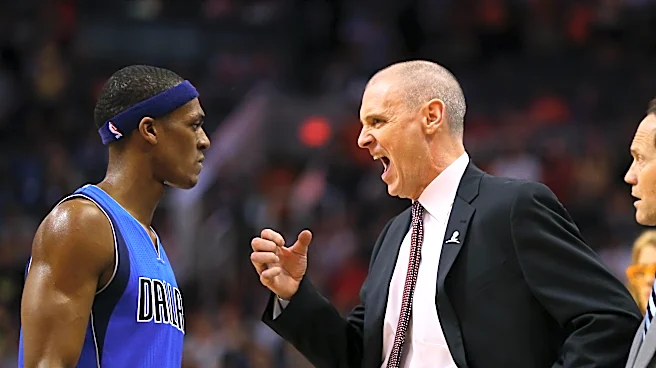




Your favorite Trade Machine has approved thousands of deals and never once flagged one for personality incompatibility. It checks the salaries, blesses the math, and leaves the human beings to sort themselves out. Three months ago, Secret Base’s Beef History series revisited the most instructive case of humans failing to sort themselves out in Mavericks history: the brief, loud cohabitation of Rajon Rondo and Rick Carlisle.
On paper, the December 2014 trade was exactly right. Dallas was a contender
missing a point guard. Rondo was a championship point guard, a basketball savant who saw the floor like a chessboard. Carlisle was an offensive mastermind with a ring of his own. Two geniuses, one goal. The video lays out how seductive the logic was, and the logic came with a precedent: Jason Kidd. Kidd and Carlisle butted heads over pace early in their partnership, Carlisle loosened his grip, and the compromise ended with a parade in 2011. Mark Cuban openly compared Rondo to Kidd. Dallas believed it had a road map.
The problem, as Secret Base details, is that the warning labels were public record. Carlisle had worn out welcomes in Detroit and Indiana with a my-way-or-the-highway approach and a compulsion to call plays on nearly every possession. Jamaal Tinsley had already lived the experience of being a point guard ordered to slow down for him. Rondo, meanwhile, spent years clashing with Doc Rivers in Boston while quarterbacking a roster full of Hall of Famers. Two men with documented allergies to surrendering control were now expected to share a steering wheel. League whispers, per the video, suggested Carlisle was never sold on the deal in the first place.
It unraveled on schedule. Seventeen games in, Carlisle benched Rondo for the final five minutes against Chicago and called it a coach’s decision. After an ugly loss in Oklahoma City, Rondo told reporters that Carlisle calls the plays and he just follows orders, which is the point guard equivalent of “per my last email.” Then came February in Toronto: Rondo walking the ball up the floor while Carlisle erupted at half court, an exchange that carried into the locker room and ended in a one-game suspension over play-calling responsibilities. The whole fight, beginning to end, was about who decides what happens next.
Then the playoffs arrived, and so did the part I will never need a documentary to remember. Game 2 against Houston: Rondo played 34 seconds after halftime and spent the rest of the night looking like a man waiting on a delayed flight. He ducked the media. The next day, Dallas issued a press release about a back injury, and reporters called cap in unison. Rondo has since offered the revisionist version, telling Chandler Parsons in 2023 that he never quit, that he was told Carlisle didn’t want to coach him, and that the injury was a mutually agreed cover story. Revisionist history is the chief occupation of the retired athlete. I watched those games. A championship veteran gave a playoff series 34 seconds of second-half effort. Call it whatever you want. I know what I saw.
Carlisle’s own autopsy, recounted in the video, is the sharpest part. Kidd and Rondo looked similar and were fundamentally different. Kidd had developed into a legitimate three-point threat by the time he reached Dallas; defenses happily ignored Rondo. Above all, pace: Kidd taught Carlisle to let go and play fast, while Rondo wanted to walk it up. Asking Rondo to change his tempo in the middle of a season was, by Carlisle’s own admission, impossible. The Kidd precedent that justified the trade was the exact thing that doomed it. Dallas pattern-matched the résumé and missed the person.
The mercy is that it was a fireball. Rondo was a Maverick for barely half a season, and fireballs burn out fast. It’s the slow corrosion that reshapes a franchise. But the lesson travels. The new brain trust is about to run the two highest-stakes chemistry experiments in basketball: hiring a head coach and remaking a roster around a 19-year-old franchise player. Every candidate and every trade target will look right on paper. Paper is undefeated that way. The Rondo half season is a reminder that fit is also temperament, ego allocation, pace preference, and the unglamorous question of who decides what happens next. The résumé tells you whether a man can do the job. It cannot tell you whether two men can do it together.
The Trade Machine will keep saying yes all summer. Someone in the room needs to ask the other question.