
The following is a guest post from Zach Lowy of Breaking the Lines; be sure to follow Zach on social media to read more of his work!
You’d struggle to find a more experienced coaching expert in North America
than Glenn Crooks. Born and raised in Basking Ridge, New Jersey, Crooks graduated with a Bachelor’s Degree in interpersonal communications before returning to the Garden State and began his career in sports radio. He later moved into coaching, taking over the girls’ soccer team at his alma mater, Ridge High School, where he guided the Red Devils to two state championships and compiled a 140-39-8 record over his decade in charge. He then launched the women’s soccer team at Saint Peter’s University in 1992, posting a 26-21-4 (.549) record.
He left as the winningest coach in the program’s history and built the women’s program at Long Island University Brooklyn, before taking charge of Rutgers University. Crooks built Scarlet Knights into an all-conquering powerhouse across his 13 years at the helm, leading them to 13 straight BIG EAST Championships and seven NCAA Tournament bids and developing promising young stars like Carli Lloyd. Furthermore, he also coached at the regional level with the Olympic Development Program (ODP) staffs in both Eastern New York and New Jersey, leading six teams to ODP Regional Championships and three teams to ODP National Championships.
Today, Crooks balances his time between traveling the country to call New York City FC matches and hosting The Coaching Academy, a radio show on SiriusXMFC’s Channel 157, which focuses on coach and player education and development with guests from both the professional and youth ranks. As a result, Crooks constantly has his eyes glued to both the American and European soccer scenes and vigorously studies the game’s top managers, from Luis Enrique to Vincent Kompany to Gian Piero Gasperini.
“The one thing that stands out about Gasperini is his man-marking approach, which is a kind of old-time concept. I remember seeing Jerry Yeagley’s Indiana team man-mark all over the field, and if they weren’t winning national championships every year, they were certainly contending for it. There are zonal concepts to it, but that’s the thing that stands out to me about Gasperini and his teams: the man-marking. That man-marking has really worked its way into the high press, which is now becoming a standard item. They’re going with the high pressure and the man-marking, which is a risk, but it brings success. Nobody likes somebody in their shorts, and I think that’s part of the intent with Gasperini’s style.”
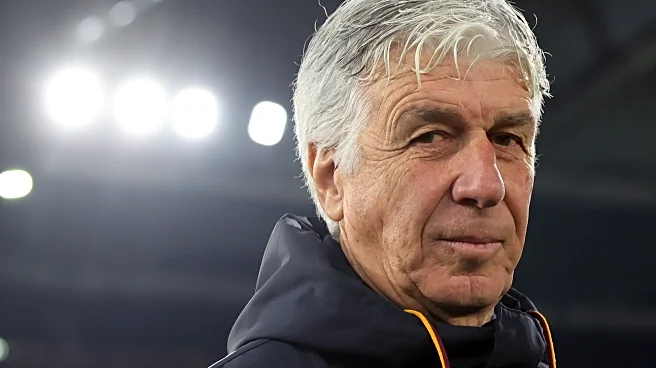
Whereas many teams have transitioned to zonal marking, Gasperini has remained true to his man-marking tactics throughout his coaching career. After bouncing around from Crotone, Genoa, Inter, and Palermo, Gasperini joined Atalanta in 2016, where he elevated them from a run-of-the-mill Italian side to a perennial European powerhouse, eventually guiding them to the 2024 UEFA Europa League title. One year later, Gasperini traded Bergamo for the Italian capital and took charge of Roma. Fast-forward to today, and it’s evident that this gamble has paid off. Roma sit fifth in the Serie A table, level on 39 points with Napoli and Juventus, one point behind Milan, and four behind league leaders Inter.
Gasperini has the Giallorossi on pace to qualify for the UEFA Champions League for the first time since 2018/19, and he’s done so thanks to an aggressive man-marking approach predicated on pressing triggers and well-coordinated movement on and off the ball. Operating in a 3-4-1-2, Roma will look to squeeze their opponent into one side of the pitch and, once the ball has reached their desired target, typically a fullback that’s slightly uncomfortable on the ball, they will immediately close him down. It’s this tenacious pressing and keen understanding of knowing when to jump that has made Roma a force to be reckoned with, with each center back closely following their man and even running across the pitch whenever the opposing forwards rotate.
This pressing intensity has not only forced opponents to take careless long balls but also led to costly giveaways in the final third. Roma can hit their opponents with this tight man-marking and quick counter-attacking, with each player well-positioned to make key interventions. They are synchronised and constantly minimise the distance between them to ensure no gap opens up for the opponent, and for the most part, they’ve been able to maintain this intensity for the majority of the game. It’s precisely this pressing effectiveness that has led Roma to the best defense in Serie A, conceding just 12 goals in 20 games. And it should come as no surprise that Roma have won possession in midfield more times (441) than any other team in Italy.
Gasperini has already built his first masterpiece in Atalanta – now, can he do the same at Roma?