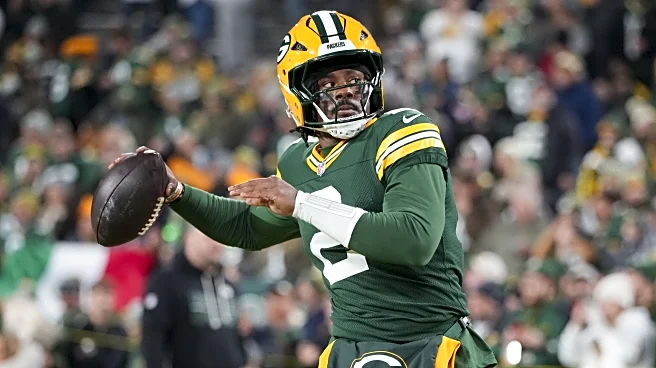




As we do every week in this space, we take a look at the Packers passing game from the previous week. We got a little Clayton Tune near the end of Saturday’s game against the Baltimore Ravens, but Malik Willis played the majority of snaps, so that’s who we’re focusing on today.

Completing 85.7% of your passes and posting a QB Rating of 134.6 is tremendous work for QB2. And it’s not like it was all checkdowns or anything: as you can see from the chart, he was pushing the ball downfield. For the game,
Willis had an ADOT (Average Depth Of Target) of 11.5 yards (per NFL Pro). That was a pretty big difference from the other sideline, where Tyler Huntley posted an ADOT of 4.2 yards. The last time Jordan Love posted an ADOT of 11.5 or higher was…Week 14 against Chicago (12.1 ADOT). So, not that long ago.
The Ravens also made a point to clog the middle of the field with linebackers, forcing Willis into some high-difficulty throws to the outside. Willis made those throws all night.
As far as the offensive approach, it was pretty pared down. In their passing game, 10 calls (38.5%) involved either Stick (quick-game staple) or Dagger (intermediate-game staple). That being said, this was different than the Willis starts from last season. Those were heavily reliant on a creative run game and passing plays to attack off of that. In this game, Willis was asked to run a more pure dropback offense, and he proved himself to be effective in that role. The pared down playbook for Willis — along with some missed reads when operating a more expanded playbook — gives me pause when it comes to thinking of him as a long-term starter. But, for a game or two, Willis continues to show how valuable he is as a back-up for this offense. However, given his performances when asked to step into a game, it certainly feels like this will be his last year in Green Bay.
When I say “pared down”, I’m not just talking about it from a “what concepts did they run” perspective. This season, they’ve given Jordan Love a lot of control at the line of scrimmage. Identifying the Mike, shifting protections, a heavy dose of Can calls, etc. Those are all ways for the Packers to get into favorable calls against the defense and allowing Love to make sure the protection is right.
All of that was pretty much stripped from the offense this week. I don’t believe I saw Willis make any checks at the line, and his single Can call ended up in a turnover when the ball was snapped directly into his facemask.
Beyond that, the Packers were operating in a more static offense than we’ve seen from them at any point this season. Coming into this game, the Packers were using motion at the snap on 34.5% of their offensive plays. If you include shifts, they were using some kind of pre-snap or post-snap motion on 65.5% of their offensive snaps. With Willis in the game this week, their motion-at-the-snap rate was 14.3% (20.2 points below their season average) and their overall motion rate was 42.9% (22.6 points below their season average). Before this game, their lowest motion-at-the-snap rate was 20.6% (Week 12: Vikings) and their lowest overall motion rate was 56.9% (Week 10: Eagles).
Motion can allow you to gather information before the snap, but motion-at-the-snap also forces the QB to process more information, and to do it further into the play. If you’re motioning at the snap, you’re seeing what that can tell you about the defensive structure – rolling safeties, man vs. zone tells, linebacker gap assignments, etc. – but it can also give you leverage reads as the ball is being snapped. Motion can be a benefit to offenses, but it also puts more on the QBs plate.
Conversely, a lack of motion gives the QB a static look. Sometimes you won’t use motion on a play because you like the match-up on the field (Peyton Manning famously didn’t like the use of motion for this reason), but sometimes you won’t use it because it forces the QB to process more information and can lead to complications. If you see a static look pre-snap, you can know where your 1st & 2nd reads should be after the ball is snapped. If the picture changes drastically, you can either check it down or bail out and use your legs.
Motion for the sake of motion isn’t always good, but LaFleur likes to use motion to create leverage in the passing game and blocking angles in the running game. Dialing back motion overall made for an easier operation for Willis, but it hampered other areas of the Packers offense.
Before we get out of here, let’s take a look at a couple plays. We’ll make it easy today: we’re looking at the first two plays of the game for the Packers.
Play 1: 1st & 10, 6:50 remaining in the 1st quarter
After sitting through a 13 play, 80 yard opening drive from the Ravens, the Packers finally got a chance to take the field more than halfway through the 1st quarter. They opened in a heavy, 611 personnel grouping (6OL, 1 RB, 1 TE, 2 WR). They’re in a tight, shotgun formation, with Romeo Doubs [87] split wide on the left.
The Ravens have the box stacked with 8 bodies, with a single-high look on the backend. The safety is aligned over the right (the strength of the formation). The Packers are running Cross-Country Dagger on the right – with a delayed Escort Screen underneath – and putting Doubs on a vertical route on the outside.
Doubs is the Alert on the play. That is, he’s either the 1st read or he’s not a read at all. If Willis likes the match-up on the outside, he’ll throw it. If not, he’ll work the concept.
At the snap, the Ravens stay in single-high and drop their linebackers deep in the middle. Since Cross-Country Dagger is a concept designed to attack the middle of the field, the linebackers dropping take that away. If Willis is reading out the concept, he’d see that movement from the linebackers then check it down on the Escort screen.
Willis is reading the safety. He stays on the right hash, dropping back deep. That tells Willis that he has a one-on-one with Doubs on the outside. He likes that match-up, so he hits the top of his drop, hops to reset, and throws to Doubs on the outside.
Doubs could have done a better job at stacking the cornerback by working over the top and back to the inside, but he’s still able to make a nice catch for a 40 yard gain.
Play 2: 1st & 20, 5:51 remaining in the 1st quarter
The Packers followed up that play with two 5 yard penalties, pushing them to 1st & 20. The Packers are in 12 personnel (1 RB, 2 TE, 2 WR), with the Ravens showing a two-high look pre-snap. It’s a heavy personnel grouping – with the Packers in a YY Wing formation on the left – but they go empty with no RBs in the backfield.
The Packers are running a Four Verts variant (“Aggie” in the Packers playbook). Against Middle Field Open coverages, the vertical routes closest to the line will run the seam and bend toward the middle of the field.

As you can see above, Willis is reading the Seam runners and picks the side based on the look (which is why they’re both listed as the 1st read).
At the snap, Willis checks the safeties and sees them dropping wide, putting them in a Middle Field Open coverage. He then checks Roquan Smith [0] on the left to check his movement. Smith drops wide to the two TE side, so he’s not going to be the pole runner in a Tampa 2 coverage. That leaves Christian Watson [9] as the best option, so Willis looks right.
Based on how Smith reacts, I believe Kyle Hamilton [14] is supposed to turn and run with Watson down the field. Instead, he settles into zone, keeping eyes on Willis. Willis waits until Watson clears, then rips a shot to the middle of the field.
It’s a nice throw. Watson extends to catch it, then outraces the defense to the end zone for a 39 yard TD.
Two plays, 79 yards and a TD. Not too shabby.
Albums listened to: Flock of Dimes – The Life You Gave; Snail Mail – Valentine; Beach House – Depression Cherry