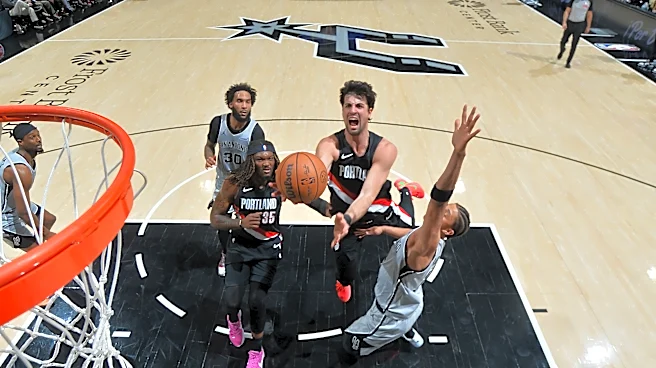








I must admit that I didn’t have high hopes entering yesterday’s game. After all, both Castle and Wemby were sidelined, and the Spurs weren’t really playing for anything (the chance of them getting the first seed is now officially zero). In contrast, a Portland win tonight would have matched their record with the Clippers, giving them an excellent chance to finish the regular season with an improved position in the play-in. Even so, the shorthanded Spurs came out firing and won each of the first three
quarters, showcasing impressive depth and versatility. While I hate to see injuries, especially this late in the season, it is heartening to know that this iteration of the Silver and Black can beat a motivated opponent without two of its best players.
Another piece of good news is that — while the box score for this game was pretty vanilla in some respects — it did produce some highly unusual combinations related to free throws, as you will see below. I’m testing out a slightly modified format for the highlights today; first, I’ll outline the key box score factors that determined the game. Second, I’ll identify any notable rarities contained within the box score. These posts are still new and evolving, so please let me know what you think!

Factors that Decided the Game
- This game was quite balanced in many key areas, and where imbalances existed they were often offsetting.
- Regarding balanced stats, San Antonio had a minor edge in total rebounds (+2), a minor deficit in turnovers (+1), and no advantage or disadvantage in total offensive rebounds. San Antonio did have an edge in ORB% (not pictured here), but again it was mild.
- The Spurs were notably more efficient from the field, including FG% and 3P% margins of +3.7 and +5.5 percentage points, respectively. However, these advantages were offset by Portland’s edge in volume, including FGA and 3PA margins of +5 and +8, respectively. The net result of these competing forces was that San Antonio made one more field goal and one less three, thus outscoring the Blazers by a single point from the field.
- With everything else being a wash, this game was effectively decided at the free throw line. Fortunately, the Spurs had big advantages in both volume (+9 FTA) and especially FT% ( +28.95 percentage points), resulting in a FTM differential of +10 (i.e., about 91% of San Antonio’s final margin of victory).
Rare Box Score Stats
- The Spurs’ victory at the charity stripe was weird, because it was quite large despite the combined free throw volume and efficiency of the two teams being unimpressive.
- For example, this contest marked just the 40th time in the last 13 regular seasons that a winning team achieved a FTM differential of +10 or better on no more than 19 FTA. Put another way, this combination happens about 3 times per regular season on average, or about once in every 422 games.
- In the set of 40 games mentioned above, the winning team almost always achieved their large FTM margin with excellent efficiency. However, the Spurs’ FT% in this game was basically average. In fact, regular season winners have earned a FTM margin of +10 or more on 19 of fewer FTA and a FT% no better than 78.95% just five times since 2012-2013, or about once in every 3,372 regular season games.
- Due to Portland’s dreadful FT% (50%), San Antonio achieved a FT% margin of +28.95 percentage points despite having a FT% of just 78.95%. In the last 13 regular seasons, about one in every 375 winners have met or bettered that FT% differential with a FT% that bad or worse (that’s about 3.3 instances per regular season).
What are Team Graded Box Scores?
Very briefly, these box scores grade winner-loser differentials for basic box score statistics, with the grade being based on the winning team’s differential relative to other NBA winners during a defined reference period. Think of it like a report card for understanding how a given winner performed relative to other winners. The reference period used runs from the start of the 2012-2013 season to the latest date of play, including only games in the same season category (i.e., regular season and playoff games are not compared to each other).
Data Source: The underlying data used to create these box scores was collected from Basketball Reference. In all cases, the data are collected the morning after the game is played. Although rare, postgame statistical revisions after data collection do occur and may affect the results after the fact.