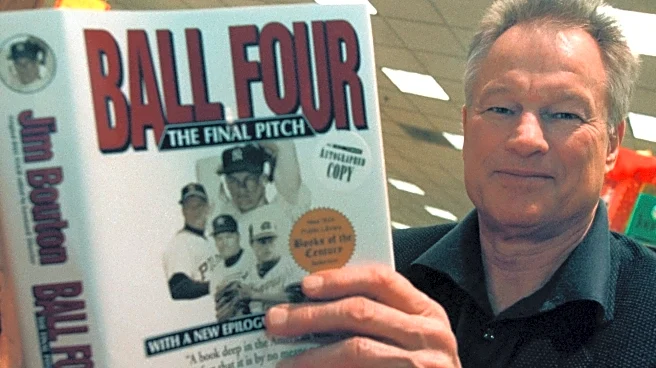


While he had a perfectly nice major league career, the name Jim Bouton is probably only going to evoke one thing, and it’s not his pitching. While he was able to get the chance to do it because he was a major league pitcher of some regard, Bouton is most famous for his 1970 book “Ball Four” along with journalist Leonard Shecter.
While “Ball Four” is a diary of his 1969 season with the Seattle Pilots, Bouton spends plenty of time on the lesser seen side of baseball teams and the players that make them
up. Some of that behind the scenes info wasn’t the most flattering, and some beloved players — including the Yankees’ Mickey Mantle — were among those mentioned. The book was massively controversial at the time, and led to Bouton essentially being blackballed.
However, there’s more to Bouton than just the book. After all, you don’t get to write a tell all like that if you’re not interesting.
James Alan “Jim” Bouton
Born: March 8, 1939 (Newark, NJ)
Died: July 10, 2019 (Great Barrington, MA)
Yankees Tenure: 1962-68
Born in New Jersey in 1939, Bouton grew to love baseball from an early age. He grew up a fan of the New York Giants and would often go with his brother to the Polo Grounds to try and hunt down souvenirs. His family later moved to Illinois, where he attended high school.
In sporting pursuits, Bouton was a bit of slow burner, as he was never the biggest or most athletic. But by his senior year, he had become good enough to get a spot on the freshman baseball team at Western Michigan University. He was also good enough to catch the eye of professional scouts too though, and the Yankees eventually got him to sign a deal in December 1958.
Bouton’s pro career got off to a bit of a rocky start in his first season in 1959, but he rebounded with excellent years in 1960 and ‘61 between the Greensboro Yankees of the Carolina League and the Amarillo Gold Sox of the Texas League. While he had been a late bloomer coming up, he was now a fast riser and got an invite to spring training with the big league Yankees for 1962.
Over the course of that spring, Bouton impressed the team, and ended up getting one of the last spots on the roster to start the season. He made his MLB debut out of the bullpen on April 8th, and he would spend the year as a bit of a swingman, making 16 starts and 20 bullpen appearances. He was a bit below average on the season, but he would win a ring, as the Yankees beat the Giants in the 1962 World Series. Bouton didn’t appear in the series, though.
In 1963, Bouton would produce his career best individual season. He again started the year in a swingman role, but an impressive opening to the season soon got him regular starts. Bouton would go on to make 30 starts in the 1963 season, as he put up a 2.53 ERA (140 ERA+) in 249.1 innings. He made his first and only All-Star team that year and even got MVP votes, finishing 16th. He helped the Yankees to another pennant, and he was very impressive in his World Series debut, holding the Dodgers to just one run in seven innings in Game 3. However, the offense—as was the theme of the series—got shut out by Don Drysdale. They lost the game and the series in a sweep that saw them score just four runs, never even mustering a lead.
The following season, Bouton was very good again, posting a 3.02 ERA (120 ERA+) in a league-leading 37 starts. That year in the World Series, he was very good again, allowing just three earned runs over 17.1 innings. He was the winning pitcher in Game 3 (a complete-game triumph once Mickey Mantle walked it off) and Game 6, but the Yankees won just one other game in the series and lost to the Cardinals in 7.
Those would be the final two postseasons starts for Bouton. While he and some others drew the hope that the next generation of young Yankees would be able to replicate the previous stars, they could not. While he was still good in 1966, the rest of his career saw him post below average stats. The root cause of that probably had something to do with injury, as he first came down with a sore bicep in 1965 and according to him, he never really got over that.
Following a couple down years, the Yankees sold him to the expansion Seattle Pilots in 1968. The franchise began their first season the following year, but Bouton struggled there as well, eventually getting traded to the Astros in August. During that season, Bouton had begun taking copious notes.
Throughout his career in New York, Bouton got the reputation as someone who would give good quotes and was often outspoken about social issues of the day. He became friends with some reporters, including Shecter, with whom he developed the idea for a season diary of his 1969.

The book was eventually released during the 1970 season to mixed reviews. While Bouton often spoke glowingly about Mantle and some other revered figures of baseball, he also didn’t pull many punches. He was candid about some of the things he saw around baseball, such as the hard drinking, womanizing, and use of amphetamines. Players—especially many of Bouton’s former Yankee teammate—were enraged at the content, and that would spill over into the public. Bouton was booed upon returning to New York to play the Mets. Commissioner Bowie Kuhn even tried to strong-arm the pitcher into signing a statement that the book was fiction, although Bouton refused.
Meanwhile on the mound, Bouton was struggling to the tune of a 5.40 ERA, getting sent down to the minors. While his pitching wasn’t doing him any favors, having written the book probably precluded him from getting other chances, and he retired later that year. He eventually went deeper into the media side of things, becoming a sportscaster and releasing more books.
Despite what many people of the time thought, Bouton truly did love baseball. After a couple years, he got the itch and returned to the minor leagues. Following a couple years there, the Braves gave him a chance, and Bouton returned to the majors in 1978, eight years after his last appearance. He put up a 4.97 ERA in five games for Atlanta before retiring for good.

In time, “Ball Four” has come to be seen as a classic of baseball literature. While some of his teammates probably never forgave him, some did. Despite a lot of the hubbub around the book coming from passages about Mantle, even he eventually reconciled with Bouton. The pitcher sent Mantle condolences after Mickey’s son had died, and the two made amends. There had been long-standing rumors that Mantle had strong armed the Yankees into not inviting the pitcher back to events like Old-Timers’ Day, but the outfielder strongly denied that.
Bouton would eventually return to Old-Timers’ Day. In 1998, his son published an open letter to the Yankees asking the team to finally invite their former starter back, as the pitcher was badly grieving his daughter, who had passed away in 1997 in a car crash. The team eventually did so, and Bouton got a nice hand upon his return in 1998.
Bouton eventually passed away in 2019. While “Ball Four” itself remains ground-breaking, a hidden message in it remains that baseball players — including Bouton himself — are human.
See more of the “Yankees Birthday of the Day” series here.