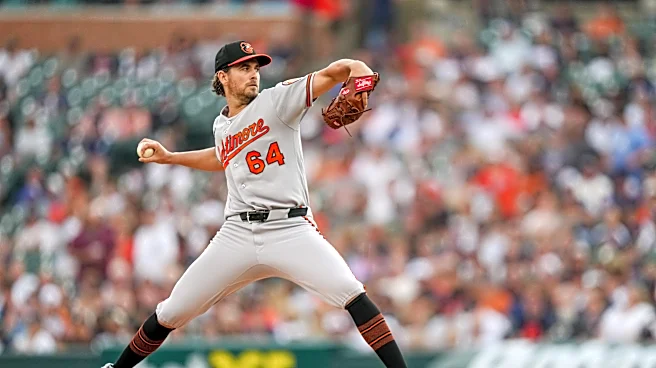


This past season saw the end of Dean Kremer’s time in Baltimore, as the longest surviving member of the Manny Machado trade ended his time with the Orioles with the same frustrating inconsistency that colored his entire career.
When it came to Dean Kremer’s role on the Orioles pitching staff, I always had the mindset of “if Dean Kremer is your 5th starter, you probably have a pretty good rotation.” The Orioles rotation heading into the 2026 season was so good (on paper, at least) that Kremer began
the year at Triple-A Norfolk.
However, he returned from Norfolk after only two starts for the Tides. An early-season injury to Zach Efflin saw Kremer immediately return to the fifth starter role in Baltimore. The 30-year-old right-hander looked strong in his first two outings of the season; in his season debut he limited the Diamondbacks to 2 earned runs over 5 innings while striking out nine. His next time out, against the Guardians, Kremer was an unlucky loser after posting a line of 6 IP, 2 H, 3 ER, 2 BB and 7 Ks.
From there, Kremer’s remaining tenure with the Orioles was largely derailed due to injury, After his start in Cleveland, he landed on the IL with a right quad strain. At first it looked like the injury would only require a short term recovery. Instead, Kremer didn’t return to the mound until June 21st and didn’t make it back to the big league roster until July 1st.
In his first start back from injury, Kremer once again looked his best self. He guided the Orioles to victory over the White Sox in Baltimore, tossing 6 innings of one-run ball while striking out four. Little did we know that that would be the last quality start of his Orioles career.
His next four outings in black and orange were largely disastrous. Over those final four games with the O’s, Kremer averaged less than 5 innings per start, pitched to a 9.47 ERA and gave up a .333 average with 7 home runs across 19 innings. His final start for Baltimore came in Detroit, where he gave up 8 runs in 4 innings as the O’s lost 14-0 to the Tigers.
Four days later, Kremer became the first of five major leaguers Mike Elias & Co. traded away at the 2026 Trade Deadline. The California native was sent from Baltimore to Minnesota, who at the time sat 1.5 games ahead of the Orioles for the final AL Wild Card spot.
At the time, the decision to trade away Kremer was viewed through a neutral lens. The O’s got back 18-year-old OF Jhomnardo Reyes, an athletic, power-first bat in the mold of a typical Mike Elias outfield prospect. Reyes immediately jumped in Baltimore’s Top 20 prospects. The decision to trade Kremer—in the moment—could also have been seen as the Orioles creating space in their rotation to acquire a level-raising starting pitcher.
Instead, Kremer became another example of the front office selling whilst tantalizingly close to playoff contention. To make matters worse, his second start for the Twinkies came against Baltimore in Target Field. That afternoon, Kremer delivered his best start of the season, tossing 7 innings while only allowing 1 run and 1 hit and punching out seven Orioles. Whether motivated by a sense of revenge or just the excitement of facing his old teammates, Kremer immediately made the Orioles look foolish for trading him.
The rest of his year in Minnesota was closer to what we’d come to expect during his 6+ seasons in Baltimore. In his final 8 starts of the season, Kremer pitched to a 4.04 ERA while allowing a .209 average against and striking out 39 in 42.1 IP. The right-hander did finish with a promising flourish, allowing only 2 runs and six hits over his final three starts. With one year left of team control before potentially entering free agency in 2028, Kremer should comfortably slot into the back half of Minnesota’s rotation next year.
Kremer never had true highlight moments with the Orioles, and therefore will not be remembered as fondly as contemporaries like Cedric Mullins, Austin Hays or Anthony Santander. However, his 130 career starts are good enough for 33rd in Orioles history, while his 707.2 IP puts him just outside the Top 50 in club history. Perhaps somewhat surprisingly, Kremer’s 616 career strikeouts with the Orioles put him just behind Ben McDonald at 22nd in Orioles’ history.
If you can separate it from the optics of selling at the deadline when only a couple of games out of a playoff spot, the decision to move on from Kremer spoke/speaks to the improved health of the Orioles pitching depth. His 4.37 career ERA in Baltimore makes him the latest in the line of starting pitchers like Jeremy Guthrie and Daniel Cabrera; professional innings eaters who every once and a while showed the ability to be something more.