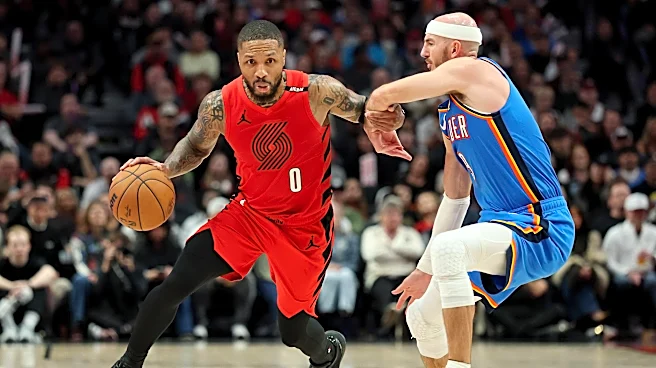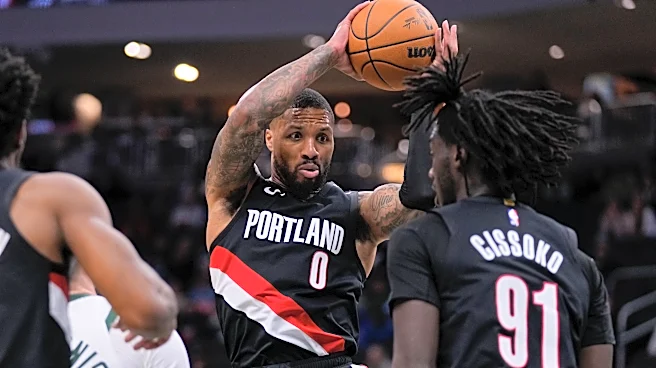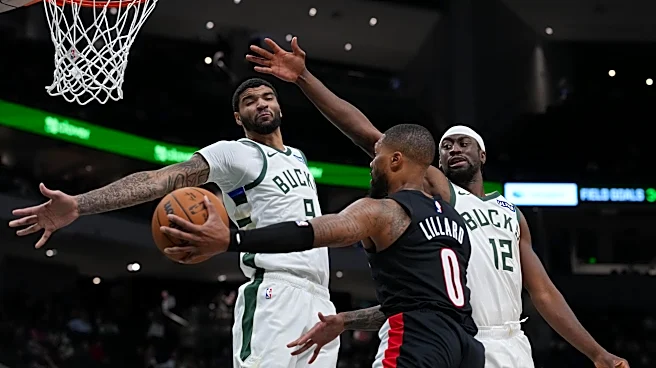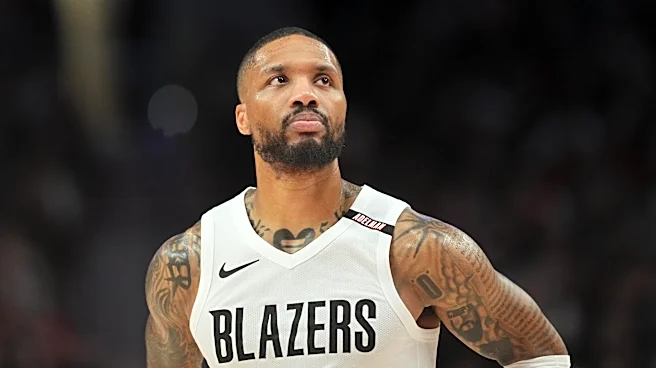



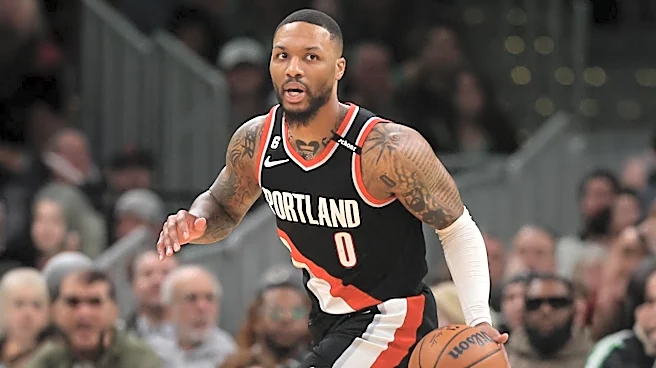
When Damian Lillard rejoined the Portland Trail Blazers last season as he rehabilitated from a torn achilles tendon, everyone knew there would be regression to his game upon returning to play. A perfectly healthy 36-year-old NBA player is already expected to be in decline from their prime, so adding what was once a career-ending injury to the mix, it made forecasting what to expect from current day Lillard a bit murky. Now a month into the season, I thought we’d have a decent sample size to gauge
how Dame’s return is going, as we measure it up against his previous two seasons with the Milwaukee Bucks.
If we average Lillard’s numbers from his two seasons with the Bucks, when he was 33 and 34 years of age, that would account for the end of his prime and up until the achilles injury.
Here’s a topline of his key stats from the 2023-24 and 2024-25 seasons:
- Per Game Averages: 24.6 points, 7.0 assists, 4.5 rebounds, 1.1 steals, 2.7 turnovers, 35.7 minutes
- Shooting: 43.6 FG%, 36.5 3PT%, 92.0 FT%, 60.5 TS%, FTA: 7.0
- On/Off Court Rating: +8.0
- Offensive/Defensive Rating: 121 / 117
Dame’s scoring dipped, as he transitioned into the number two scoring option behind Giannis Antetokounmpo. His overall numbers weren’t too far off from his final years in Portland, but the two superstars never fully synergized to get the most out of their pairing. Lillard was still putting up all-star worthy numbers at age 34 prior to the injury.
With all 16 games under his belt so far this season, let’s see where Dame stacks up from when he left the hardwood for 17 months. Here’s a first glimpse of his performance post-achilles injury.
- Per Game Average: 20.6 points, 4.0 assists, 3.2 rebounds, 0.6 steals, 2.3 turnovers, 29.7 minutes
- Shooting: 40.3 FG%, 34.2 3PT%, 89.0 FT% 58.8 TS%, FTA: 6.3
- On/Off Court Rating: +10.5
- Offensive/Defensive Rating: 119 / 115
The first thing you notice is the decline of his raw stats, however, Dame is playing 29.7 minutes, which is almost six and half minutes less per game this season than his career average of 36.1 mpg. He’s at exactly six minutes less than his previous two seasons. Using the Player Efficiency Rating over 36 minutes works great when analyzing Lillard. His numbers this season are at a 36 minute pace of 24.9 points, 4.9 assists, and 3.9 rebounds.
This is good in the sense of lessening his load, and hopefully prolonging his career. At the moment, Lillard is still performing at Milwaukee levels. His assists have dipped almost three per game due to playing less minutes, and having Deni Avdija, Jrue Holiday, and Ja Morant (4 games), taking on the bulk of the playmaking. Lillard has never played with as many high end tablesetters as this group so his assist drop isn’t alarming. His rebounding is down about 1 per game (4.7 to 3.9), but that can also be attributed to the expected decline he should be having given his situation.
Lillard’s shot diet and conversion rates this season tell a pretty straightforward story, about how he’s evolving in his golden years. For several seasons, Dame was among the best scoring guards at the rim, and his career average for shots from 0-3 feet is 25.5%. In 2018-19 when Portland advanced to the Western Conference Finals, Dame averaged 30% of his scoring at the rim. Fast forward to his Milwaukee run, and Lillard’s percentage of shots from 0-3 feet was 18.3%. This season, he’s averaging a career low of 11.4% of his shots at the rim.
That tells us his burst to get past defenders has lost at least one step. It puts less strain on his body by not taking it to the rim nearly as much. So where has his lost offense at the rim gone? Naturally to his three-point shooting. For his career, Lillard’s offense coming from the 3-point shot represents 45.8% of his scoring. In his two seasons with the Bucks, it moved up to 50.5%. This season, Lillard is averaging a career high of 62.0% of his offense coming from behind the arc. We’ve seen this play out with the likes of Avdija and Morant driving to the rim, forcing the defense to collapse, and Lillard often left with desirable looks from deep. That is exactly how he should be used offensively at this stage of his career, and thus far it’s working.
Unfortunately, Dame’s field goal percentages leave a lot to be desired. He’s shooting 40.3% overall, and 34.2% from three, which are on par for the first 23 games Dame played in the 2021-22 season where he had to be shut down for abdominal surgery. These percentages are career lows. It’s eerily similar to when a 36-year-old Kobe Bryant returned from the same achilles tendon injury in 2014. Bryant played two more seasons and shot 36.5% vs. a career 44.7% average, and his three point shooting dipped to 29.0% vs a career 33% average. Hopefully, Dame can creep closer to his career averages of 43.8 FG % and 37.1 3PT%. Whether he does or doesn’t, it will be an indicator to keep an eye on. It could be shaking the rust. However, if the percentages stay at career lows throughout the season, then something is off with the lift in his legs, which again is just a byproduct of age and the injury.
Some good news in the shooting department, Dame is averaging 6.3 free throw attempts per game which ties him for 21st in the NBA. He’s also tied for 40th in clutch scoring with the likes of Tyrese Maxey, Alperun Sengun, and Evan Mobley. At this stage of Lillard’s career, he’s becoming a bit like an elite closing pitcher for the Blazers. That’s an excellent role for him. If he can be the Mariano Rivera to Deni’s Alex Rodriguez for a couple seasons, it helps give Portland a decent chance at a darkhorse run.
Defensively, Lillard hasn’t gotten any worse, and he’s had some standout moments as a team defender. A little more effort and focus on that end of the floor coming at the expense of some of his offense is an acceptable trade off. Overall, I think we just need to cross our fingers that Dame can be playing well when the playoffs roll around. The Portland backcourt is talented, but fragile. How much Lillard has left in the tank will shape these next two seasons of Blazers basketball. So far, he’s adapted well, but there are caution flags also. If the shooting percentages keep sinking, he becomes an inefficient volume scorer, and his value slides rapidly. Yet, when doubted, Lillard always finds more “wood for the fire” to make a Rocky Balboa level comeback, so perhaps that fuel tank has at least one more solid winter and spring left in it.