


International breaks can sometimes feel like an interruption to the rhythm of a club season, but for Sunderland Women, this one serves as a powerful reminder of who they are becoming. Seven players have been called up across four nations, spanning senior World Cup qualifiers and youth international fixtures. Not one of these selections is unexpected. Every player involved is already a recognised figure within their national programme, and their call-ups reflect continuity, trust and the calibre of footballer
Sunderland now attract and develop.
For a club that has rebuilt itself with patience and purpose, this international window is not merely a point of pride. It is a statement about Sunderland’s trajectory. The squad is no longer a collection of promising Championship players quietly working under the radar. It is a group whose influence stretches across continents, whose talent is acknowledged at the highest levels, and whose presence on the international stage feels entirely natural.
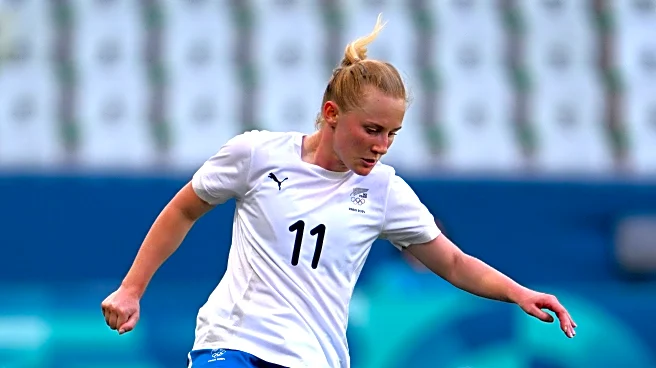
Katie Kitching’s involvement with New Zealand is a perfect example. Her selection for the Football Ferns’ World Cup qualifiers is not a surprise, nor is it a sudden breakthrough. Kitching has been part of New Zealand’s plans for some time, and her performances for Sunderland have only reinforced her standing. She has been one of the club’s most consistent and influential players since she arrived, combining technical quality with intelligence and a relentless work ethic. Her ability to link midfield and attack, to carry the ball with purpose, and to dictate tempo has made her indispensable on Wearside.
For New Zealand, she offers versatility and composure in high-pressure fixtures. For Sunderland, her international involvement is another layer in her development, exposing her to different tactical demands and the intensity of knockout-style football. Her call-up is not a reward for a purple patch; it is a continuation of her established role within a national team preparing for a crucial qualifying campaign.

The Republic of Ireland contingent reflects a group of players who are already firmly embedded in their national setup, each at different stages of their international journey. Jamie Finn, Grace Moloney and Marissa Sheva are all familiar figures within the Irish squad, and their call-ups for World Cup qualifiers are entirely consistent with their standing.
Finn, with more than twenty caps to her name, has long been a trusted figure for Ireland. Her versatility, tactical intelligence and composure have made her a reliable presence in green, just as they have in red and white. At Sunderland she has been a model of consistency, adapting seamlessly to different roles and offering a level of maturity that anchors the team around her. Her selection is not news; it is simply the continuation of a career that has already earned significant international respect.
Moloney’s inclusion reflects her growing importance within the Irish goalkeeping group. With nine caps, she is still in the earlier stages of her international career, but she has quickly established herself as a dependable option. Her performances for Sunderland have shown her authority and shot-stopping qualities that translate naturally to the international stage. Her call-up is a recognition of her upward trajectory and the trust she has earned in recent windows.
Sheva, meanwhile, brings twenty caps’ worth of experience to the Irish forward line. Her energy, directness and relentless work rate have made her a valuable asset for Ireland, just as they have for Sunderland. She is a player who stretches defences, presses intelligently and offers versatility across the front line. Her involvement in the qualifiers is entirely expected, reflecting her established role within the squad and the consistency of her contributions.
Wales have also turned to Sunderland for their World Cup qualifiers, selecting Rhiannon Roberts and Mared Griffiths. Roberts is one of the most experienced internationals in the squad, a player whose leadership and defensive intelligence have been central to Wales’ progress in recent years. Her presence at Sunderland has already proven invaluable, offering guidance to younger players and stability in key moments. Her call-up is a continuation of a distinguished international career, and her performances in the WSL2 have shown that she remains a player of significant quality.
Griffiths’ selection comes at a very different moment in her club journey. Having only just joined Sunderland on loan from Manchester United in January 2026, she has not yet made her debut for the club. Her call-up, therefore, is not a reflection of her time on Wearside but of her established standing within the Welsh national setup. A talented and composed midfielder, Griffiths has been steadily building her international profile, and her involvement in Wales’ qualifiers is a natural continuation of that trajectory. For Sunderland, her arrival and immediate international involvement underline the calibre of player the club is now able to attract.

New loan signing, Caragh Hamilton has also been called up for Northern Ireland. Interestingly enough on their announcement graphic as a ‘forward’ which surprise a few fans myself included. Although she is listed as a defender at club level, Northern Ireland have frequently used her higher up the pitch as a midfielder and winger, where her energy, ball carrying and pressing suit the demands of international football.
Hamilton’s inclusion in the Northern Ireland squad for the FIFA Women’s World Cup 2027 qualifiers against Switzerland and Turkiye is a deserved recognition of her consistency and experience at international level. Hamilton has been a senior Northern Ireland international since 2012 and has accumulated 53 caps and 7 goals for her country, making her one of the squad’s most seasoned players. Her versatility, experience and tactical intelligence make her an important asset as Northern Ireland look to build momentum in their World Cup qualifying campaign.
Mared Griffiths’ call up to the Wales senior squad for their upcoming fixtures is another important step in the rise of one of the most exciting young midfielders in British football. Still only eighteen, Griffiths has already made four senior appearances for Wales and scored once, building on an impressive youth international record that includes fifteen caps and three goals for the under seventeen side and six caps and one goal for the under nineteen team.
She plays primarily as a midfielder for Wales, operating with intelligence, energy and a natural ability to carry the ball through tight spaces. Her recent performances at club level, including her sensational long range goal on her Sunderland debut, have only strengthened her reputation as a player with enormous potential. Wales have used her in central and advanced midfield roles, trusting her creativity and composure in possession. Her ongoing development at Sunderland, combined with her growing international experience, makes her an increasingly important figure for Wales as they build towards future qualification campaigns.
Completing the list is Ella West, called up to Scotland’s Under-19 squad for a series of friendlies. While youth international fixtures may not carry the same weight as senior qualifiers, they are crucial in shaping the careers of young players. West has been on Scotland’s radar for some time, and her selection is a continuation of her involvement at youth level. For her, this is an opportunity to test herself against high-quality opposition, to experience the demands of international football, and to continue her development in an environment designed to challenge and elevate young talent.

Her call-up also reflects Sunderland’s long-standing commitment to youth development. The club has a proud history of producing players who go on to represent their countries, and West’s inclusion continues that tradition. She is a player with significant potential, and her international involvement will only enrich her understanding of the game.
Taken together, these call-ups paint a picture of a squad that is both diverse and deeply talented. Sunderland Women are no longer a team quietly rebuilding in the Championship; they are a club whose players are shaping international campaigns, influencing World Cup qualifiers, and representing their nations with pride. The breadth of call-ups, spanning New Zealand, Ireland, Wales and Scotland, speaks to the global reach of the squad and the quality that runs through it.
For the club, this international break is a moment to reflect on the progress made in recent years. Sunderland have built a squad that blends experience with youth, international pedigree with domestic promise. The players called up are not fringe figures or occasional squad members; they are central to their national teams’ plans. That level of recognition is not accidental. It is the result of careful recruitment, strong coaching and a culture that encourages players to grow, compete and aspire.
There is also a practical benefit. Players who compete internationally return with sharpened instincts, heightened confidence and a deeper understanding of the game. They bring back lessons learned from facing different styles, different systems and different pressures. That experience filters into the squad, raising standards and enriching the team’s tactical awareness.
Of course, international duty also brings challenges. Travel, fatigue and the risk of injury are always considerations. But for Sunderland, the positives far outweigh the concerns. Having so many players involved in international football enhances the club’s reputation, attracts new talent and reinforces the message that Sunderland is a place where careers can flourish.
As the league resumes, the returning internationals will bring with them the momentum of representing their countries. They will return to a squad that has grown in confidence and cohesion, ready to push forward in the WSL2. And they will carry with them the pride of having worn their national colours, knowing that they are part of a club that supports and celebrates their ambitions.
This international break is not a pause for Sunderland Women. It is a milestone, a marker of how far the club has come and a glimpse of where it is heading. With players competing on the world stage, the future looks bright, ambitious and full of possibility. And when they return to Wearside, they will do so not just as Sunderland players, but as representatives of nations, carrying experience that will only strengthen the team’s journey ahead.