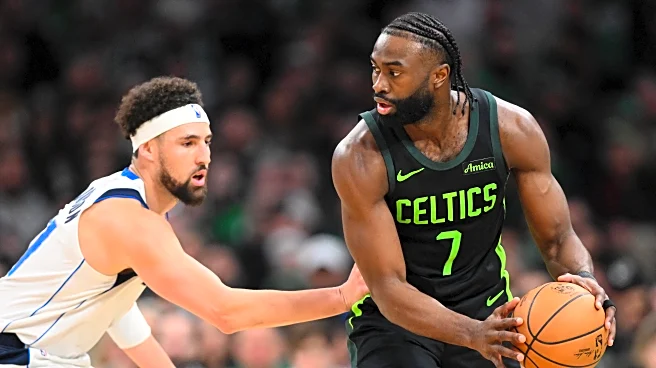


It feels like a lifetime since the Boston Celtics and Dallas Mavericks met on the NBA’s biggest stage in the 2024 Finals. Much has changed since then as the red-hot Celtics (31-18) visit the Mavericks (19-30), who are looking to end a four-game skid. Here are three things to watch ahead of Dallas’s matchup with the East’s second-best team.
The Celtics shoot threes, lots of threes
The Celtics and Mavericks play two completely different styles. Boston is second in the NBA this season in threes attempted per game at 42.9, and second in made
threes per game at 15.6. As a team, they shoot 36.7% from three, ninth in the NBA. In comparison, Dallas is 26th in the NBA in three-point shot attempts per game at 32.0, 28th in makes at 11.0, and 26th in percentage at 34.3%.
One thing that has not changed since the 2024 NBA Finals is Boston’s ability to shoot volume threes, which can demoralize opponents when the threes are falling. In today’s NBA, the math of three being worth more than two is a big part of Celtics coach Joe Mazzulla’s strategy. In the absence of perennial All-Star Jayson Tatum, the Celtics lean on the three-point shot even more than before. Boston has six players who shoot above 39% from three this season — Anfernee Simons, Sam Houser, Josh Minnott, Baylor Scheierman, Jordan Walsh, and Luka Garza. This doesn’t include veteran sharpshooter Derrick White, who has struggled from three this season at 32.4%. Meanwhile, the Mavericks have one player who shoots north of 39% from three — Max Christie.
Dallas’s style of bully-ball and relentless attacking in the paint can work on teams that aren’t efficient from three, but three is still worth more than two, and the math favors the Celtics.
The Celtics are deep
Even without Jayson Tatum, this Celtics team has been finding its groove lately, and a lot of that success stems from its depth. Boston is 7-3 in its past 10 games with a plus-nine point differential. After a 5-7 start, the Celtics are 26-11 since and sit in a second-place tie with the New York Knicks in the Eastern Conference. Boston has five players who score in double digits per game: Jaylen Brown (29.4), Derrick White (17.2), Payton Pritchard (16.8), Anfernee Simons (14.2), and Neemias Queta (10.1).
The depth of the Celtics is also a big reason why they have the league’s second-best offense at 121.3 points per game. One particular player that could cause problems for the Mavs is Queta, who has shown real promise in his fifth year. The seven-footer is averaging 10.1 points per game, 8.1 rebounds, and 1.3 blocks on 63.5% shooting. Dallas’s lack of men in the middle could give the Celtics second and third opportunities to hoist from three.
Another player to watch is reigning Sixth Man of the Year Payton Pritchard. A lot of focus on the court tends to shift to Jaylen Brown and Derrick White, and for good reason. But Pritchard has quietly had another fantastic year for the Celtics, averaging 16.8 points per game, 4.3 rebounds, and 5.3 assists. His ability to attack off the dribble and shoot from three is a big reason why the Celtics’ offense has remained efficient without Tatum.
And of course, there’s Jaylen Brown, who’s statistically having his best season at 29.4 points per game, 6.9 rebounds, and 4.8 assists. Brown usually takes on the form of Robin, with Tatum being Batman, but Robin has done a pretty good job at keeping the ship afloat without the captain.
Cooper Flagg is the new Jayson Tatum?
One of the most common player comparisons Cooper Flagg has drawn is Jayson Tatum. And it makes sense. Both went to Duke. Both were one-and-done. Both are widely viewed as elite two-way players. Flagg is listed at 6’9, 205 pounds. Tatum is listed at 6’8, 210 pounds. Both have the size and length to guard one through four on defense. Both have great court vision and passing ability to lead an offense. They do feel all too similar. So how are Flagg’s rookie numbers comparing to Tatum’s?
The situation Tatum was drafted into had some similarities to Cooper Flagg’s. The 2016-2017 Celtics were 53-29 and lost in the Eastern Conference Finals to LeBron James and the Cleveland Cavaliers. In the 2017 NBA Draft, the Celtics took Jayson Tatum third overall. Tatum was thrust onto a good roster right away and was able to fit into his role. In his rookie year, he averaged 13.9 points per game, 5.0 rebounds, and 1.6 assists. In comparison, Cooper Flagg is averaging 19.8 points per game, 6.6 rebounds, and 4.1 assists in his rookie campaign.
Tatum’s team success in his first year was far greater than Flagg’s, with the Celtics going 55-27 and coming one game shy of the NBA Finals, losing once again to LeBron James’s Cavaliers. As of now, the Mavericks sit at 19-30, 11th in the Western Conference. But Tatum was surrounded early by veterans who helped him figure things out – Kyrie Irving, Marcus Smart, Al Horford, to name a few. Flagg has that in Dallas — Kyrie Irving, Anthony Davis, and Klay Thompson. Veteran leadership matters, it’s just that most of the Mavericks veterans are hurt. Tatum has now grown himself to a top five to 10 player in the NBA. That may not even be the ceiling with Flagg. His ceiling may be top one.
Flagg will have his hands full on Tuesday night, being guarded by some of the league’s best perimeter defenders in Jaylen Brown and Derrick White. Let’s see how the next Jayson Tatum fairs against the team that grew the original one.
How to watch
The two teams, going in seemingly opposite directions, will take the court on Tuesday night. But if there’s one thing we know, Dallas tends to beat the good teams. Go figure. The Mavs and Celtics will tip off at 7 p.m. Central time on NBC and Peacock.