

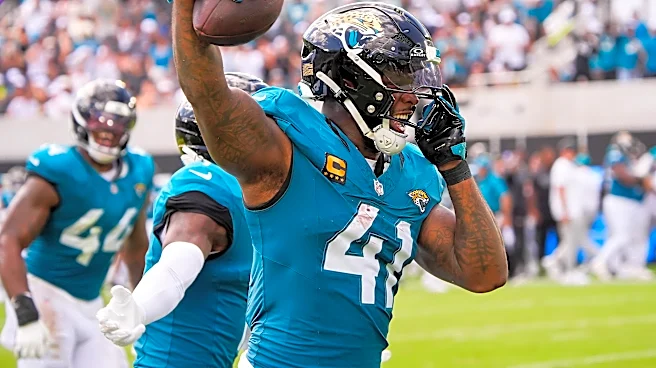
The Jacksonville Jaguars are starting to make a habit of this.
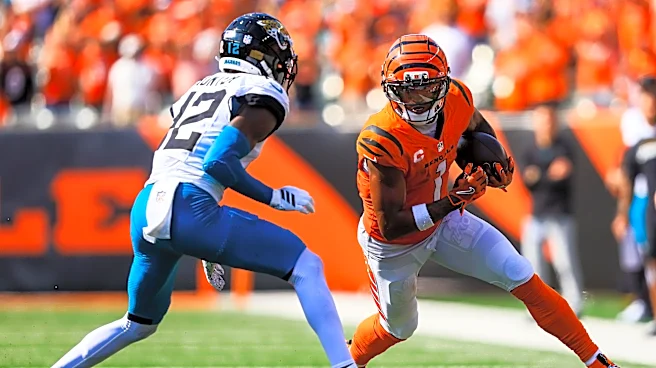
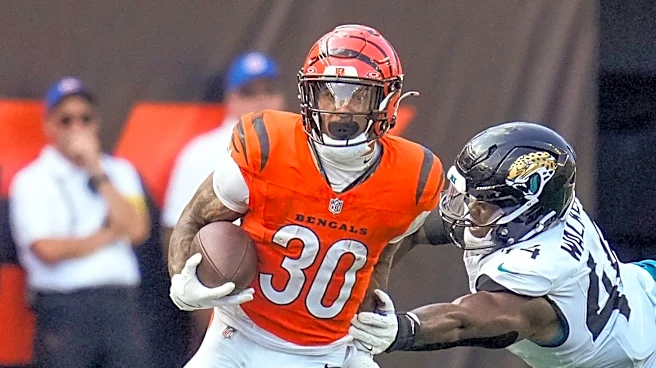
A week after dismantling the defending AFC champion New England Patriots 35-6, Jacksonville walked into Paycor Stadium and left with another victory over an AFC contender, beating the Cincinnati Bengals 22-17 to move to 3-1 on the season.
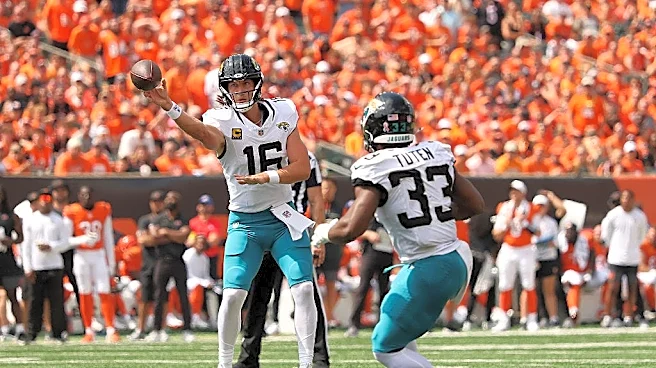
It was not particularly pretty. Trevor Lawrence threw for 227 yards and a touchdown, the Jaguars managed only 111 rushing yards and they committed an extraordinary 13 penalties for 125 yards. Joe Burrow
threw for 428 yards, nearly twice Lawrence’s total, and yet Jacksonville controlled enough of the game to win it.
The Jaguars are finding different ways to win, and Sunday’s victory offered another three reasons to believe this team could be considerably more dangerous than many expected when the season began. Here are three reasons why the Jags added another W to the win column in Week 4:
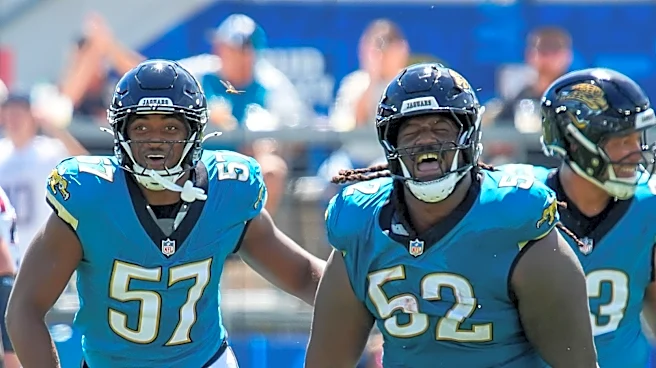
Jacksonville brought the kind of physicality that borders on chaos
There is playing physically, and then there is whatever the Jaguars were doing in Cincinnati.
Jacksonville entered the game having been penalized only 15 times through its first three games. It then committed 10 penalties for 100 yards before halftime alone, eventually finishing with 13 penalties for 125 yards. Two of Bhayshul Tuten’s touchdown runs were wiped out by penalties, while a roughing-the-passer penalty on Arik Armstead erased what would have been an interception by Travis Hunter.
It was hardly disciplined football. It was, however, extremely physical football.
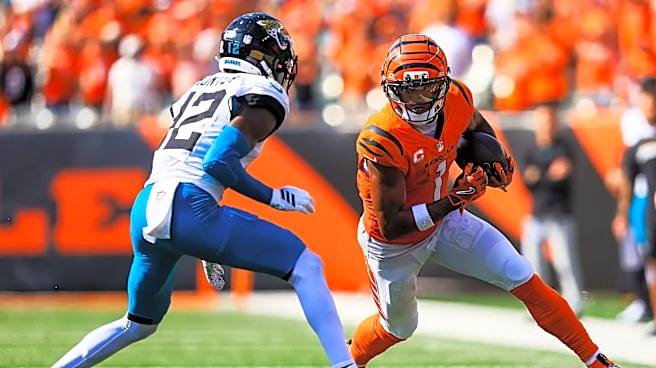
Armstead’s hit on Joe Burrow in the first quarter was penalized for helmet-to-helmet contact, while Jarrian Jones was flagged for grabbing Ja’Marr Chase’s facemask on a four-yard reception early in the second quarter. Chase went down awkwardly, was subsequently hit by Ventrell Miller and was ruled out with a concussion. He finished with three catches for 26 yards.
There is an important distinction here. The Jaguars should not be celebrated for injuring an opponent, and some of their aggression flirted with crossing the line. The point is that Jacksonville made the Bengals uncomfortable from the opening whistle. This was not a defense sitting back and hoping Burrow would make a mistake. It was a defense attacking, tackling and challenging Cincinnati’s offense on virtually every possession.
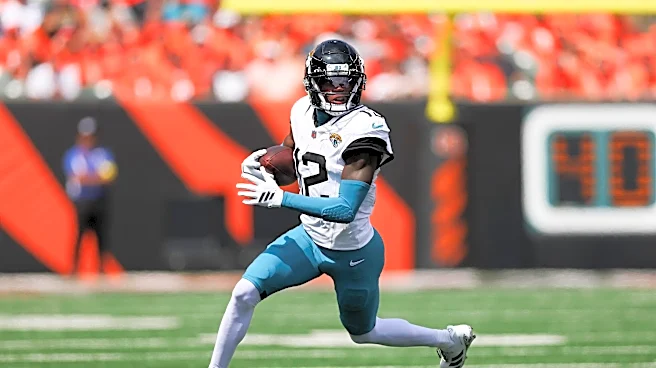
Hunter was involved in the action throughout, finishing with four tackles and a pass defended, while Jourdan Lewis supplied the first of Jacksonville’s two interceptions. The Jaguars entered the game already tied for third in the NFL in takeaways and left Cincinnati with eight through four games.
Perhaps the most impressive part was that Jacksonville managed to absorb its own mistakes. Giving away 100 yards in penalties before halftime should normally be catastrophic. Instead, the Jaguars went into the locker room 13-3 ahead. Cincinnati had opportunities, but Jacksonville repeatedly disrupted drives, forced negative plays and made the Bengals work for everything.
That physical edge eventually produced the decisive moments. Foye Oluokun intercepted Burrow early in the fourth quarter with Cincinnati threatening, preserving a 16-10 lead, and the Jaguars’ defense then held the Bengals to a fourth-down stop on the final meaningful possession of the game.
This is not a defense that is simply accumulating numbers against bad teams. It has allowed three or fewer points in the first half of all four games this season, a start matched by only the 2019 Patriots over the past several years. Jacksonville has also intercepted a pass in nine consecutive games, the longest streak in franchise history.
The Jaguars may need to clean up the penalties. But there is something valuable in having a defense that plays with this kind of edge.
Trevor Lawrence doesn’t have a favorite target – and that’s the point
There was a moment during Sunday’s game that summed up Jacksonville’s offense rather neatly. Parker Washington, who entered the afternoon as the Jaguars’ leading receiver, finished the game with just one catch.
That would have been a major problem for plenty of NFL offenses. It wasn’t for Jacksonville.
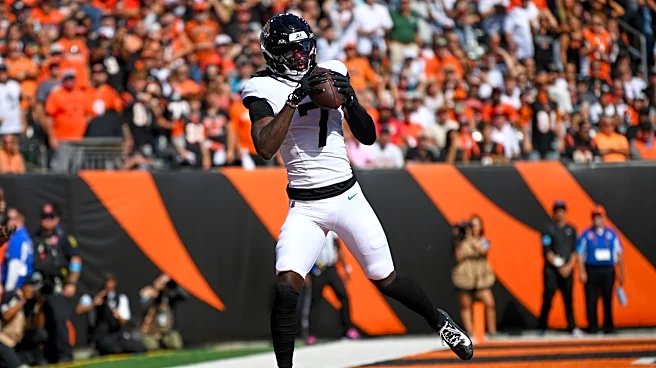
Instead, Brenton Strange became a major part of the passing attack, Jakobi Meyers produced important plays, Josh Cameron supplied a 29-yard reception and Brian Thomas Jr. caught the touchdown that gave Jacksonville its halftime lead. Seven different Jaguars caught passes during the game, with Lawrence completing 18 of 23 attempts for 227 yards and a touchdown without throwing an interception.
This distribution is not an accident. Through the first three games, Washington had established himself as Lawrence’s most productive receiver with 15 catches for 221 yards and two touchdowns. Meyers had 10 catches for 132 yards and two scores, while Strange and Thomas Jr. had seven receptions apiece. Bhayshul Tuten, Josh Cameron, Ameer Abdullah, LeQuint Allen Jr., Nate Boerkircher, Travis Hunter and Quintin Morris had also already recorded receptions.
And then Washington effectively disappeared from the box score in Cincinnati. But whether that was down to the Bengals gameplanning for the receiver, or just an off-day for Parker, Jacksonville simply moved on.
That is what makes the construction of Liam Coen’s offense so interesting. There is no obvious volume receiver that a defense can remove and expect the entire passing game to collapse. The Jaguars can attack underneath with their tight ends, get Meyers involved on intermediate routes, take shots to Thomas Jr., use Washington from the slot and involve their backs in the passing game.
Strange, in particular, is becoming an increasingly important piece. His 23-yard reception on third-and-18 was one of the early highlights of the game, and the tight end finished as one of Lawrence’s most productive targets. The result is an offense that does not necessarily need a 10-catch performance from its biggest name every Sunday.
That matters over a 17-game season. Defensive coordinators can spend an entire week trying to remove Washington or Thomas Jr. from the game, only for Meyers, Strange or one of the backs to exploit the space that creates elsewhere.
It also takes some of the pressure off Lawrence. He doesn’t need to force the ball to his best receiver simply because that player is his best receiver. He can take what the defense gives him, and the Jaguars have enough variety around him to make that approach work.
That is exactly what happened in Cincinnati. Expect a similar story when the Jags head to London to face the Eagles and Texans the next two weeks.
Maybe the Jaguars are the best team in the AFC?
It sounds ridiculous. And it’s not necessarily a reason they won. But it might also be time to at least ask the question – are the Jaguars just REALLY good?
Jacksonville is 3-1 after beating the Browns, losing narrowly to Denver, destroying New England and now beating Cincinnati on the road. The Jaguars have won their last two games by a combined 57-23 and have now beaten two teams with legitimate AFC ambitions in consecutive weeks. They have also won 11 of their last 12 regular-season games dating back to last season.
More importantly, they are doing it without relying on one particular formula. Against New England, the Jaguars dominated from start to finish. Against Cincinnati, they won a much tighter, more chaotic game. Lawrence has been efficient rather than spectacular, while the defense has consistently kept opponents from scoring early.
Jacksonville’s defense is balling out, particularly early in games as alluded to earlier. Anthony Campanile’s unit has eight takeaways, and its offense has enough variety to survive an opponent successfully taking one player away. None of that automatically makes the Jaguars the best team in the conference, but it’s confidence building. Yet, despite the strong start to 2026, there are still obvious questions.
The penalty count against Cincinnati was absurd. The Jaguars allowed Burrow to throw for 428 yards, and they will not be able to give away 125 yards of field position every week and expect to survive. There will be better offensive lines, better rushing attacks and quarterbacks who punish mistakes more consistently.
But that is what makes the question worth asking. The Jaguars are not sitting at 3-1 because everything has gone perfectly. They are 3-1 because when games have become difficult, they have found different ways to win them. And that might ultimately be the most significant development of all.
Jacksonville does not need Lawrence to throw for 350 yards. It does not need Washington to catch eight passes. It does not need the defense to produce five sacks. It does not even need a clean game. It just needs enough players to make enough plays, and simply be better man for man than their opponent.
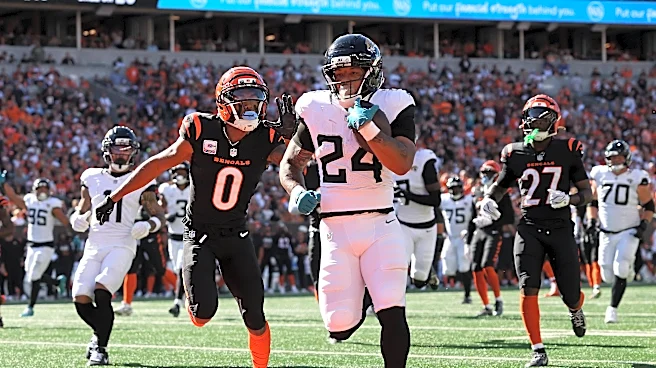
On Sunday, that meant a physical defense creating two interceptions, Lawrence taking care of the football, Thomas Jr. making the most of his opportunities, Strange contributing in the middle of the field and Chris Rodriguez Jr. breaking off a 25-yard touchdown run to give the Jaguars some breathing room in the fourth quarter.
That is not necessarily the profile of the best team in the AFC. But after four weeks, it is certainly the profile of a team that deserves to be part of the conversation.