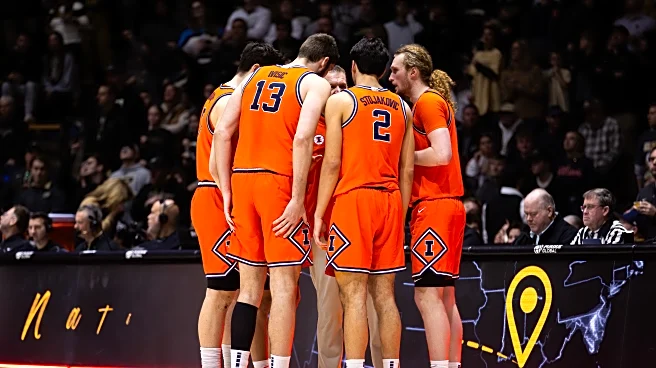


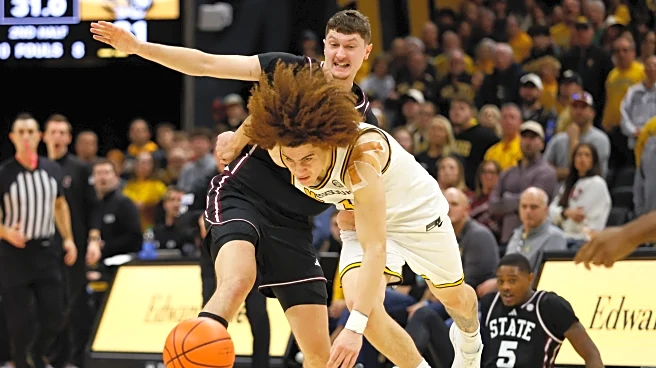

Delusional as it sounds, there was a fleeting moment on Monday night where Missouri could have put No. 20 Illinois on tilt.
With 10:05 left in the first half, point guard Kylan Boswell picked up his second foul and trotted to the bench. A minute later, junior wing Andrej Stojaković pulled up lame and took a seat. While Keaton Wagler remained on the floor, the Illini found themselves without two sets of trustworthy hands.
And it presented the Tigers with an opportunity.
The Illini have struggled at times
when turning to Mihalio Petrovic and Brandon Lee. Sometimes, forward David Mirković brings the ball up the floor to initiate sets, but that’s usually after grabbing a board on the defensive end.
Without proven ball handlers, the Tigers could have rolled out a press and backed into a man-to-man defense that would trap ball screens. Sound outlandish? MU had already forced five turnovers. Finding a way to gin up easy rim attempts against a team intent on sealing off the paint was also imperative.
Instead, the Tigers, whose roster is supposedly filled with long and rangy athletes, remained passive. Not that it helped. Even when MU forced a miss, the Illini tracked down the second chances, a 20-6 run over seven minutes that ushered in a 91-48 disemboweling inside the Enterprise Center.
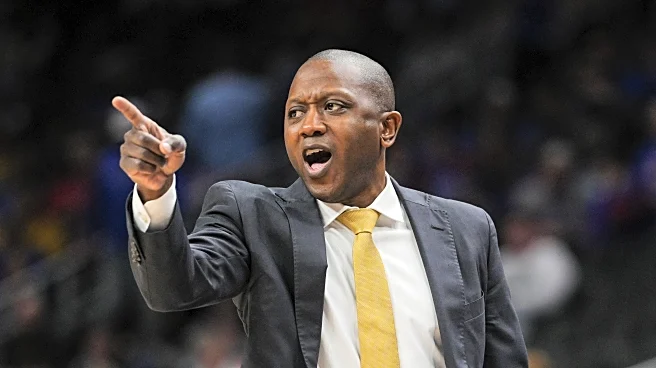
To anyone watching or interested in the macabre metrics afterward, it was painfully obvious MU allowed the Illini to dictate terms. It came two weeks after the Tigers allowed another rival to do the same thing ($) on the other side of the state. And even in a close road loss to Notre Dame, coach Dennis Gates’ squad only imposed its will for a narrow stretch in the first half.
So, is MU sorting out an identity crisis like the one it faced two years ago?
No, but the program faces a close cousin of that question: Has it opted for a version of itself at odds with the talent on hand?
After Monday’s loss, Gates framed the Tigers’ woeful December as a byproduct of bad injury luck that had sapped the roster of shooting. Assuming Jayden Stone and Trent Pierce arrive as reinforcements for SEC play, it should restore those reserves and give Gates a full complement of bench talent. That assessment isn’t wrong. However, it might not also address more fundamental critiques about how MU has structured its rotation.
And if MU’s plotting to use more time to see how it looks once Stone and Pierce are back in uniform, it might also delay harder conversations to salvage a season – one where the baseline expectation was an at-large bid – tracking toward failure.
Let’s start by simply looking at the rotation itself.

Unsurprisingly, Mark Mitchell and Anthony Robinson II have done their part. Even amid Monday’s slog, Mitchell’s shouldered more touches and reliably produced beaucoup returns attacking the rim. Robinson’s usage remains modest and his output uneven, but the junior remains one of the SEC’s best defenders. On the wing, Jacob Crews is making the kind of second-year leap we’ve seen from multi-year transfers like Tamar Bates and Caleb Grill.
The trouble starts just behind that trio.
By any metric, Sebastian Mack has struggled. And since the Border War, he’s found himself relegated to a deep reserve role. With him on the floor, MU’s net rating drops by 15.1 points per 100 possessions, per EvanMiya.com.
Yet the guards who’ve garnered promotions haven’t fared much better. Annor Boateng and T.O. Barrett each create drag on MU’s net rating. In Boateng’s case, the metrics are stark, especially a minus-34.5 net rating driven by ranking in the 12th percentile nationally for defensive efficiency.
So, the Tigers’ top transfer isn’t delivering, while development for two sophomores has stalled.
It’s also another downstream consequence of betting on Shawn Phillips Jr. as the focal point in the Tigers’ front court. After Monday’s loss, Mizzou is 13.2 points worse per 100 possessions with Phillips on the floor. His 0.08 Bayesian Performance Rating ranks 150th out of 157 SEC players who’ve logged at least 150 possessions. In other words, by the numbers, Phillips has graded out as one of the conference’s least effective big men.
That choice carries consequences, especially for Mack. Defenses shrink the floor. Gaps narrow. And drives become slogs. It’s more jarring when you look at Luke Northweather’s profile, especially the fact that MU’s net rating jumps by 5.3 points per 100 possessions when he checks in. That contrast carries over at the lineup level.

To its credit, MU shelved jumbo lineups after a 20-point loss to Kansas. The group that’s taken place – with Boateng at combo guard and Crews on the wing – has also performed reasonably well. Yet its net rating still lags substantially compared to the plus-76.7 mark posted by a combination of Robinson, Mack Crews, Mitchell and Northweather.
The drop-off becomes sharper with a simple swap. Replacing Northweather in that same group drags the net rating to minus-37.4. Introducing Barrett’s ball-handling in place of Boateng offers only marginal improvement.
The pattern remains when you study positional usage, too. Phillips and Northweather have logged nearly identical minutes at the five. Yet Missouri’s scoring margin is 98 points better with Northweather in that role.

Consider this: against Illinois, Missouri was outscored by 26 points with Phillips on the floor — and by just five with Northweather in the game. Widen the lens to include losses to Notre Dame and Kansas, and the gap barely budges. It’s minus-40 with Phillips and minus-5 with Northweather.

Point being, the Tigers’ incremental changes in recent weeks haven’t resolved a central tension in the organizing principle of their rotation. Making a hard decision and pivoting away from Phillips could also resolve the most maddening aspect of MU’s season and establish a straightforward identity.
That search would be brief. On paper, the Tigers already had one before it tipped off at Howard.
Among players who logged at least 80 pick-and-roll touches last season, the Tigers boasted two who finished inside the top 10 nationally for efficiency. That’s a natural floor and a reliable way to manufacture advantages and offense in the half-court.

Instead, MU shunts ball-screen offense to the periphery. MU only uses PNRs on 9.1 percent of its possessions, according to Synergy data. That ranks in the 12th percentile among Division-I programs. Against high-majors, MU only averages 0.738 points per possession.
That matters for a couple of reasons. First, it was an inherent strength of MU’s personnel. Second, pick-and-rolls serve as a baseline. Your two-man game can be the steadiest way to manufacture offense when opposing scouting reports smother triangle-based sets. Instead, Mack’s on the fringes, while Robinson searches for a steady footing.
Yet those PNRs require proper spacing to flourish – the kind that using stretch bigs like Northweather and Jevon Porter can provide. Data backs up that intuition. For example, MU sees its net rating improve when Mack is paired with Northweather (+14.4) and Porter (+15) but remains virtually static with Phillips (+0.2) on the floor. The same relationships exist for Robinson, too.
Accounting for injuries doesn’t dramatically alter the matter, either. Below, you can see MU’s most used lineups featuring Stone. What stands out? Plugging the Detroit Mercy transfer into lineups with a stretch five reaped substantially better returns.

With or without Stone available, Missouri has functioned best when it leaned on bigs who could space the floor, pull defenders out of the lane, and open operating room below the free-throw line. Having Stone and Pierce healthy would only make that easier — assuming they dial their jumpers back in.
Optimizing lineups around Stone and Mack would also allow Gates to slide Boateng back to his more natural spot on the wing. Pierce could absorb minutes on the wing and at the four, easing the load on Mitchell and creating more runway for Porter as a stretch five. That, in turn, would allow Mizzou to split remaining minutes between Phillips and Trent Burns. Pierce’s return might even open the door to more small-ball looks with Mitchell at the five — dialing up tempo, pressure, and pace.
Those adaptations might also pave the way to embrace the opportunity it passed up against the Illini – extend its defense. When the Tigers opt to press – usually out of a 2-2-1 alignment – they allow 0.718 points per possession. That ranks in the 85th percentile nationally. And when that press backs into man-to-man defense, opponents only muster 0.633 PPP – a 23 percent improvement over what the Tigers typically allow. Meanwhile, pressing before guarding straight up produces a takeaway 21.5 percent of the time.
Yet MU takes that course of action on only 14 percent of possessions, ranking 296th in the country.
So, in that sense, what we saw against Illinois wasn’t an aberration. Instead, the Tigers defaulted to a version of themselves that has struggled to scale up against quality opponents. Those are choices – not merely the unfortunate byproduct of ill-timed maladies. Across two months of data, the same pattern keeps resurfacing.
None of that erases the complexity of managing absences, navigating development curves, or sorting out depth. But the stakes have only grown. Missouri’s best stretches haven’t been accidental. They’ve come when the Tigers committed to strengths that were visible as early as last spring.
Whether they ultimately lean into those strengths may determine whether this season can be steadied — or whether moments like the one against Illinois continue to define it.