
![Rich Paul on Sixers: ‘How could they not have [LeBron’s] attention?’](https://glance-mob.glance-cdn.com/public/cardpress/binge-magazine-card-generation/spaces/US/en/sb-nation/images/ppid_2cf3d240-image-178308715101616918.webp)


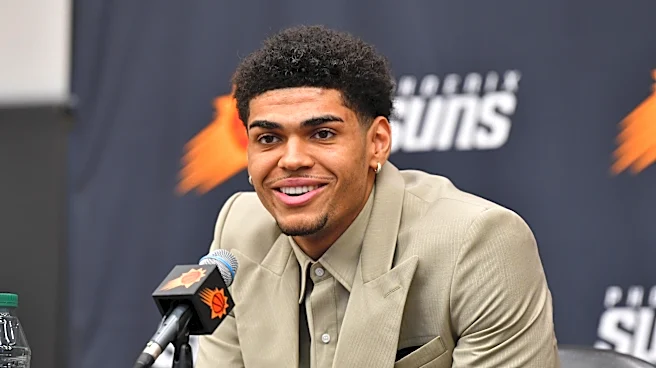


The goal of this piece is to be the only Koa Peat article you ever need. We will cover his hometown connection, his combine measurements, all the statistics, his family/upbringing, his fit in Phoenix, strengths, weaknesses, and more.
The Phoenix Suns traded three second-round picks to land the 30th overall selection, used it on a 19-year-old Gilbert kid who grew up winning state titles at Perry High School, carried Arizona to its first Final Four in 25 years, and bet on himself when half the industry
told him to go back to school.
Length, physicality, motor, and multi-positional defensive versatility. Every box the Suns have been hunting for three years, crossed off in one phone call to Dallas (and then New York).
He is now a Phoenix Sun. Here is the comprehensive breakdown.
The Measurables
(2026 NBA Draft Combine)
Height (barefoot): 6’7″
Height (in shoes): 6’8″
Weight: 245 lbs
Wingspan: 6’11.25″
Standing Reach: 8’8″
No-Step Vertical: 34.5 inches
Max Vertical: 37.5 inches
A near 7-foot wingspan on a 6’7″ forward is a legitimate weapon. It lets him contest shots outside his frame, grab rebounds his body has no right reaching, and guard positions above and below his listed spot. This is what makes the Aaron Gordon comps land.

The Arizona Connection
- Hometown: Gilbert, Arizona (born January 20, 2007, in Chandler, AZ)
- High School: Perry High School, Gilbert, AZ
- College: University of Arizona, 2025-26 (Freshman)
- Pro: Phoenix Suns
Koa Peat joined Perry’s varsity program in 2021 under head coach Sam Duane Jr., the same coach who had guided two of Koa’s older brothers to state titles at Tempe Corona del Sol. As a freshman, he averaged 15.0 points, 6.1 rebounds, 1.6 assists, and 1.8 blocks, teaming with Cody Williams to deliver Perry its first-ever Class 6A state championship.
Four state titles, back to back to back to back. In his senior year, playing with a broken right hand suffered two days before the state quarterfinals, Peat scored 16 points in the semifinal win over Sandra Day O’Connor and dropped 20 in the title game.

His senior averages: 18.7 points, 10.3 rebounds, 5.1 assists, 1.6 blocks, and 1.0 steals per game on a 27-2 squad. Arizona Gatorade Player of the Year all three of his final seasons. MaxPreps Arizona Player of the Year three consecutive times. McDonald’s All-American invite and a Nike Hoop Summit selection, both missed after surgery on that same broken hand.
He chose Arizona over Arizona State, Baylor, Houston, and Texas, announcing on the Pat McAfee Show while pulling open a Perry hoodie to reveal a Wildcats shirt. Ranked No. 8 nationally and No. 1 in Arizona for the 2025 class.
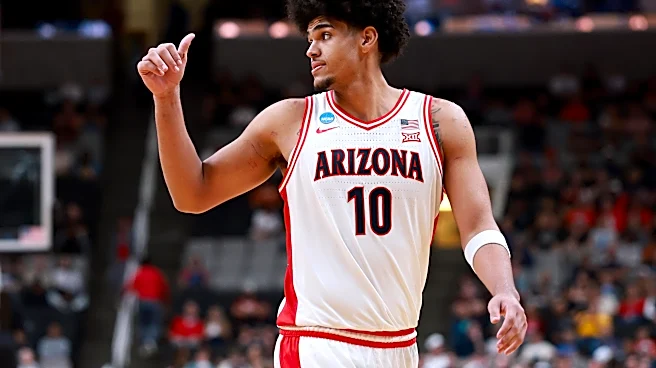
One year in Tucson. His collegiate debut on November 3, 2025, produced 30 points, seven rebounds, and five assists in an upset over No. 3 Florida, the reigning national champions. That made him just the second Big 12 freshman to score 30 or more points in a career debut, joining Michael Beasley (Kansas State, 2007). He led Arizona to the Big 12 regular season title and tournament championship. He went for 20 points and seven rebounds in the Elite Eight against Purdue to send the Wildcats to their first Final Four since 2001. Arizona’s run ended in a loss to Michigan, where Peat still posted 16 points and 11 rebounds.
Across five NCAA Tournament games: 17.2 points and 7.6 rebounds per night. He scored at least 14 in all five.
The Family
Koa is the youngest of seven children. His father, Todd Peat Sr., played nine NFL seasons as an offensive lineman with the Arizona Cardinals and Los Angeles/Las Vegas Raiders. His mother, Jana, played basketball, volleyball, and softball. Every sibling played college sports.
Brother Andrus was selected 13th overall by the New Orleans Saints in the 2015 NFL Draft out of Stanford, and enters his 12th professional season with the Pittsburgh Steelers. Todd Jr. played college football at Nebraska. Cassius played at Michigan State. Keona plays football at the University of Arizona. Sisters Leilani and Maya both played college basketball.
Koa and Andrus are now the second set of siblings to be first-round picks in different sports. Perry coach Sam Duane Jr. on Koa: “Humble, grounded character. That’s how Koa is because of his family and the way he was raised.” Tommy Lloyd on Koa: “A ferocious competitor on the court. He’s a warrior and a heat-seeking missile. This dude’s seeking contact, playing through contact.”
The Numbers: 2025-26 Season Stats
(Arizona Wildcats / 36 Games / All Starts)
Points Per Game: 14.1
Rebounds Per Game: 5.6
Assists Per Game: 2.6
Blocks Per Game: 0.7
Steals Per Game: 0.6
Minutes Per Game: 27.8
Field Goal %: 52.8%
Three-Point %: 35.0% (7-of-20)
Free Throw %: 62.3%
Assist-to-Turnover Ratio: 1.6 (93 assists, 58 turnovers)
True Shooting %: 55.7%
NCAA Tournament Averages (5 Games): 17.2 PPG, 7.6 RPG, 1.6 APG, 0.6 BPG
Peat shared touches with Brayden Burries and ran inside Tommy Lloyd’s motion-heavy system, where no single player owns the ball. His usage rate sat at 24.4%. He ranked 20th in the Big 12 in scoring on a 36-3 team with multiple legitimate scorers. His production happened in a supporting role, and he still elevated every time the stakes went up.
USA Basketball Resume
Koa Peat has more junior international gold medals than most prospects have meaningful college minutes.
- 2022 FIBA U17 World Cup (Spain): Gold Medal, All-Tournament First Team, 9.6 PPG
- 2023 FIBA Americas U16 Championship (Mexico): Gold Medal, 2023 USA Basketball Male Athlete of the Year, 17.2 PPG
- 2024 FIBA U17 World Cup (Turkey): Gold Medal, first player to win multiple U17 World Cup gold medals, 17.9 PPG
- 2025 FIBA U19 World Cup (Switzerland): Gold Medal, first player in USA Basketball history to win four junior-level international gold medals, 12.6 PPG
Four gold medals. He won every time he put on a USA jersey, against international competition, starting at age 15. Combine that with his state championships and it’s clear to see why the Suns’ front office loved him. He wins everywhere he goes.
I highly, highly recommend reading this piece that highlights his record-setting four gold medals.
The Scouting Report
STRENGTHS
1. Physical Profile and Motor
At 245 pounds with a near 7-foot wingspan and a 37.5-inch max vertical at 19 years old, Peat arrived physically ready in a way most one-and-done prospects are not. The 247Sports scouting report described his frame as what you would “expect from a family of football players.” Broad, powerful, and long.
He plays every possession like contact is the objective. The Babcock Hoops evaluation: he “runs the floor hard, plays with energy, and consistently impacts winning.” He does not take plays off. That is unusual in any draft class, rare for a freshman.
2. Interior Finishing
Peat shot 69.7% at the rim at Arizona. He gets there through a combination of strength, timing, and body control that creates advantageous angles before the ball leaves his hands. He finishes through contact, earns free throw attempts at an elite clip, and carries a reliable turnaround jumper from the mid-post as a secondary weapon.
True shooting percentage sat at 55.7% for the season. The SI scouting report placed him at 66.8% specifically at at-rim situations, ranking him among the most efficient finishers in the class. Sam Vecenie of The Athletic described him as having “an unusual cross section of lateral quickness and brute strength” with a passer’s feel once he catches the ball moving.
3. Connective Passing
2.6 assists per game. 1.6 assist-to-turnover ratio. 93 assists, 58 turnovers across 36 games. Assist percentage of 16.7%, which is strong at the positional level. He makes quick reads on short rolls, finds cutters, throws accurate lobs, and trusts perimeter shooters on kick-outs.
As a secondary playmaker in flow offense, the passing is already functional. For a player who projects primarily as a screener and cutter at the next level, that feel is a meaningful bonus.
4. Multi-Positional Defense
Multiple scouts identified this as the element of Peat’s game most immediately translatable to the NBA. He has the quickness to cover forwards on the perimeter, the strength to hold up against physical bigs in the paint, and the wingspan to contest credibly at both levels.
Peat is a very good isolation stopper who has demonstrated his ability to make plays rotating from the weakside. He registered 1.4 combined steals and blocks per game. He ranked in the 94th percentile among college forwards in defensive RAPM. In one of the most-cited defensive performances from any Wildcat this season, he completely locked down Iowa State’s Joshua Jefferson.
5. Winning Pedigree and IQ
Four state championships. Four international gold medals. A Final Four. A 36-3 team record. His Perry coach compared his basketball IQ to Jalen Williams of the Oklahoma City Thunder. Koa Peat understands the game at a level that makes his limitations manageable. He does not fight his role.
He adapted to sharing touches at Arizona in a system that demanded unselfishness, elevated in March when Arizona needed him most, and bet on the NBA at 19 over a guaranteed $6-7 million NIL payday to return to school.
WEAKNESSES
1. Three-Point Shooting
Seven makes on 20 attempts across 36 games. That is essentially zero volume, which makes the 35% rate meaningless as an evaluation tool. Every one of his makes came off a catch-and-shoot look.
He created none of them off the dribble. His mechanics have been flagged at multiple points throughout the pre-draft process, and a form overhaul at the Combine pushed scouts further into skeptic territory. Bleacher Report noted the mechanics overhaul “took people even more off.” Peat is a non-shooter right now. Floor spacing is currency in the NBA, and his inability to threaten from deep limits lineup construction options around him and reduces the defensive pressure a team can apply to his corner.
2. Free Throw Shooting
62.3% from the stripe on 9.8 attempts per 40 minutes is a late-game problem. He earns those trips, which is a real skill. Converting them is the issue. The gradual improvement across international play suggests this is fixable, but it has not happened fast enough yet.
His free-throw trend pre-college does carry some optimism: 45.5% at the 2022 U17 World Cup, 63.6% in 2024, 70.2% at the 2024 adidas 3SSB. The trajectory is there. The mechanics need to follow.
3. Tweener Positioning
At 6’7″ barefoot, Peat is undersized to hold his own nightly against true NBA power forwards in straight post-up situations, and without a credible three-point threat, he cannot play at the four in the traditional floor-spacing sense either.
He needs the right system and lineup construction around him. The modern switchable NBA mitigates this more than it would have a decade ago, but the fit question is real.
4. Off-Ball Defensive Attentiveness
Multiple evaluators flagged his tendency to drift off-ball and miss steals and blocks due to reactive timing rather than anticipatory reads. He is not a natural defensive playmaker in the traditional sense of helping first.
Role Projection
Floor: Physical, switchable defensive big contributing 10-12 points per game through cutting, lob-catching, short-roll playmaking, and hard rim attacks. A longer, more athletic P.J. Tucker archetype.
Realistic Outcome: Starting-caliber power forward producing 14-16 points per game in the right system, defending multiple positions, anchoring switchable lineups. Early-career Aaron Gordon before the perimeter shot arrived, already impacting winning.
Ceiling: A consistent three-point threat at 35-36% on real volume, combined with everything Peat already does, produces a genuine two-way contributor who can start on a championship roster. Defensive versatility to guard 1-through-4, athleticism to finish in transition, and passing feel to run actions himself. That is a real player.
Development Path
The shot is the only question that matters. His catch-and-shoot mechanics need a full overhaul, which the Combine work apparently started. His mid-range touch and soft hands at the rim indicate the natural feel is in there. Free-throw habits are coachable.
If Phoenix can get him to 35% or better on four or five three-point attempts per game within two seasons, the rest of his game becomes dramatically harder to guard and easier to build around.
Everything else is refinement: tightening his off-ball defensive instincts, adapting his interior finishing game to NBA-length bodies, and sharpening his handle enough to use as a tool rather than a liability in ball-screen coverage.
The adaptability is already there. He adjusted to a supporting role at Arizona without complaint. He raised his level every time March asked him to. He chose the draft over $6-7 million guaranteed NIL money and a roster spot Arizona held open for him. That competitive instinct is not coachable. That is character.
The Phoenix Suns Fit
The trade to acquire Peat cost Phoenix the No. 47 pick and second-rounders in 2029 and 2033. None of those selections carries meaningful weight against landing a 19-year-old first-round forward with this physical profile.
Peat joins a young frontcourt trio alongside Ryan Dunn and Rasheer Fleming, two players who also fit the long, physical, switchable mold Phoenix has been assembling. And of course, Miles Bridges as well.
He does not need the ball in his hands to contribute. He is a screener, cutter, connector, and defender built for a secondary role next to a legitimate lead ball-handler.
Kevin O’Connor’s pre-draft analysis noted Peat “could serve as a small-ball center in switchable lineups.” A player who can guard 1 through 4, hold up physically in the paint, and finish above the rim is a necessity in the Western Conference, not a luxury. The Aaron Gordon parallel applies structurally here as well: Gordon’s best basketball came alongside a dominant interior scorer who forced defensive attention and opened lanes for Gordon’s cuts and rolls. Peat thrives in that same structural setup. Phoenix does not currently have a Jokic-level anchor, but the organizational template for deploying Peat correctly is clear.
Perry coach Sam Duane Jr. once compared Peat’s basketball IQ to Jalen Williams of the Oklahoma City Thunder. He did not say that casually. Peat will be a professional teammate, a guy who competes every day, and a player who fits the culture this roster is building.
The Bottom Line
At pick No. 30, the Suns acquired a 19-year-old Arizona kid who won everywhere he played, arrived physically ready to compete, defends with genuine ferocity, and carries exactly one major developmental question. Develop the shot, and Peat becomes a rotation cornerstone for the better part of a decade. Stall on the shot, and he remains a credible defensive forward who contributes to winning basketball.
That is a bet worth making at the end of the first round every single time.
He grew up here. He won here. Now he plays here.
Welcome home, Koa.