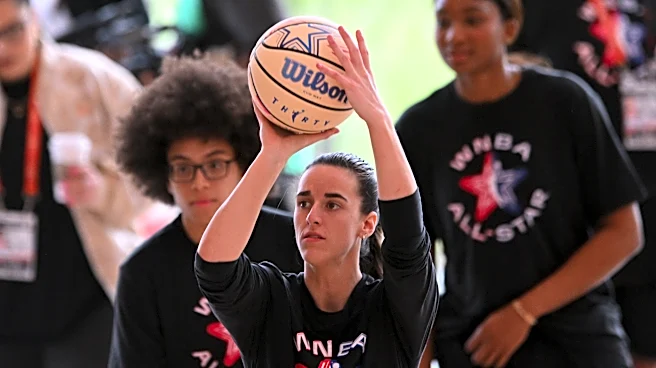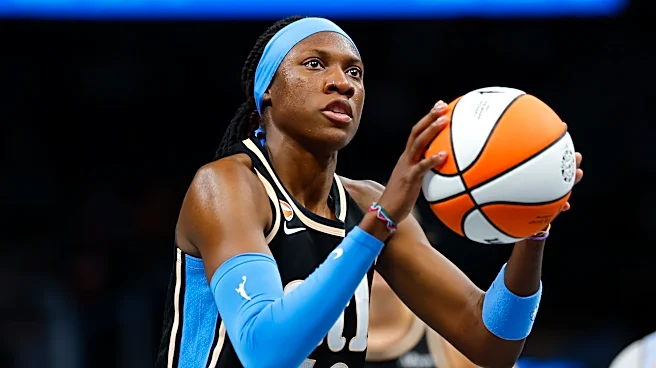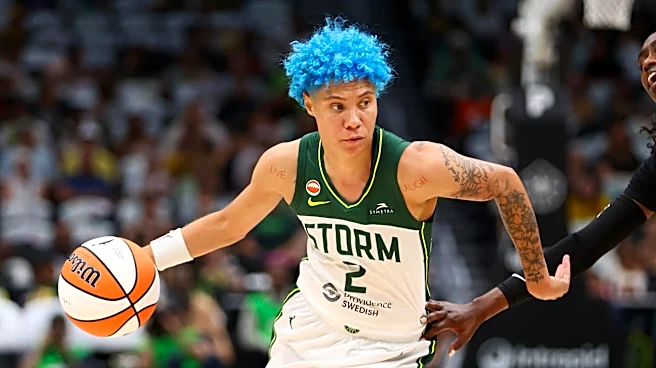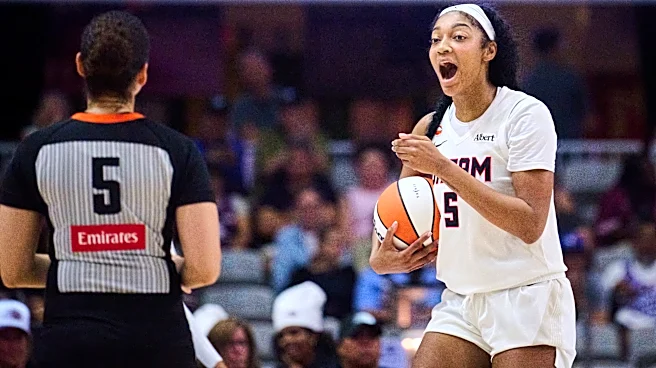







Let’s begin with a guessing game. Which Atlanta Dream players are being described below?
- Player A has the second-best field goal percentage for any player in the WNBA with at least 250 minutes played.
- Player B has the best free throw percentage of any player in the WNBA, at 100%, with more than double the number of free throw attempts of any other player with a perfect percentage.
If you read the article sub-headline above, that should have been a clue that Player A is Madina Okot, who had a field goal percentage of 60.9% going into the All-Star break. She is the only player on the Dream shooting over 60%. Naz Hillmon at 46.2% and Allisha Gray at 45.5% are the next-most efficient shooters so far this season.
Player B is Isobel Borlase, who has continued her stellar free throw percentages
that she displayed en route to winning the Australian WNBL MVP last season.
Okot and Borlase took very different playing paths to get to their rookie years with the Atlanta Dream this season and have shown different trajectories over the first part of the 2026 season. Okot has shown steady gains and improvements throughout the year, while Borlase has performed in line with her professional experience in Australia, which is a win for the Atlanta Dream. Looking ahead, both players will need to be vital contributors for the team as they look to the 2026 playoffs.
The Atlanta Dream entered the 2026 season in “win now” mode. The Dream finished third in the standings in 2025 with a 30-14 record and the three-seed in the WNBA playoffs. The team re-signed or extended all of last year’s starting five under the WNBA’s new CBA. They then made the splash of the WNBA offseason by trading for Angel Reese, sending out two first round picks for the third-year star.
Finally, they added to their star-studded starting lineup by drafting Madina Okot and Indya Nivar in the 2026 WNBA draft, while bringing Australian 2024 draftee Isobel Borlase into training camp to make her WNBA debut this season.
While Coach Karl Smesko and his staff rely heavily on the Dream’s starters (with all five Dream opening day starters among the top 24 in minutes played per game for the entire WNBA), Smesko has spoken highly of the team’s rookies throughout the season. According to hoopsjunkie.io, Madina Okot features in the third-most used Dream lineup (alongside starters Gray, Howard, Hillmon, and Reese in a big lineup without guard Jordin Canada). Isobel Borlase features in the fourth-most used Dream lineup (alongside Gray, Howard, Reese, and Canada, playing for Naz Hillmon).
Both lineups have a positive net rating, with the Borlase lineup performing better than Atlanta’s very good starting lineup net rating (19.7 to 18). For the Dream to be successful in the WNBA postseason, Madina Okot and Isobel Borlase, in particular, need to work through the growing pains of learning a new system in order to fulfill their high-upside potential in the long-term for the team.
Madina Okot: Raw talent progressing every month
If you watch any WNBA broadcast featuring the Atlanta Dream, you may hear the announcers reference the fun fact that Madina Okot just started playing basketball six years ago in Kenya. Since then, Okot has played at the national level for Kenya’s 3×3 team and collegiately for teams in Kenya, Mississippi State, and the South Carolina Gamecocks under Dawn Staley on the team that lost to UCLA in this year’s national championship. Her rapid rise continued when she was drafted at no. 13 overall by the Atlanta Dream in 2026.
Okot has continued to improve, even in just three months of the WNBA season thus far. From May to June, the following categories have improved for Okot:
- Her minutes per game have increased from 8.8 in May to 10.1 in June and 10.4 in July
- Her points per game have increased from 4.7 in May to 5.9 in June and 9.1 in July
- Her free throw shooting percentage has increased from 62.5% in May to 70% in June to 87.5% in July
- Her field goal percentage has increased from 56% in May to 62.2% in June to 62.5% in July
While Okot exploded on the scene with 11 rebounds and 14 points in her third game of the season against the Las Vegas Aces in State Farm Arena, she has added several more impressive performances throughout the summer.
- She put up 18 points and 16 points in back-to-back games against Toronto and Golden State in late June.
- She scored 11 points with just 1 turnover against GSV with over nine minutes played in early July.
- She played a season-high 23 minutes in a game that Angel Reese missed due to injury, scoring 19 points with eight rebounds and just two turnovers against Portland on July 11th.
These increasingly common impressive occurrences show that the work the Atlanta Dream coaching staff is doing with Okot, along with her own effort, plus the mentoring of more-experienced frontcourt players (including Naz Hillmon, Brionna Jones, and Angel Reese) is all paying off for Okot and the Dream. She has the ability to put pressure on the opposing team at the rim, to rebound on the offensive and defensive ends of the court, and to finish efficiently. Okot has and will continue to develop, although she does still have limitations that have negatively affected her performance on the court and Coach Smesko’s willingness to trust her in close games in tight situations.
The biggest struggles for Okot thus far are with her defense and turnovers. She has been called for three-second violations and travelling on repeated occasions. Her defense can be a liability, as seen in her +/- statistic of -30, which is the second-worst number on the Dream (ahead of only Te-Hina Paopao at -63, who has seen her playing time decrease in recent weeks with the increased usage of Isobel Borlase and the recent signing of Jaylyn Sherrod).
Okot’s 1.3 turnovers per game may not seem that problematic, but this number is worrisome when considering that she has played less than ten minutes per game this season. She has the same turnover rate as Arike Ogunbowale (who has played 29.6 minutes per game at a guard position) and Bridget Carlton (who has averaged over 30 minutes per game).
Teja Oblak, a 35-year-old rookie with the Portland Fire, is the only other player in the WNBA’s top 100 for turnovers per game who is also averaging under 15 minutes per game. The next-worst player at turning the ball over who plays less than ten minutes per game is Li Yueru, who only has .5 turnovers per game. Okot’s rate is more than double that of Yueru’s rate.
The hope for the Dream is that Okot can limit her turnovers as she gets more experience. Hopefully the time off with the All-Star Break and the continued work with the Dream’s coaching staff will help her in this area, so that Coach Smesko is comfortable playing her late in games when Atlanta needs her height and presence in the paint to close out tough physical matchups. Her willingness to take on veteran frontcourt players throughout the season shows her potential and Coach Smesko has repeatedly talked about her upside as a developing player.
Isobel Borlase: Consistent skills transferring from Australia to America
In the 2025–26 WNBL season, Isobel Borlase led the Australian league in scoring with 22.9 points per game, along with 6.3 rebounds per game, and 3.5 assists per game on 45.6% overall field goal accuracy and 90.7% shooting from the free throw line. While Okot has been impressive as a steady improver throughout the season, Borlase has been impressive as her numbers have translated almost directly to the higher level of competition in the WNBA.
Borlase has a shooting percentage of 44.9% (which is 5th-best on the team behind Okot, Hillmon, Gray, and Canada). She has improved her already excellent free throw shooting with the perfect tally so far this season going 17-17 from the line. No other WNBA player is perfect with more than six made free throws, meaning that every player in the league who has attempted at least seven free throws has missed at least one, besides Borlase. Even if she missed her next free throw, she would still be second in the league for free throw percentage behind only Ariel Atkins who was shooting 34-35 (97.1%).
While Borlase has never been a great three-point shooter (hovering around 27% for three-point shooting in the Australian league with similar numbers of 28.6% in the WNBA this season), she does add a unique element of shooting to the Dream that the team struggles with: an impressive willingness to drive to the basket and efficient shooting between the 3-foot and 16-foot zones. While Smesko’s teams are notorious for focusing on high-efficient shots from three-point range or at the basket, Borlase has been surprisingly effective in her shooting between these areas:
- Borlase has shot 80% (4-for-5 shooting) from 10-16 feet; the next best player on the team is Allisha Gray at 39.1% (9-for-23 shooting).
- Borlase has made 50% of her shots (13-for-26 shooting) from 3-10 feet; only Naz Hillmon at 52.4% (11-21 shooting) and Rhyne Howard at 51.9% (28-for-54 shooting) have been better than Borlase in this range, with much more playing time than her.
Because of her steady production, Borlase has been trusted more by Coach Smesko: she has played double-digit minutes in 14 of her last 17 games, after just getting to that mark in two of her first nine games. With the increased playing time, her rebounds, steals, and points per game are all up from May into June and July.
She went into the All-Star Break with back-to-back 10-point outings against Los Angeles and Toronto, before scoring eight points in Atlanta’s win over Chicago. Hopefully she can continue her positive momentum and maintain her contributions in the rotation spelling Jordin Canada and the team’s other guards in the second half of the season.
Indya Nivar: Drafted as a role player, but yet to shine
While Okot and Borlase are the rookies getting the most playing time, the Dream did renew their commitment to Indya Nivar by bringing her back on a developmental contract on July 8th after waiving her earlier in the season. Nivar was originally drafted by Atlanta in the second round of this year’s 2026 WNBA draft.
In their press release from the draft, Atlanta described her as “a dynamic, defense-first guard known for her disruptive instincts, playmaking ability and all-around versatility.” The University of North Carolina press release announcing Nivar’s drafting mentioned her ACC All-Defense accolades and her record-setting steal numbers while in college.
Nivar has gotten limited minutes off the bench for Atlanta this season, averaging less than four minutes per game across 20 contests. However, the team using one of their two developmental spots on Nivar could indicate her performance, effort, and contributions in practices for the team.
Nivar has struggled with her shooting from the field (38.9% shooting in the WNBA) and from the free throw line, where she has shot a bizarre 7.7% (1-of-13 shooting) despite being a career 57.3% free throw shooter over four years in college at Stanford and UNC. Hopefully Nivar will have the opportunity to play more, perhaps in end-of-quarter situations, which could allow her shooting numbers to regress to her collegiate means and give her the opportunity to shine on defense.
Assessing Future Success for the Dream’s Rookies
Overall, the Atlanta Dream should be pleased with the growth and performance of their rookie class, particularly Madina Okot and Isobel Borlase. Rookie development is not always linear, but both players have shown an upward trend in their playing time and contributions on the court.
As the season progresses, it will be worth watching to see if Okot can minimize her foul trouble and turnovers while maintaining her impressive efficiency. For Borlase, the team hopes she can continue her strong shooting, while also adding to her game with rebounds, assists, and competitive defense to spell the team’s other guards off the bench.
With a healthy Brionna Jones having returned to the lineup, the concerns over the squad’s depth may be addressed as the team’s rookies contribute in the roles created for them.