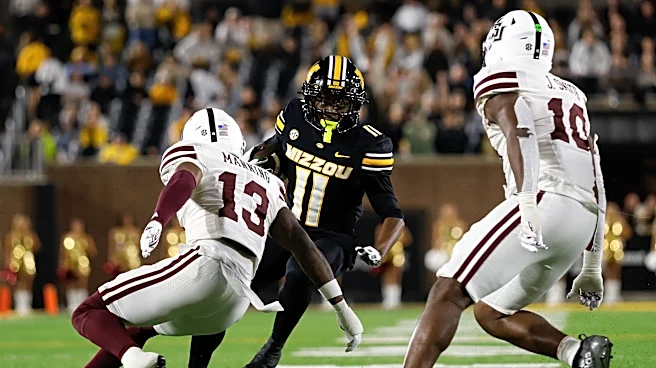




As Mizzou students return to campus from spring break and the football team freshly finished with spring practice, the collected college football gaze begins to shift from development to prognostication. Rock M Nation godfather and current ESPN writer and analyst Bill Connelly just released his first batch of SP+ ratings for the 2026 season and the Tigers clock in at No. 20 nationally.
To be honest, there are few bigger Mizzou homers than myself, but when I saw the Tigers check in as highly as they
did in BillC’s first batch, my first reaction was… slightly dubious.
Following the Tiger roster turnover throughout the offseason makes it clear just how much the Tigers are replacing heading into 2026. Ten defensive starters from last year’s excellent unit are gone. The secondary has been almost completely rebuilt. The front seven lost multiple NFL-caliber players. Even on offense, there are key pieces to replace, particularly up front and at wide receiver.
So seeing Mizzou land comfortably inside the top 25 feels ambitious at first glance, but let’s take a deeper dive into why.

SP+ has never been about perception. It is not a poll. It is not a projection based purely on returning starters or headline names. It is an efficiency-based metric built on a combination of returning production, recent performance, recruiting and transfer history. It tries to measure how good a team is on a per-play basis rather than how explosive it might be.
That is where this first rating starts to make a lot more sense.
Under Eli Drinkwitz, the Tigers have quietly become one of the more efficiency-focused teams in the country. He’s built his offense, either by preference or need, not geared toward the constant need for chunk plays, but rather as one that values staying ahead of the chains and avoiding negative plays and finishing drives (with field goal attempts.) Defensively, it is about limiting explosives, forcing long drives and capitalizing on mistakes.
That style is not always the most flashy, but it tends to grade out very well in metrics like SP+. Efficiency is the whole point.
So even as Mizzou loses a massive amount of production, especially on defense, the underlying structure that SP+ values is still there. The system has worked. The coaching staff has shown it can develop players within that system. The roster, while less experienced, is not devoid of talent.
That combination tends to earn the benefit of the doubt in BillC’s preseason models. There is also some recent history backing it up.
SP+ has been consistently high on Mizzou in the preseason under Drinkwitz. In 2024, the Tigers opened at No. 11 in the preseason rankings and finished No. 19 by the end of the year. In 2025, they started at No. 15 and finished at No. 21.
Those are not massive misses by BillC’s knobs, dials and buttons. If anything, they show that SP+ has a pretty solid read on what Mizzou is as a program under Drinkwitz: a team that is reliably above average, often flirting with the top 15, but not quite elite.
At the same time, a pattern has emerged. In both seasons, the preseason ranking was a bit more optimistic than the final result. Not dramatically so, but enough to notice. That pattern matters when looking at this year’s No. 20 ranking because if there is a consistent critique of SP+ when it comes to Mizzou, it is that it tends to slightly over-index on efficiency.

The Tigers play a style that looks great in the numbers, but that does not always translate to a higher ceiling on the field. When things break down, when the margin for error shrinks, when explosive plays are needed to win big games, that efficiency-first approach can hit its limits.
Now layer that onto a roster that is replacing as much production as this one is. Ten defensive starters gone is not a small thing. That is a full unit reset. Even with belief in the scheme, there is going to be a learning curve. New starters have to communicate. Young players have to adjust to bigger roles. Transfers have to acclimate.
The same is true, to a lesser extent, on offense. There are intriguing pieces coming in, especially at wide receiver and along the offensive line, but there are also real questions about how quickly it all comes together.
That is why No. 20 feels a little high at first glance. It assumes a relatively smooth transition from one roster to the next, as well as that the efficiency Mizzou has built over the past few years will carry over, even with so many new faces. That is a significant assumption, but it is not an unreasonable one.

If there is one thing Drinkwitz and his staff have proven, it is that they can build a functional, efficient football team. They have done it with different personnel. They have done it after roster turnover. They have done it while navigating the transfer portal era.
While there are doubts about how seamless this transition will be, there is also reason for optimism.
Defensively, the scheme is still there. Even with the losses, the Tigers have recruited well and added pieces through the portal that fit what they want to do. It may not be as dominant early in the season, but it would be surprising if it falls off a cliff.
Offensively, there is reason to believe the unit could improve in certain areas. If the offensive line stabilizes and the new wide receivers provide more consistent separation, the passing game could take a step forward from where it was in 2025.
Put that together, and the outline of a team that lands somewhere in the top 25 becomes more justifiable. Not elite, not rebuilding, just solidly in the mix. That is exactly where the Tigers have been the last three years and it is right where SP+ has them.
So yes, No. 20 was higher than expected at first glance. The roster turnover alone suggested the Tigers might land a bit lower, at least in the preseason. The last two years suggest that SP+ has been mostly right about Mizzou, even if it has leaned a little optimistically. But hey, who am I to judge about being too optimistic?