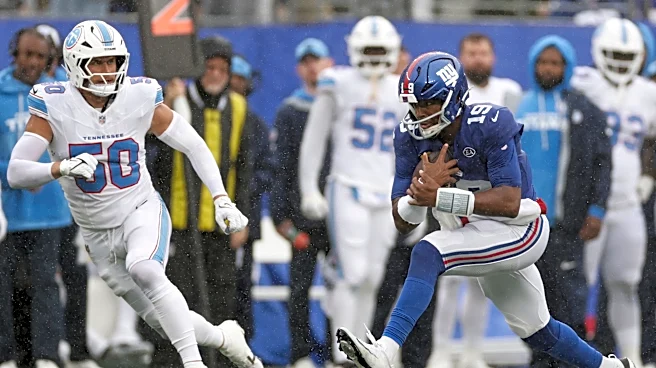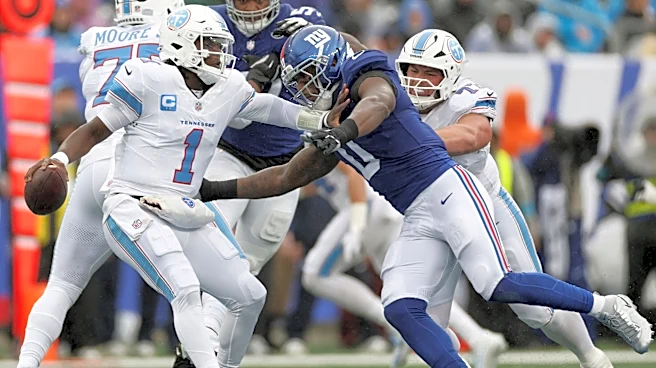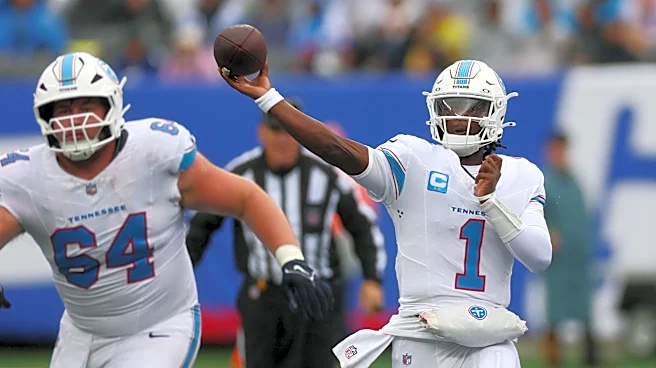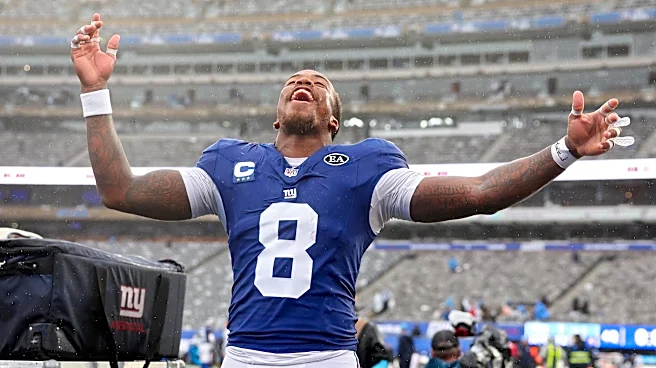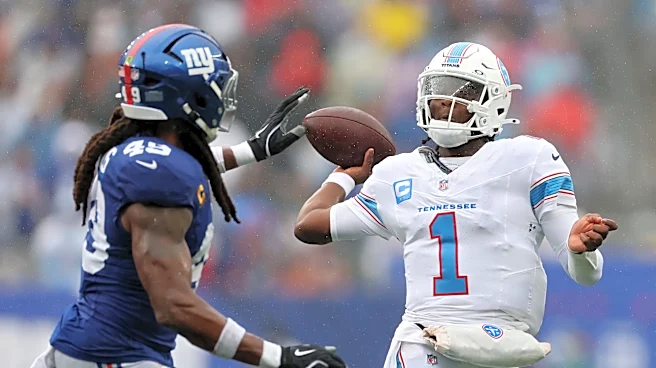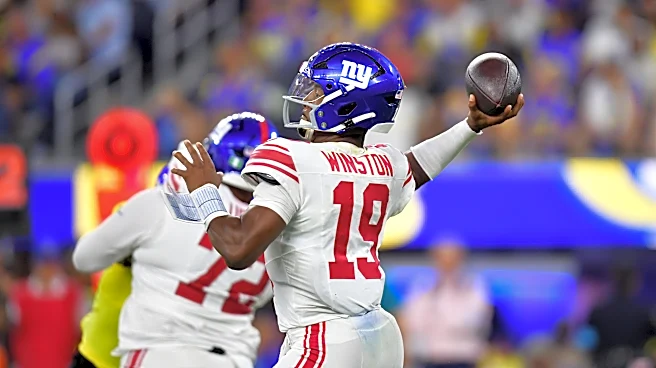


Given the awful weather conditions at MetLife on Sunday for the Giants’ 12-7 victory over the Tennessee Titans, analysis of the performance of any Giants player or unit is at best of limited use. The fact that the Giants’ best defensive player, Brian Burns, is now out for the season with what looks like an ACL tear, following on the gut punch of losing their best offensive player, Jaxson Dart, to his own knee injury the week before, seems like a classic “only the Giants” sequence of events. That
said, the Giants are 2-1, their best record after three games since 2022, and tied for first place in the NFC East.
The only point is that as ugly as Sunday’s game was, the Giants found a way to come out with a win, something they haven’t done much of the past few years, and the season goes on even if you’re not as excited about it as you were two weeks ago. The Giants will play 14 more games, so we might as well look at who is and is not playing well to see where hope for the future lies.
PFF grades
Here are the PFF grades for the offense:

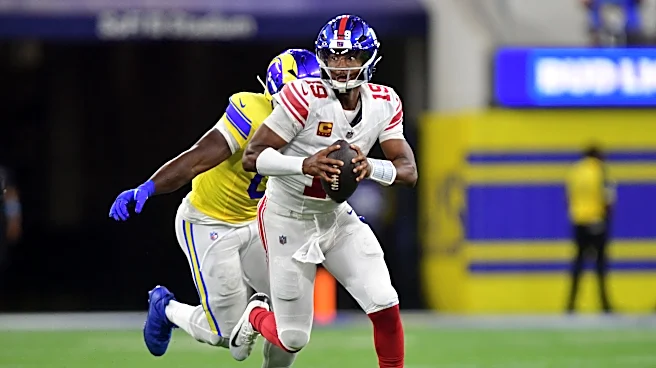
Jameis Winston had a rough outing (47.3 passing grade), but he gets a mulligan because of the conditions. He’ll have to do better in the coming weeks…if the coaching staff is willing to open up the offense a little bit when the weather cooperates, and if he doesn’t take a seat with the acquisition of J.J. McCarthy. Strangely, Jameis graded better under pressure (66.8) than when kept clean (41.6). The reason was because his one “big-time throw” came when he was flushed from the pocket because Jermaine Eluemunor’s man beat him, and he threw downfield just before being hit to the Giants’ big deep threat…Cam Skattebo. His one turnover-worthy play came from a clean pocket.
The offensive line was a mixed bag. Eluemunor and Andrew Thomas both pass-blocked pretty well overall, although Eluemunor drew two penalties. Sisi Mauigoa had a clean game, and Jon Runyan pass-blocked well other than drawing one flag. The real problem was John Michael Schmitz, who is both overmatched in pass blocking against big physical defensive linemen and sometimes makes curious decisions about who to block.
The rest of the offense was just a collection of average and slightly below-average performances, as befits the weather conditions. Isaiah Likely drew the lowest grade because he only caught 2 of 5 targets and had a drop.
Moving on to the defense:

Arvell Reese had clearly his best game as a Giant, grading 84.6 overall with 80+ grades each in run defense, tackling, and pass coverage. Reese had eight tackles and an assist, five of them “stops” (unsuccessful running plays). He did give up three receptions in four targets but for only 14 yards total and only 2 YAC. D.J. Reader also graded elite overall, with at least average grades in every category and very good grades in run defense and pass rush (a QB hurry from an interior defensive lineman!).
For a change, the Giants’ secondary graded pretty well overall. Unsurprisingly, Jevon Holland was the star of the show because of his game-saving interception, but Dru Phillips and Jason Pinnock also graded well, notably for Phillips in coverage as well as run defense, and Greg Newsome graded very good in coverage. Of the other DBs, I was surprised to see Colton Hood get a grade as high as 57.9 in coverage, considering that Cam Ward targeted him all game, completing six of seven passes thrown his way plus the only touchdown of the game. Ar’Darius Washington was the lowest graded Giant on defense, because of the two catches in two targets he gave up for 22 yards including 13 YAC.
Otherwise the defense graded in the average category overall, with the occasional bright spot. For example Abdul Carter got a 70.9 in pass rush despite getting no pressures. This suggests that he beat his blocker sometimes but didn’t get to Ward in time to affect his throw. Ward’s 2.47 s average time to throw yesterday indicates that he was getting the ball out quick. More on that below.
Advanced metrics
Like you, I am dismayed about the Giants’ lack of an effective pass rush. There may be multiple reasons – the lack of a big physical bull-rushing edge defender; a lack of creativity from Dennard Wilson with twists, stunts, blitzes to get free rushers; or the Giants’ edge defenders are just overrated. Here’s one thing, though, that shouldn’t be overlooked:
Of course if you have defensive backs who tightly cover receivers it’s not so easy to get rid of the ball completely. A good DB is an edge rusher’s best friend. In fairness, though, the Giants’ DBs were not terrible Sunday overall, as I indicated above from the PFF grades.
Here’s an objective metric, QB EPA/play, that tells us several things of interest to Giants’ fans (click on the figure to see the full list; the QBs of interest are near the bottom):
First, take a moment to lament the Dart injury; he led the NFL in EPA/play in Week 1. For this week, though, go to the bottom of the chart. Cam Ward is ranked No. 30 for the season. His -0.15 EPA/play yesterday was among the lowest in the NFL, though the weather may have had something to do with that. Unfortunately just a few spots below Ward is Jameis Winston at -0.14, just about as bad. That said, it beats Jameis’ -0.45 against the Rams.
Oh how quickly they forget, though. Here are EPA/play rankings from weeks 6-12 last year:
This suggests several hypotheses, more than one of which might be correct:
- Jameis and Dart being No. 1 and No. 3 during that period means they played really well
- The fact that Jameis is so low in EPA/play this year is due to the fact that in his two starts he had to face a ferocious Rams defense (not that it looked great against Denver) with the Giants already behind and then had to play in windy, rainy conditions in his second start
- The fact that Jameis is so much worse this year than last is due to the Brian Daboll-Mike Kafka passing offense being much better designed than this year’s Matt Nagy-Brian Callahan passing offense.
- J.J. McCarthy being dead last on the list does not suggest that he will be an improvement over Jameis.
Choose whichever explanation(s) you like.
Here’s another take on quarterback performance, looking at how EPA/play compares to PFF passing grade:
PFF doesn’t always agree with EPA/play, but there is a definite positive correlation, and for Jameis yesterday they are in good agreement – he was below average (as was Ward). Take solace, though, because Drake Maye’s carriage has suddenly turned into a pumpkin this season.
How well did the Giants play overall on offense and special teams yesterday (again, click on the figure to see the full list)?
- Aside from the below-average EPA/play, their success rate (how close to a first down the offense gets on each down) was below average but not the worst
- Their special teams EPA was the best in the NFL, no surprise given Jordan Stout’s booming punts and Dominic Zvada’s perfect performance on field goals.
- The explosive play rate was small, but far from the worst in the league.
- They were second worst in penalties, ahead of only the woeful Los Angeles Chargers (hmm, another Harbaugh team).
On defense, one of the big stories is the Giants’ anemic pass rush. Here’s a chart that perhaps sheds some light on the reasons for it:
The fonts are small, so here’s what’s going on. The figure shows the double-team rate on the y-axis vs. the PFF pass rush win rate on the x-axis. Note that PFF assigns a “win” if the rusher beats his blocker. That is not equivalent to a QB pressure because if the QB lines up in the shotgun, rolls out, etc., the rusher may be too far away to register a pressure unless the QB holds the ball too long, and the pass rusher has little control over that (as I alluded to earlier for Abdul Carter). The chart is for the season to date, not just Game 3.
Four Giants are on the chart:
- In the upper left is Kayvon Thibodeaux, with a very small pass rush win rate. However, he has the third-highest double team rate of any rusher on the chart.
- Moving to the right, Brian Burns has a pass rush win rate of almost 10% but an almost equally high double-team rate.
- Moving further right, Chauncey Golston has almost as high a double-team rate but an almost 15% pass rush win rate.
- Finally, in the middle of the diagram, Abdul Carter has about a 10% pass rush win rate but a significantly smaller (about 30%) double-team rate.
Taken as a group, the Giants’ pass rushers are not distinguishing themselves – all are in the lower half of the population in pass rush win rate except perhaps Golston, who is in the middle. But all of them except Carter are being double-teamed more than almost any other pass rusher in the NFL.
How can that be? It suggests that on most teams, opponents have to double-team at least one interior defensive lineman, leaving an edge pass rusher one-on-one. On the Giants, though, that’s no longer necessary.
Where have you gone Dexter Lawrence, Giants Nation turns its lonely eyes to you, woo-woo-woo.