
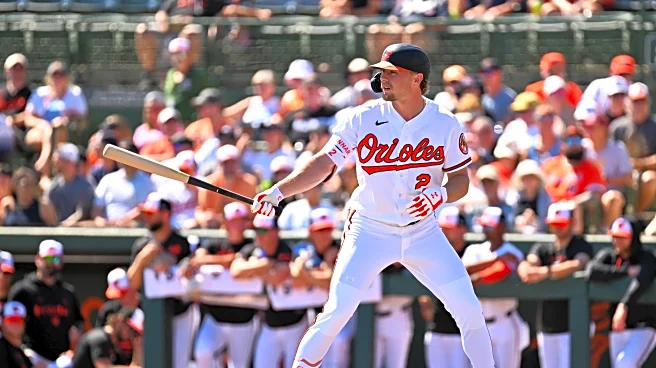
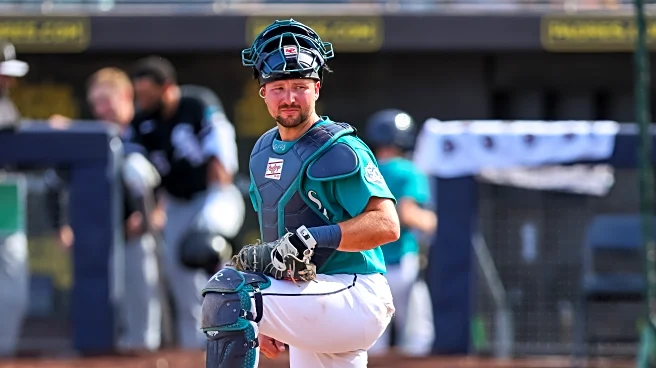
Since I can remember, the answer to the question, What is the Orioles’ weakest link? was always the same: the starting rotation. This winter brought high hopes for a top-of-the-market splashy signing of the kind that would put the conversation fully to rest: such a signing failed to materialize. Nonetheless, the mood around the rotation is unusually confident. “This might be the most underrated rotation in all of baseball,” said Opening Day starter Trevor Rogers. Free-agent addition Chris Bassitt
added, “I would rather be a stealth bomber, so to speak, and not have anybody talk about us. Just surprise people.”
It’s not the flashiest group out there, but a starting rotation of Trevor Rogers, Kyle Bradish, Shane Baz, Chris Bassitt, and Zach Eflin looks better, perhaps, than anything Baltimore has put out there in recent memory. This group has an extremely high floor.
The picture came into focus on Saturday when the team made the shocking announcement that Dean Kremer was being optioned to Triple-A Norfolk to start the season. With the longtime Oriole starter required to stay there until April 9, the move confirmed what some had suspected: Baltimore is going with five men, not six, to start the season. Here’s who those five are and what to expect from them.
Trevor Rogers, LHP
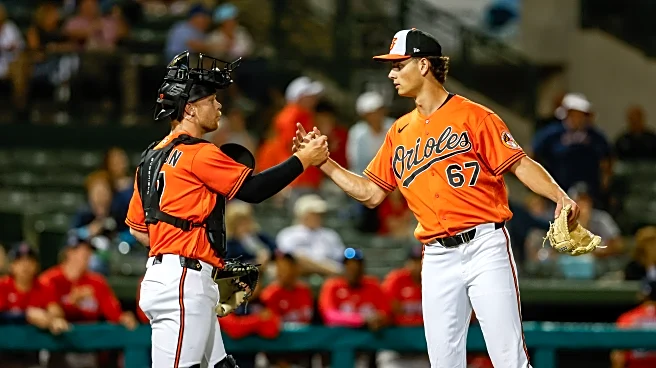
Rogers is your Opening Day starter… which is a sentence that would have seemed impossible a year ago. Dealt from Miami to Baltimore at the 2024 trade deadline, Rogers posted a homely 7.11 ERA in four starts before getting sent down to Norfolk. Then in 2025, something clicked—in an astonishing way. Though he started the season late, his 1.81 ERA and 0.90 WHIP across 18 starts broke a 71-year-old franchise record and proved good enough for ninth-place in the AL Cy Young vote. He’s continued to look good this spring, and will get the ball on Opening Day, on March 26 against the Twins at Camden Yards.
The concern is the innings total—he threw just 109 2/3 last season—and whether the electric results hold over a full season. But why would you hand the ball to anyone else right now?
Kyle Bradish, RHP
It’s strange—but nice—to turn to the No. 2 slot in the rotation and find Kyle Bradish, the brilliant strikeout artist who’s posted a 2.78 ERA and 268 strikeouts across 44 starts since the beginning of 2023. Yes, that stretch was interrupted by Tommy John surgery, but Bradish returned last year and looked very much like himself: a 2.53 ERA and 47 strikeouts in six starts.
The surgery risk is real, but Bradish is brilliant enough that a lesser Bradish would still be brilliant. And so far this spring, the evidence (a 2.35 ERA, 12 K’s and a .207 opposing average in 15.1 innings) says Bradish is back. A healthy Bradish gives this staff a genuine two-headed monster at the top.
Shane Baz, RHP
The Baz acquisition was the most aggressive, and interesting, move of the offseason, costing four prospects and a competitive balance pick. It’s a pretty price to pay for a 26-year-old who posted a 4.87 ERA in 31 starts for Tampa Bay in 2025, and hadn’t thrown a fully healthy season in four years at the major league level.
This is an extremely high-risk, high-reward acquisition (kind of good, come to think of it, to say that about a move made by this front office). The 2017 first-rounder was the Rays’ No. 1 prospect in 2022, having struck out a whopping 113 strikeouts in 78 2/3 innings between Triple-A and Double-A the prior season. At one point, Baz was measured as one of 12 Major Leaguers with a fastball averaging at least 97 mph and 11.4 inches or less of vertical movement, putting him on a list that at one time included Aroldis Chapman, Gerrit Cole and Jacob deGrom. Whether the 26-year-old still has that kind of stuff remains to be seen; at least it can be said that, for a Orioles’ front office that doesn’t like to spend on pitching, the king’s ransom they shipped out for Shane Baz suggests they are pretty darn excited.
Chris Bassitt, RHP
Bassitt is this rotation’s version of a utility infielder: not flashy, deeply reliable, almost always there. His five-year average of 176 innings and 30-plus starts tells us pretty much what we’re getting: a professional who takes the ball, throws strikes, and keeps his team in games. His 3.66 ERA over that stretch is comfortably above average. Baltimore could have done much worse than slotting Bassitt into the back end of a rotation that has genuine upside at the top.
Zach Eflin, RHP
Outside of Baz, Eflin may be the rotation’s wild card, and not in a bad way. After back surgery last August cut short his 2024 season, he finished those final two months with a 2.60 ERA in nine starts before going under the knife. He’s been cleared and, by Mike Elias’s own account, looks excellent (this is the reason he leapfrogged Dean Kremer in the rotation). Forty plate appearances of elite production followed by offseason surgery is not a large sample to bet on, but Eflin at his best is a genuine asset.
And Kremer?
The Kremer demotion was striking—he’s logged over 600 innings for Baltimore and had earned himself a rotation spot. But with Eflin healthy and the April schedule full of off-days, Mike Elias framed it as a calendar decision rather than a capability verdict. The six-man rotation talk that dominated fan discussion this winter isn’t dead; Elias explicitly left the door open for revisiting it as the season develops. Kremer may be stung by this, but he’s hopefully the answer to the next injury or busy stretch, not a casualty of numbers.
FanGraphs projects 11.8 WAR from this group, tied for 16th in baseball and 10th in the American League. That’s a middle-of-the-pack projection, which is probably the honest baseline. The optimistic scenario looks much more exciting: Rogers sustains last year’s brilliance, Bradish returns to his 2024 form, Baz develops into the pitcher Tampa Bay always hoped he’d be. If all that goes right, it pushes this staff into a genuinely competitive tier. A few things would have to go right. It would be surprising, but hardly impossible.