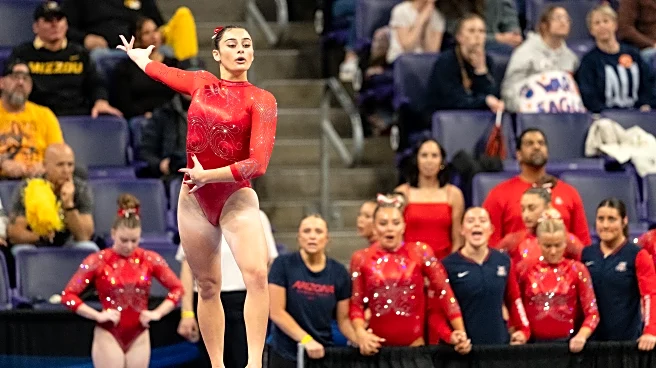




The Arizona GymCats went into Big 12 Championships last Saturday basically locked into a spot in the first round “play-in” meet if they made regionals. A disastrous conference championships ensured they would stay there, but at least they made NCAA Regionals as a team for the seventh straight time. They also get to compete relatively close to home.
Arizona will travel to Tempe to take on the Arizona State Sun Devils in the first round on Wednesday, Apr. 1 at 2 p.m. MST. The winner of that meet advances
to the regional semifinal on Thursday to compete against No. 3 Florida, No. 14 California, and No. 20 Penn State. The other semifinal will consist of No. 6 Georgia, No. 11 Michigan State, No. 24 BYU, and No. 28 Southern Utah. The top two teams from each semifinal will meet in the regional final on Saturday, Apr. 4.
If Arizona does not advance as a team, there will still be GymCats performing in the later rounds. Junior all-arounder Abigayle Martin qualified to compete on all four events. Assuming her ankle has healed, senior Emma Strom will compete on floor exercise. Strom missed the final regular season meet and the Big 12 Championships. Sophomore Jessa Janicke qualified on vault and junior Tirzah Wise qualified on balance beam.
Martin and Strom both earned All-Big 12 honors based on their individual national qualifying scores (NQS). They were not the only GymCats honored, though. Senior Giana Lenczner, who specializes on beam, was named the Big 12 Gymnastics Scholar-Athlete of the Year at last weekend’s Big 12 Championships. She maintains a 4.0 GPA with a major in accounting.
Staying close to home will be an advantage to the GymCats. They had considerable struggles on the road this year beginning with a 193.350 in their first away meet and ending with a 194.725 at league championships.
Things started hot at the Big 12 Championships. Arizona had a superb floor rotation and was just .050 behind Utah in second place after the opening event. Freshman Delaney Mead had to step in for Strom at the last minute for Arizona’s final home meet. She had a fantastic performance. She couldn’t repeat the magic at the league championships, but Arizona was able to drop her 9.150 when everyone else scored 9.800 or better.
The broadcast showed very little of Arizona’s performances throughout the meet, but Sophie Derr paced the team with a 9.925 on floor. Her music could be heard as athletes from other teams were shown, but the performance wasn’t broadcast. That would be true throughout the meet.
The event was broadcast on ESPNU and streamed on ESPN+. The ACC’s championships were taking place at the same time. While the ACC had a main feed that was aired on TV, it also had four event feeds available on ESPN+. That made it possible to choose which team to watch at a given time or to skip around and watch specific gymnasts from different teams that weren’t shown on linear TV. This is a common setup for postseason meets. For whatever reason, ESPN did not have the same setup for the Big 12 and the linear feed showed very little of Arizona over the evening. When Arizona was shown, it was often a short clip stuck between two routines by athletes from other teams rather than entire routines.
Whatever was happening that wasn’t shown got progressively worse as the meet progressed. Arizona went from floor to vault, where the GymCats give away considerable tenths by performing six vaults with 9.95 start values. No one scored over 9.775.
Denver leaped past both Utah and Arizona after the second rotation, but the GymCats were still in a good spot. They trailed Utah by .350. At worst, perhaps they could take third and finish one spot higher than their seed.
The second half of the meet was disastrous, wiping away not only the possibility of moving up in the standings, but dropping Arizona into fifth behind ASU’s score from the first session.
Both Mead and Martin had major difficulties in their routines. Mead’s start value ended up at just 8.000 and her score was 5.250 after all deductions were taken. Martin followed the freshman with a chance at lifting her teammate, but she ran into issues, as well. Her start value was down to 9.800 after she fell off the low bar. The final score was 9.000 flat, and Arizona had to keep it because of the previous fall.
Things rebounded a bit when Derr earned a 9.800—the only Arizona score above 9.725. They didn’t stay there, though. Sophomore Aubrey Krohnfeldt also had huge problems. While she got all of her start value, Krohnfeldt’s score was just 9.225. Arizona earned a shocking score of 47.400 on the rotation.
On the positive side, the team finished up strong on balance beam. No one scored below 9.725 and four of the six scores were 9.825 or better.
Lenczner gave Arizona a solid start with a 9.775. Krohnfeldt’s 9.725 came next. Then, the team took off and showed what they can do when they’re on.
Janicke started it off with a 9.825. Derr bumped it up with a 9.850. Wise and Martin closed things out with identical scores of 9.900. The 49.250 was what Arizona needed to prove to themselves that they are a very good team when they put it all together.
Five of the Big 12’s remaining six teams qualified for regionals. Iowa State canceled its season and discontinued its program halfway through the season. In addition to the three teams that will be in Tempe, Utah (No. 12) and Denver (No. 23) will compete at the Corvallis Regional. West Virginia didn’t qualify as a team, but the Mountaineers will send three athletes to the Baton Rouge Regional where they will compete as individuals.