


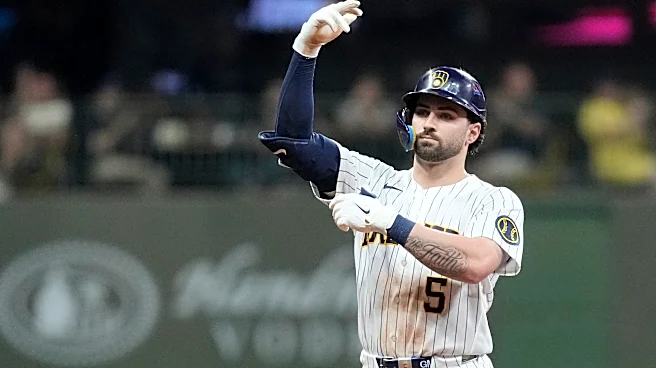
The Brewers have had a good offense all season, but they’ve done so in an odd fashion. For most of the season, they’ve been dead last in home runs. In the first half, they were an incredible team with runners in scoring position. They are fast, and they’re second in the league in that old out-dated stat, batting average (behind their American League doppelgangers, the Tampa Bay Rays).
It’s been effective. The Brewers are second in the league in runs scored—and they’ve been pretty consistent, as they were
fourth in the league in runs before the All-Star break and are second after it. And while the team has been one of the worst teams in the league in terms of homers, it’s not as if they can’t hit: over the full season, the Brewers are fourth in the league in OPS, and despite some second-half improvements, they were still in the top 10 in OPS before the All-Star break.
Here’s where I say “all that being said.” The Brewers, as a team that has mostly relied more on stringing hits together, taking walks, good situational hitting, and the league’s best sequencing coach*, have been prone to slumps this season. This is also why the Brewers have so many doubters about their postseason prospects: they’re a team without superstars and without the types of dangerous players up and down the lineup who can pop a two-run homer to immediately get you back in a game, and a team without those kind of players are especially vulnerable in the meat grinder of the playoffs, where you rarely face the same pitcher twice (and if you do, that pitcher is probably a Cy Young contender).
We’ve seen the Brewers go through bad stretches. In April, Milwaukee as a team had a .670 OPS, 26th in the league. In May, they had an identical .670 OPS (but moved from 26th to 21st in the league rankings). Much of their early season struggles can be attributed to the absence of two of their most effective bats—Jackson Chourio and Andrew Vaughn—and their return to the lineup in May (and the time it took them to get up to game speed) is one of the reasons why the team bounced back so hard in June, when they were second in baseball with an .830 OPS. They split the difference in July, when they were 11th in the league at .750, and they held at 11th with a .724 OPS in August.
In September, though, the Brewers are killing the ball. It’s a small sample, just 12 games, but the Brewers have the best OPS in the league (.874) by a whopping 53 points this month, and there are only two other teams in the league within 81 points of their league-leading mark.
Is this just another blip in a streaky season? Or has something changed?
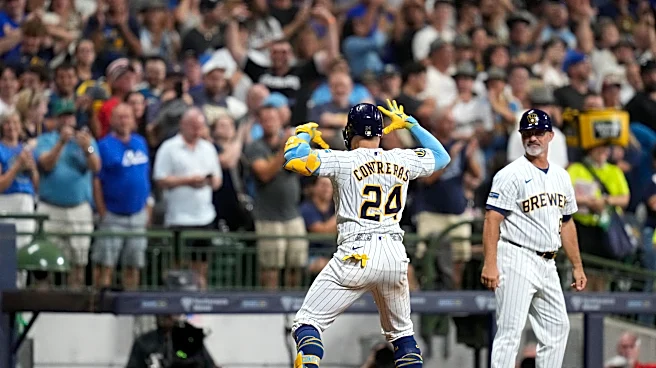
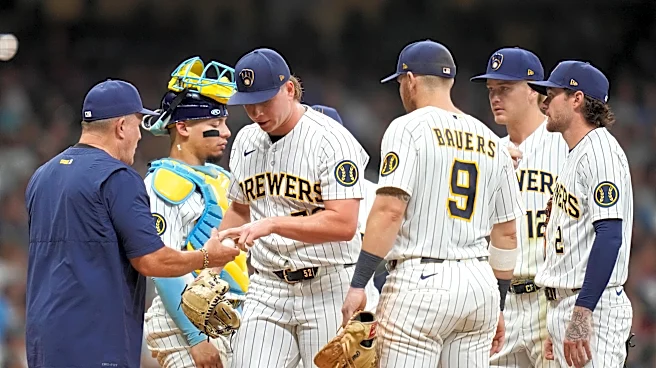
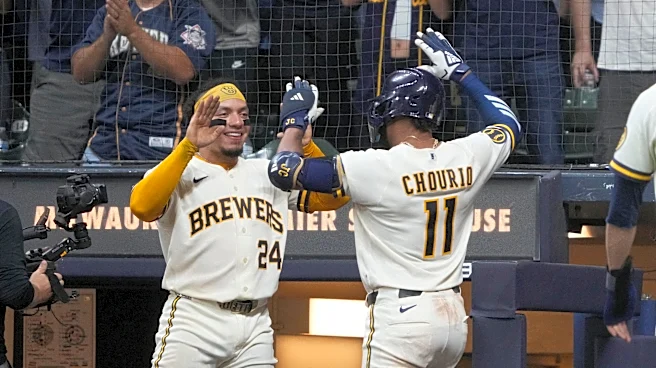
First, there is no denying that the team is blistering hot. Seven different Brewer regulars have an OPS of at least .942 this month: Brice Turang (1.224), Garrett Mitchell (1.067), Jackson Chourio (1.025), William Contreras (.997), Joey Ortiz (.988), Andrew Vaughn (.967), and Jake Bauers (.942). That’s just an insane team-wide two-week heater.
But the team looks different. After bringing up the rear in homers for essentially the whole season, the Brewers are tied for third in September with 19 in 12 games, enough to bump them (slightly) up the season-long leaderboard (they’re currently 28th, but just one behind a couple more teams). They’re also showing the kind of lineup-wide depth that could be crucial in the postseason.
This second point is the huge difference between their first-half offense and their second-half offense. In 57 games as a Brewer between the beginning of the season and June 14, Luis Rengifo hit .205/.280/.254. A week earlier, Joey Ortiz’s OPS dipped to its lowest point of the season, when after 53 games he was hitting .192/.295/.240. On the day that Rengifo played his last game as a Brewer, David Hamilton was hitting .231/.316/.320 over 198 plate appearances.
Let’s look at some slightly cherry-picked cutoffs for Brewer infielders in the first half of the season, all revolving around the departure of Luis Rengifo, who played his last game as a Brewer on June 14.
- Rengifo played 57 games as a Brewer and hit .205/.280/.254 in 209 plate appearances.
- On the day Rengifo played his last game as a Brewer, David Hamilton was hitting .231/.316/.320 over 198 plate appearances.
- A week earlier, on June 6, Ortiz was batting .192/.295/.240 in 149 plate appearances—his .535 OPS was actually slightly up from where it had been at the end of May.
Since then:
- Hamilton is performing only slightly better (.253/.306/.349) but his playing time is down: he’s played in 54 of 81 team games and accumulated 162 plate appearances (exactly two per game) versus 58 of 69 games and 198 plate appearances (3.4 per game) before.
- Ortiz is a completely different player. Since my cherry-picked day on June 6th, he’s hitting .307/.342/.495. Those are legitimate stud numbers: since that date he’s 38th in the league in fWAR, which doesn’t sound all that impressive, but he’s way behind most of the players ahead of him on that list in plate appearances.
- Cooper Pratt, who replaced Rengifo’s playing time, is hitting .273/.341/.369—basically league average—while providing way better defense.
Garrett Mitchell is part of this, too, even if he’s been fairly reliable all season. Since the beginning of June, Mitchell is batting .289/.362/.466 for an .828 OPS, and much of that time has been spent hitting in the back half of the lineup. The combined production of Mitchell, Ortiz, Pratt, and Luis Lara (who has been what I’d call “okay” but has been better than Sal Frelick was prior to his injury absence) has turned this into one of the toughest top-to-bottom lineups to face in the entire league, a stark contrast from the team of the first half and the end of last season which would often feature two total offensive black holes at a time.
Of course, it helps when your boppers bop. Here are some more offensive highlights:
- Jake Bauers, the metronome for this offense all season, had an OPS of .922 in May, .975 in June, .840 in July, .938 in August, and is at .942 so far in September. Remarkable consistency.
- Contreras’s OPS hit its low point on August 14th, exactly one month prior to when I am writing this. Since: .355/.417/.634 with six homers and eight doubles in 23 games.
- Aside from a tough July, Chourio has been quite good all season, but since August 1st he’s hitting .329/.390/.561 with 10 homers and eight doubles in 40 games; those are MVP level numbers, especially when considering how well he’s been playing in the outfield.
- Vaughn is down a bit from his excellent start, but he’s done an outstanding job staying productive despite inconsistent playing time. He hasn’t been quite as good as Bauers on the consistency front, but including Septemeber, Vaughn has an OPS of at least .957 in all of May, June, and September.
- Turang has had a wild ride of a season—he’s got two-and-a-half superstar months, two decent months, and one very bad month. But he’s trending up at the right time and is the hottest of all the hot Brewers in September.
- Even Christian Yelich is helping. His indicators have looked way better in the second half than the first, and in the last month he’s hitting .293/.355/.463.
There are still a couple weeks of season before the playoffs start, and heck, it’s entirely possible that everyone will look like dog poop again before the season ends. We should also acknowledge the fact that there are a lot of bad teams who are just going through the motions at this point in the season and a lot of good teams who are being protective of their pitchers, like the Brewers are currently. Setpember is not the month in which you face the stiffest competition.
But there’s no way to paint these recent developments as anything other than extremely encouraging. The Brewers have been a good offensive team all year but they often didn’t look like a good offensive team, if you understand what I mean. Right now, they look the part, and they’re doing so exactly when you want to.