



Inspiration.
A table in this AZ Snake Pit article listed batters with high impact PAs (that took the Diamondbacks from behind to either tied or ahead, and those PAs RBIs made a difference at the end of the game). The table was incomplete because it was posted on 8 September.
Data for this article from Baseball Reference and Baseball Savant.
The Complete Table for 2026.
The following table shows that of 47 come-from-behind wins, 25 involved high impact PAs.

Now that we have the complete list, let’s compare the batters with high impacts.
Who were the top impact batters in come from behind wins?
Ten batters
had the most impact in come from behind wins. This ranking was based on both number of games impacted and number of RBIs in those impactful PAs.

Let’s narrow our comparison to these impact batters. SLG is an important metric in RISP situations per this AZ Snake Pit article. Let’s look at SLG for two situations: PAs when either the tying or go-ahead run is on base, and all PAs with RISP.
Which impactful batters were the top ten batters (SLG) with RISP and either the tying or go-ahead runner on base?
The following table shows the top batters. Noorbaar and Fernandez each had better SLG than Carroll, who was outstanding. Tyler Locklear had too few PAs to be included.

Which impactful batters were the top ten batters (SLG) in all PAs with RISP?
The following table shows the top batters. Noorbaar and Vargas each had better SLG than Carroll, who was outstanding. Tyler Locklear had too few PAs to be included.

Which impact batters had the best SLG with the two types of RISP?
The following table provides a top-level view, without distracting details. Significantly, Corbin Carroll and Lars Nootbaar were top-five in each of the two types of RISP. Nevertheless, Carroll had much more impact in come from behind wins.

The Workhorse Batters: Which 4 Batters had the most PAs with RISP?
Interestingly, the four batters with the most PAs with RISP were also top-ten impact batters in come-from-behind wins. Their RISP PAs, and season SLG with RISP follow:
- Perdomo, 197 RISP PAs, SLG .263
- Arenado, 171 RISP PAs, SLG .444
- Carroll, 168 RISP PAs, SLG .511
- Moreno, 169 RISP PAs, SLG ..480
- Note: League average SLG with RISP was .408.
The following table shows that in June, workhorse batters SLG slumped in RISP PAs.

Why did batting with RISP slump in June?
Was it because opponents were hot-shots? Twenty out of 27 games were against opponents who ended the season below 500 on wins-losses. So, the opponents were not hot-shots.
And against those 20 teams with losing records, the Diamondbacks won 10 and lost 10. What did the opponents do? In June, in PAs with RISP, 48.9% of pitches were four-seam fastballs, sliders, and sweepers. In June PAs with RISP, against those pitch types their SLG was very low (.197, .042, and .083). My conclusion is that those teams knew how to pitch to keep SLG low (despite mostly having losing records).
Summary.
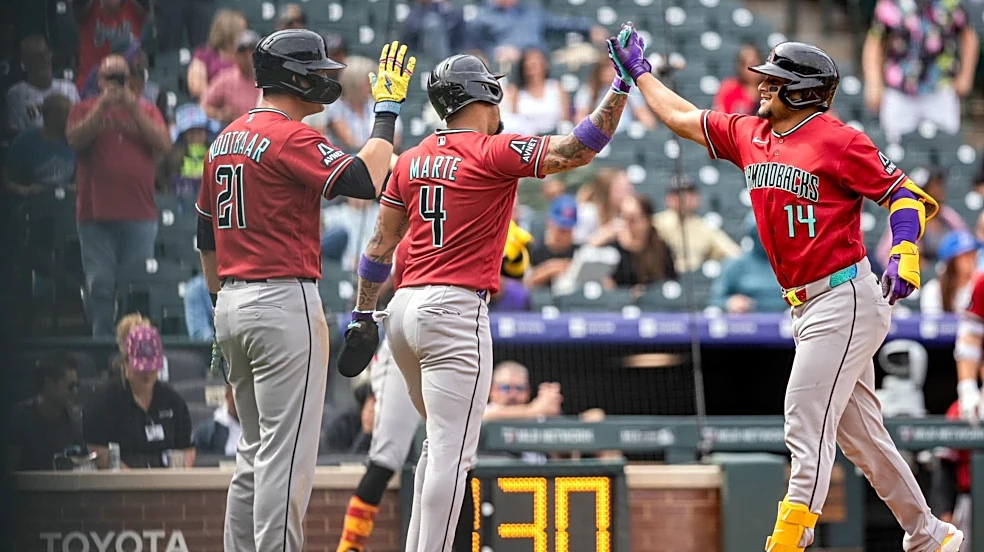
Of 47 come-from-behind wins, 25 involved high impact PAs in come-from-behind wins. Ildemaro Vargas had the most impact in come from behind wins, with Nolen Arenado ranking second. Corbin Carroll and Ketel Marte tied for third most impact.
Among the batters who made the most impact in come-from-behind wins, Lars Nootbaar and Corbin Carroll ranked in the top-5 Diamondbacks for two types of RISP. Surprisingly, Lars Nootbaar had better SLG with RISP than Corbin Carroll. Nevertheless, Corbin Carroll made a higher impact in come-from-behind wins than Nootbaar.
The four workhorse batters, slumped in June PAs with RISP PAs. In June, 20 of 27 games were against teams who ended the season with losing records. In June PAs with RISP, against 4-seam fastballs, sliders, and sweepers, their SLG was very low. Those teams might have known how to pitch to keep SLG low.