




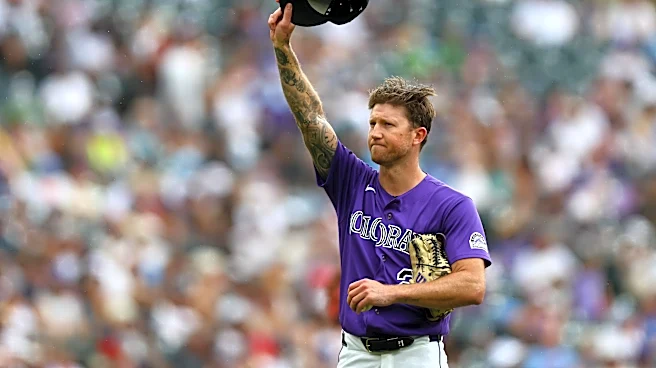
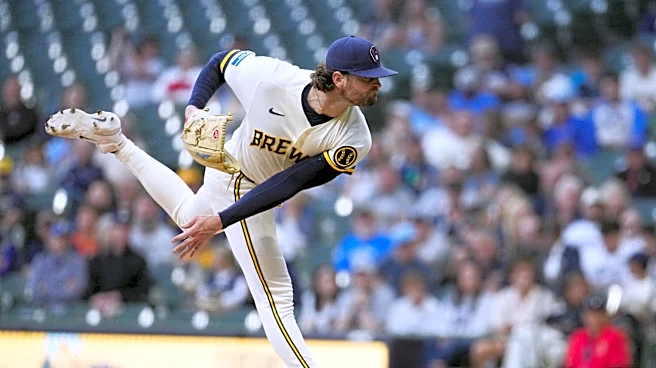
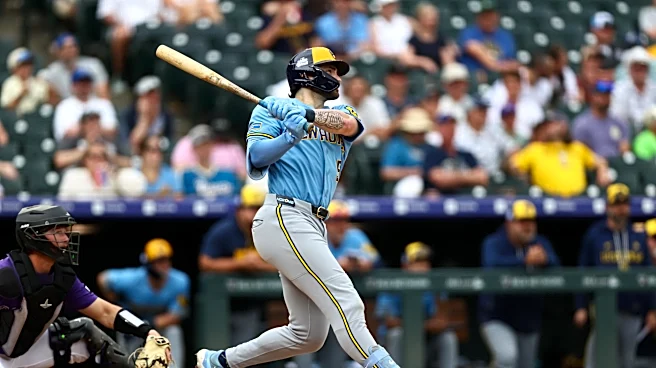
Note: the stats in this article were accurate through Monday; Pratt hit another homer on Tuesday.
When Cooper Pratt signed an eight-year, $50 million contract (with two lucrative option years) on April 3, a clock started. Pratt was no longer beholden to any concerns about team control, super two status, 40-man roster status, any of it. That’s all been sorted out.
This clock was for the players on the left side of the major league Milwaukee Brewers infield.
This was a known weakness coming into the season.
When the Brewers traded Caleb Durbin, Andruw Monasterio, and Anthony Seigler to Boston before the season, they opened up some holes. Despite offensive concerns, Joey Ortiz was still around to play shortstop, and Seigler, maybe, was never in the plan beyond providing some minor league depth. Monasterio played a utility role, and though he played that role nicely, David Hamilton, who came back in the trade, could probably make up for that loss.
The starting role at third base, though, was a question. Milwaukee’s minor league system is chock-full of tantalizing infield talent, but before the season started, all of Pratt, Jett Williams, Jesús Made, Luis Peña, and Andrew Fischer had a combined 151 plate appearances at Triple-A or higher. All of those belonged to Williams, and his OBP during that stretch was .285.
The problem
The kids weren’t quite ready, so Milwaukee made a move for a temporary solution: Luis Rengifo, a proven commodity, a 29-year-old with six years of MLB experience who was coming off a tough year but had a reasonable track record of success going back to 2022. It wasn’t unreasonable to think it would work fine for a year until someone showed they were ready for the big-league Brewers in 2027. My own analysis told me that Rengifo’s issue was less about hitting the ball hard than about needing to elevate the ball. If he could just hit more fly balls than line drives, he could turn back into a 15-homer guy and provide solid-enough offense for Milwaukee.
Well, it hasn’t happened. Rengifo’s exit velocities are largely in line with his career average, but the launch-angle aspect hasn’t come to fruition at all. There’s some bad luck in Rengifo’s season results: his BABIP is just .226, and his weighted on-base average (.243) is underperforming his expected number (.296) by more than 50 points.
But that xwOBA would still be the worst for Rengifo since he became a regular player in 2022. He has zero home runs. The doubles he was hitting at the beginning of the season have mostly dried up. What’s worse, arguably, is that he’s not offering any defensive value while all of this is happening. Rengifo, depending on whether you prefer looking at DRS or OAA, is either slightly above or slightly below average in the field. He’s passable, but he’s not good.
This might be an issue for the Brewers as a whole. I say “might be” because your preferred defensive stats will influence this conversation. By DRS, the Brewers rank eighth, which is actually a slight step above the 10th-place finish they had in 2025. But by Outs Above Average, Milwaukee, at -5, is 18th; they were third in 2025 at +33.
Rengifo is not solely responsible for that drop in OAA. Jake Bauers is way worse in 2026 than he was in 2025. Andrew Vaughn has flipped from +5 to -2. Sal Frelick has gone from one of the team’s best defenders (+7 in 2025, behind only Joey Ortiz) to neutral (0). David Hamilton weighs heavily on the Brewers’ OAA score — at -6, he’s the worst defender they’ve had in the last two years by this measurement. (This should be taken with a grain of salt, though; DRS quite likes Hamilton’s defense, and this accounts in large part for the Brewers’ gap between DRS and OAA).
The thing about all of those other guys (save for Frelick, who might be a discussion for a different time): they’re not all that easily replaceable. The Brewers need offense from Vaughn and Bauers. Hamilton is coming around offensively, offers a lot of value as a base runner, and the Brewers may very well believe that he’s a good defensive player (which wouldn’t be unreasonable at all).
The solution
In Pratt, the Brewers have a replacement.
Will he struggle when he gets the call? Probably. Pratt started the season badly at the plate, and he had just a 107 wRC+ at Double-A last season. But in his last 24 games, which covers exactly the last month, Pratt is hitting .301/398/.516 for a 143 wRC+. He’s striking out only 16.5% of the time and walking almost 13%. His wRC+ for the season was at 74 at the end of play on May 8; it’s now at 105.
And the thing about Pratt is that he could give the Brewers a huge defensive boost, not just because of his own ability but because of how the pieces would fall into place alongside him. His scouting grades give him a 60/60 fielding/arm score. People feel like he’s ready today to be plugged in at shortstop at the major league level. He might not be better than Ortiz, but he probably isn’t much worse.
My solution, then, would be to cut Rengifo, move Hamilton and Ortiz into a third-base platoon, and give Pratt the shortstop job. Hamilton is clearly better against right-handed pitching; Ortiz has reverse splits this season, but has been clearly better against left-handed pitching over the course of his career. If you believe DRS’s measure of Hamilton’s impact is more accurate than OAA’s, then you’ve vastly upgraded the defense at third base. A Hamilton/Ortiz platoon isn’t going to strike fear into opposing pitchers’ hearts, but it’s going to give you more than what Rengifo has this season.
Crucially, it paves the way for Pratt to play every day, which seems to be a major concern of management. It’ll probably be a struggle for a while at the plate, but when the guy being replaced has a 49 OPS+, I’m not all that worried about Pratt’s struggles. This is a rare move that works at two levels: it’s a pivot to the future, but it’s also a move that makes the team better today.
The case for haste
Look: I don’t like doing this. I’m acutely aware of the fact that baseball players are human beings, even if they are lavishly compensated for that work. I feel bad saying this. But the Brewers should cut their losses with Rengifo. They’re already on the hook for a $1.5 million buyout of a mutual option in 2027, and he has a clause in his contract that rewards him an extra $100,000 for every 50 plate appearance he makes at this point in the season (and more if he gets to 400+); that’s not a ton of savings, but there’s no reason Milwaukee should keep paying those bonuses. Rengifo is harming the team offensively, and he’s not helping on defense.
The Brewers are winning. That has afforded them time to wait and see if Rengifo turns it around. With the wins piling up, there’s no harm in that.
But there could be a form of harm later in the season, specifically in the postseason. It seems certain that at some point soon, the Brewers will need to come to the conclusion that Rengifo is not going to be who they want at the hot corner in a postseason series.
Maybe they think the answer is outside the organization. I’m skeptical. I haven’t really done my pre-deadline scan of the league yet, but I’m not expecting the Brewers to trade for a real difference maker at third base when they have the upcoming prospects that they have.
So if the answer is not coming from outside, that means it’s already here, and that means it’s either Pratt or Williams. Williams is struggling. Pratt is improving. The longer the Brewers wait, the less time Pratt will have to adjust to major league pitching, and the less prepared he’ll be for a potential postseason series. It’s time to make this happen.
A quick post-script
Given that Luis Lara signed a contract similar to Pratt’s after I had already done much of the research for this piece, I do feel it’s necessary to address his situation at least a little bit. Lara is now in line to come up to the big leagues if there’s any immediate need, but I don’t see it happening unless something else happens first. For one thing, Lara’s track record is far shorter than Pratt’s.
There’s also an issue of playing time. Garrett Mitchell has been good lately. Frelick hasn’t been, but he’s a favorite of the manager, and he was a three-WAR player last season and a Gold Glove winner the year before. Blake Perkins will be sent back to the minors as soon as Brandon Lockridge is ready to return, and if what Murphy said about Pratt is true — that they don’t want him in the big leagues unless he’s going to play regularly — then one would assume that would also be true of Lara, and he would thus not fill a soft-side platoon role in the majors. (Lara is also a switch-hitter, which complicates things; he’s better from the right side, so could conceivably do a loose platoon with Frelick.)
If Mitchell (or Jackson Chourio) gets hurt again, Lara will be up. If Frelick is still rocking a 70 OPS+ in August, then Lara will probably be up. But I think Mitchell and Frelick have earned some patience here that Rengifo has not, and this is why I’d make the Pratt move immediately and save Lara for later.