
Special thanks to Jonathan Schopp, contributor emeritus to Spartan Nation, for joining this week’s podcast to discuss Michigan State’s roster:
The hard luck at Michigan State has been astonishing. The Spartans have played four quarterbacks this season with the starter out for the year and the main backup questionable, have been without their best running back for most of the year and have recently lost 2nd and 3rd string backs, lost their top tight end two weeks ago and the backup is questionable this week,
have had repeated injury absences for their left guard who’s the best of the three-guard rotation, lost by far their most havoc-generating defensive tackle two weeks ago, spent almost the entirety of the season without all three of their top linebackers and are still without the best one who’s the most talented player on the team, have been out their top three cornerbacks for the majority of the season, and just lost their starting strong safety and possibly nickelback as well.
This was on top of a coaching change which, as is typical, brought about some roster churn, and even at the positions where injuries have had the least effect, there was something of a depth-of-talent cap and some questionable offseason unit management decisions already observable early in the year against their two weaker non-conference opponents.
There’s also something … peculiar at the administrative level for Michigan State’s hiring and firing, player eligibility, and financial decisions that simply doesn’t add up. Jon and I have been circling around it during our last few podcast conversations; unfortunately, resolving it remains out of reach until we learn more and at any rate it’s beyond the scope of article. For our purposes this week it suffices to say to any reader who’d leaned about MSU’s recent record-breaking donation and might have figured roster help was on the way for that reason: not this year.
Yet for all of those things, it’s clear to me from reviewing the Spartans tape that this is a solid, well coached, fundamentally sound team. With few exceptions, they’ve been in every game through the 4th quarter and it’s only been that spectacular combination of injuries that’s let game after game slip away from them – specifically that the offense hasn’t been able to put opponents away by scoring when MSU has had them on the ropes, and the undermanned defense can’t rally the last time in the 4th quarter to keep the opponent off the scoreboard. This same Spartans team with average injury luck is likely a bowl team; if they had the same kind of amazingly good luck that certain other teams I’ve recently studied enjoyed then they might have eight wins with a season-defining victory over Notre Dame.
Offense

In 2025, the previous MSU staff eventually benched starting quarterback Aiden Chiles for #10 QB Milivojevic; the latter finished the year with a comparable number of meaningful pass attempts and half a standard deviation better in NCAA passer rating (that’s a long story to unpack, for now I’ll say I don’t think either QB has had ideal development circumstances for his skillset before or since, but the switch was better than doing nothing, as was Chiles’ transfer to Northwestern).
In terms of QB error rate, a stat I track when charting failed dropback passing plays, Milivojevic likely would have exceeded FBS median passer rating in 2026 if not for mismanagement of the offensive line and wide receiver rooms during the coaching transition – constant pocket breakdowns and no separation for even outlet receivers to get rid of the ball to led to a high number of smart but stat-killing throwaways, and Milivojevic isn’t a super mobile scrambler.
At several points during the season, either as part of a deliberate plan or as relief for Milivojevic for some issue (it was often difficult to tell, the timing of Milivojevic’s absences and returns line up best with a recurring UCL sprain on his throwing hand, which has delayed effects), 6th year senior #2 QB Fancher played part or all of a drive. I think it was always the plan for Fancher to come in for one-off gadget plays as a running QB with the ability to pass as we saw one of these as early as the 1st quarter in the opener.
Both the one-off plays and the series-long play for Fancher continued each game until the 3rd quarter against Wisconsin in week 5, when he took a pretty scary hit and missed the next six weeks, not appearing again until last Saturday against Washington. True freshman #10 QB Coffman finished out the garbage time snaps when Milivojevic sat out the end of the blowout against Wisconsin, and Milivojevic played every snap of the next two weeks against Illinois and Northwestern. Evidently Milivojevic injured or re-aggravated an injury to his thumb during week 7’s game, because he missed all of the week 8 game against UCLA.
With Fancher still out from the Wisconsin hit, Coffman started that game and played through the middle of the 3rd quarter until taking a sack which rattled both him and UCLA edge rusher Ryan McCullough. Redshirt freshman #15 QB Hannan played the rest of the game — 21 meaningful plays over the last two quarters — as the fourth MSU quarterback to see action this year.
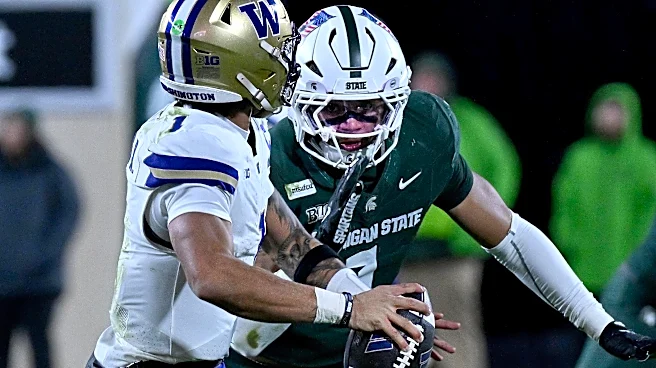
After the bye week, Milivojevic returned and played in the entire rivalry win over Michigan, with a protective sheath on his throwing thumb. He played halfway into the 2nd quarter the next week against Washington, when in an unfortunately familiar sight, an opposing linebacker de-cleated Milivojevic on a scramble and celebrated like he’d just won the Super Bowl while the prone quarterback took a quite while to get up. Fancher was ready to play again and finished the rest of the game, with the exception of a three-and-out series which Coffman played after Fancher took a temporary ding trying to escape a sack and throw the ball away, which turned into an interception.
This table shows how the passing and rushing offense, using normalized data controls from charting, was affected with the different quarterbacks in. Because there weren’t enough individual reps on Coffman or Hannan but their numbers strongly suggested similarity if the low-sample noise could be evened out, I’ve combined their reps into cumulative figures:

On this week’s availability report, Milivojevic is listed as out, and even if he hadn’t been Jon’s argument on the podcast we recorded on Monday was persuasive to me – there’s no upside and significant downside in him playing. Fancher is listed as questionable.
Jon contends that, as Friday’s game is Senior night, and next week’s game at Rutgers is not only winnable but an opportunity with nothing to lose for the staff to play younger, possibly more talented guys and see what they’ve got in order to plan for next year – and as they’ve been eliminated from bowl contention, that’ll be their last chance to do so. It’s an elegant setup, and irresistable sentiment: honor the past on Friday by playing the seniors, look to the future next Saturday by playing the freshmen (Jon and I made some prop bets about how mnay freshmen and which QBs during the podcast, which I realized too late obligated me to be among the dozens tuned into that game).
I think this logic will obtain for several units where, from a purely odds maximization standpoint, we might otherwise have seen some reshuffling. Jon’s answer every time, and I think he’s right, was that this probably will happen, just next week against Rutgers, not Friday against Oregon. The upshot for the QBs is that if Fancher is ready to play, then he as a 6th year is likely to get the start over the much younger Coffman or Hannan.
Here’s a representative sample of Fancher on called passing plays throughout the year, with targets restricted to players likely to be available:
If Fancher is not available, the staff has made clear their next go-to is Coffman. I think, although it’s been on a very limited sample of tape, I might go with Hannan if I were picking purely on arm talent. Here are a couple of representative reps with likely available surrounding players for Coffman (#10, first two clips) and Hannan (#15, third and fourth clips):
Tight Ends

Surprisingly, the tight end who took over the room was #31 TE Savoury, a redshirt freshman and former basketball player who’s relatively new to football. For most of the year, Savoury was the second-most targeted pass catcher on the entire offense, just ahead of each of the outside wide receivers. But after a late catch in the UCLA game, Savoury has been unavailable with an injury and is listed as out this week.
#82 TE Parachek’s career at MSU has been snakebit, he was a highly rated recruit in the 2023 cycle with a great frame for the position, but instantly eclipsed when the previous staff arrived with Jack Veling in tow, then spent last year in-and-out and ultimately took an injury-related redshirt. 2026 looked to be his breakout year, but Savoury stole his limelight, and with only 10 targets and very poor blocking grades, it’s difficult for me to evaluate his impact. He’s listed as questionable on this week’s injury report.
I expect we’ll see a step up for #88 TE Rios with Savoury out, given that OC Sheridan — himself a former TE coach — employs 12-personnel quite a bit. But if Parachek can’t play, then it’s likely to be nothing but Rios – in the videos above, he’s targeted on the first clip shown. Some of the other tight ends and fullbacks who have appeared in garbage time or previous seasons are also on the injury report, so the next most likely player to appear for 12-personnel sets is the fullback who’s officially listed as a tight end but who’s had far more carries than targets, #12 TE Gulker.
The figures for everyone in this unit denote possession players, success rates in the 60s but yards per play numbers under 5.0 (for Gulker it’s 2.8, as he’s really just a FB dive player). Only Savoury had the field-stretching plays that would make throws to anyone in this unit worthwhile outside of short-yardage or goalline situations, and even then Savoury had a puzzlingly high level of incompletions.
Wide Receivers

This has been the oddest unit on the team to statistically parse. I think the bottom line is that there’s not enough raw talent in the room, and the staff erred — or had their hand forced by mysterious campus powers — by not acquiring more during the offseason to give themselves more chances.
The most targeted player is the slot receiver for the last couple seasons, #13 WR McCray, a former 2-star from Kent State. His 52.8% per-target success rate and 7.27 adjusted YPT are a notch below FBS medians for a leading wideout, and none of his numbers really change regardless of the QB throwing him the ball.
That kind of stagnation is analytically unsupportable for a top target and cries out to try someone else – the bottom four receivers, all youngsters by comparison, have only 13 meaningful targets between them or 8.13% of WR targets, but cumulatively are the best “receiver” on the team at a 64.3% success and 9.54 YPT. Those are #17 WR Collier, #5 WR Gash, #8 WR KK Smith, and #19 WR Taplin; Jon and I discussed them on the podcast and sure enough, we have a prop bet about them playing against Rutgers next week. Jon’s pretty sure the redshirt-senior McCray will continue to get the start and lion’s share of the targets Friday night.
Michigan transfer #6 WR F. Moore plays on the outside receivers, and at 6’1” is the only thing close to a reliable and sort of tall outside target. He has the best per-target success rate in the WR corps at 60%, though like McCray his YPT is a below average 7.29. Still, with numbers like that Moore is by far the best option to move the ball of anyone on the team who’s not on the injury report this week; he really should be getting something like a 50% increase in targets if the staff were rational.
#3 WR Bullard is a former Div-II transfer MSU had to fight a court battle over this offseason. His numbers are underwater at 48.7% success and 6.39 YPT. Commentators on broadcasts have repeatedly called him the team’s burner but I think that’s the anchoring effect based on a couple of big catches in the non-con, during conference play he’s been targeted 15 times and has no explosive plays. He also plays out of a weird spot, he’s 5’11” and lines up as the X-receiver, since they don’t want to bump McCray out of position, but he can’t really win contested catches so everything is trying to win with separation by speed.
Bullard is listed as questionable on this week’s availability report. Although it’s macabre to say, I think the most likely beneficiary if Bullard can’t play is the fourth wideout, #14 WR B. Williams. That’s because Wiliams’ quotient of targets is a lot higher than Bullard’s whenever any of the backup QBs are in, and because at 6’2” he can play outside receiver with access to a full range of routes. Williams’ success rate is awful, though it’s potentially misleading because it comes down to 11 incompletions of which two were clear pass interference fouls by Michigan the Big Ten officials overlooked and one was an illegal throw by Coffman.
At any rate, even with a poor success rate Williams’ YPT at 8.33 is the single highest on the team, indicating a boom-or-bust player – of his seven actual catches, one was a touchdown and five were for 20 to 35 yards apiece. That all indicates a substantial opportunity for growth in the redshirt freshman. In the video compilations above, Williams is targeted on the last clip shown.
Running Backs

OC Sheridan’s offense hasn’t changed its tendencies even as the running back unit goes through some of the worst attrition I’ve ever seen. It remains a run-first and rush to stay ahead of the chains offense, desperate to avoid their nightmarish 23.5% 3rd & long passing conversion rate and eager to exploit their 86.4% 2nd & short rushing conversion ability (it’s 65.2% on 2nd & medium, and 20 percentage points than their passing efficiency in the same situation, so their early down rushing logic extends all the way to 2nd & 6).
In addition to the lunacy of forgoing “money down” 2nd & short shot plays which makes me want to strap every Big Ten OC to a Clockwork Orange-style chair and force-read passages from Theory of Games and Economic Behavior, the major problem with this early-down rush preference is the very low YPC and explosiveness rates from Sheridan’s backs in 2026. Even with relatively high success rates in the early-down run game, they are crawling down the field and would need 14+ play possessions to achieve full-field touchdown drives, which is not sustainable for college offenses.
This natural condition is exacerbated by their late-down approach. MSU’s rush and pass efficiency flip completely on 2nd & long — 37% rush success, 62% pass success — so they should only be rushing about a fifth of the time just to keep defenses honest in that situation. But true to just about all Big Ten offenses they run excessively on 2nd & long by nearly double the analytically justifiable rate. When they hit 3rd & medium they become completely one-dimensional and pass only, with a success rate of just 36.4%, a full standard deviation below FBS median, and the same is true of their 3rd & long tendency and conversion rate, mentioned above.
I believe this is the stuff Jon was talking about on the podcast when he said he thought Sheridan wasn’t ready to be calling plays at this level and he’d like Coach Fitzgerald to move on. I understand the point, though I also understand falling into something of a defensive crouch when this much is going wrong with the offense. They lost the back with by far the best combination of success rate and explosiveness in #0 RB Edwards with only four games played, #4 RB Patterson has missed the last couple games and is still listed as questionable, and a potential breakout player who had an intriguing freshman campaign before transferring in #21 RB Parrish was just listed as out this week.
Everything has been going to two backs lately, #7 RB Tullis who at this point I would characterize more as the workhorse — although he’s really more of a short-yardage guy, he gets 3 yards no matter whether it’s 3rd & 1 or 1st & 10 — and #32 RB K. Williams who’s bounced around and has the profile of a boom-or-bust runner with several chunk yardage runs but a lot more stuffs. Williams’ numbers come out very poorly, 36.7% success and 3.93 YPC, but if anyone gives them even a shot at hitting a long run it’s him.
Here’s a representative sample of successful runs by Williams and Tullis:
And their unsuccessful runs:
Offensive Line

With the exception of taking #63 C Fraley, the 2025 Rimington trophy winner from North Dakota State (he’s effective and by far MSU’s best lineman, but Fraley wasn’t actually the best center in the country last year; as is typical for awards in the trenches this was a sentimental rather than analytically defensible selection), just about every decision made in managing the offensive line was botched by new OL coach Tabacca, in my opinion.
Tabacca had inherited a lineup from former OL coach Jim Michalczik that, with the addition of Fraley, would have been perfectly viable and vastly superior if he had simply left it alone. Those returners are #54 OL A. Johnson, #55 OL R. Johnson, #58 OL C. Moore, #60 OL Vincic, #73 OL Young, each of whom had extensive prior playing experience with each other, three of whom are cross-trained at guard and tackle. Tabacca had multiple viable options to play a 4-homegrown line with a sixth man who’s also a homegrown.
Tabacca took three more transfers in addition to Fraley and has played everyone, but in a total mess. Young he relegated to depth, A. Johnson is now only the jumbo package player and accomplishes little, and the guards and tackles are both on three-man rotations since it wasn’t apparent to him that at every position the transfers #75 LT Murawski, #52 RG Sharpe, and #71 RT Wright have been inferior to the guys they’ve replaced and ought to be pulled from the rota.
The injury issue they’ve dealt with this year — Moore missed most of the week 4 game against Nebraska, and was hurt again on a pretty nasty hit while blocking a screen pass downfield last week against Washington and is listed as questionable but Jon and I both think that should bave been doubtful — has been dealt with by that guard rota. That is, Sharpe moves from RG to LG, and Vincic comes in to fill the RG spot.
The tackle rota has been that Murawski starts out at LT, and at some point in the 3rd quarter goes to the bench and stays there the rest of the game. R. Johnson moves from RT to LT at that point, and Wright comes off the bench to fill in at RT. Murawski is not as good as Johnson is so the left side gets stronger, but Wright is such a step down that it’s a net loss in pass protection and one of the easiest reasons to trace why the team stops scoring points late in games and allows opponents to steal wins.
While scrimmage-based negative plays are very high for MSU this season — during meaningful play it’s 20 TFLs, 19 sacks, 7 fumbles, 6 INTs — they’ve kept the overall negative play rate at about the FBS median at 11.87% because the line’s rate of generating penalties is pretty low, just eight procedurals and eight holding flags on the season, fewer than one of each per game.
Defense

My estimation of DC Rossi has grown over the last five years; he’s always coached a fundamentally sound, conservative 4-down defense predominantly playing zone coverages with at least two high safeties, focused on taking away explosive plays. But I think he’s adapted well to new challenges and seen through a lot of the tricks that most of his Big Ten contemporaries fall for. This year with the number of injuries he’s had to deal with he’s done perhaps his best coaching job yet to keep the entire team in games up until the very end, in many ways by playing more aggressively than I think he’d like to in order to cover up a lot of inexperience in the defensive backfield.
The strength of the defense — if for no other reason than because it’s had fewer players out with injuries — is the front, and compared to previous seasons I have charted of Rossi’s at Michigan State and Minnesota before, 2026 has seen more pressure packages and 3rd down blitzing to force the issue. There’s a massive disparity in the 3rd & short vs long pass defense numbers — a delta of 26 percentage points — as they have elite effectiveness at 71.5% on 3rd & long but are badly underwater on 3rd & short. That’s what Rossi is trying to cover up with blitzes, a secondary that’s too banged up to effectively cover on their own without QB pressure.
They really pay for it in any short yardage situation against the run, with under 25% defensive success rates, but the tension is overwhelming on 2nd down because they’re equally under 25% against the pass on 2nd & short and 2nd & medium. That means if offenses have any kind of success on 1st down, MSU is in deep trouble – the offense can either run to convert, or better yet, take a shot, and if they miss run to reliably run to convert on 3rd down. Offenses can even extend the logic a second time since MSU is no better at defending 4th & short, and take shots on 3rd & short against a 45% pass defense with a near-certainty of pressure coming and a void to fill.
Where it gets tragic for Rossi’s defense is the 4th quarter, when fatigue in the front begins to set in and Rossi starts running low on stunts to pull with the front so as to run interference for the secondary. Week after week I’d observe the same pattern: MSU would keep a lid on the opposing offense through three, even into the early 4th quarter, but the opponent could afford to wait them out since MSU’s own offense wasn’t scoring, and when the QB got a clean look at a depleted and very young secondary, he’d hit them with a heartbreaker:
The reason that MSU stays away from this death spiral for as long as they do is an excellent defensive performance against efficiency rushing on 1st downs, at over 60% defensive success rate (meaning only 40% of the time that opposing offenses run on 1st down, those offenses get ahead of the chains and can therefore access the above vulnerabilities). MSU is just so-so against the pass on 1st down, but Big Ten offenses have acted like they don’t know that, and run right into the teeth of the Spartans’ defense on 1st down over and over, putting themselves behind the chains. MSU is very good regardless of play selection on 2nd & long, above 55% defensive success, and that’s how they get opponents into 3rd & long and thus punting situations.
My predictive algorithm suggests that offenses still need to rush about a quarter of the time on 1st down, and 15% of 2nd & short/mediums, just to keep MSU from assuming pass and bringing pressure regardless, but that otherwise a strategy of ‘pass whenever you can, run only when you must’ is optimal.
Defensive Tackles

Unfortunately, the most effective tackle, former Oregon transfer #55 DT Roberts, has also missed the most time with injuries this and last year. He missed the last several weeks, then at the last minute was listed as available against Washington last week, and got in to play a tiny number of trivial snaps. This raised Jon and my expectations that this was a trial for him to make his return on Friday, so when he was marked as out it was pretty disappointing. Roberts is all over the tape, and is one of the main reasons why I wasn’t able to publish this article a day early as I’d hoped to – I had video compilations prepared which needed to be revised and re-processed with the new injuries listed, and Roberts’ absence caused major revisions.
The other 1st line player, #96 DT Coenen, also gets pretty high grades, but is much less of a penetrator – he has effectively the same level of havoc generation in absolute numbers, but with nearly double the rep share at this point. The two 2nd line players and the backup, #52 DT Beeler, #98 DT Simmons, and #25 DT Simmons, respectively, are a step down in terms of effectiveness, but not a giant one, and they’ve dealt with this situation before, with the experience and numbers to still complete a four-man rotation.
Defensive Ends

This is the one unit on the team unaffected by injury (knock on wood). I think it also has the most effective of any of the non-injured players on the team, #1 DE Soares, a quality edge rusher and former linebacker for Coach Fitzgerald who did a gap year at North Carolina State after they both left Northwestern. Soares plays far and away more than anyone else, as well as generating more havoc. There’s then a step down in terms of playing time to #11 DE Lafaele, though he keeps the havoc rate per rep relatively high, and the staff keeps him in at a pretty consistent level throughout the year so I’d simply call him the other 1st line DE beside Soares.
It gets … weird after those two. The three remaining defensive backs rotate in with a pattern which is basically random and doesn’t align with the injury reports. Since none of them are really generating havoc, the theory I put to Jon on the podcast — and he agreed it makes as much sense as anything else — is that #9 DE Thompson, #13 DE I. Smith, and #8 DE Lisle are being used in different experimental combinations, as part of different 3-, 4-, or 5-man rotations every week, in an attempt to find some kind of chemistry that would let them be effective, and not finding anything yet. Here’s the heat map of rotating rep shares to show just how bizarre this has been:

The one they haven’t tried yet is a 3-man rotation of just Soares, Lafaele, and Smith, so I’ll guess that’s up next.
Linebackers

The most significant cause of the crash in short-yardage defensive efficiency has been the unprecedented simultaneous injuries to all three of MSU’s top linebackers, the most significant being #5 LB Hall who’s been out almost the entire season and is perhaps the entire team’s most talented player. Each of the other two top backers, #45 LB Pretzlaff and #44 LB Wheatland, have missed two full games, as well as diminshed rep counts in such large swaths of other games that they effectively add up to two more missed games’ worth.
The way these injuries overlapped meant that from the middle of week 4 against Nebraska up through week 10 against Michigan, MSU had to rely on at least two and sometimes all three of their backups, #18 LB Crawford, #12 LB Stodghill, and #10 LB Malone. There’s a pretty major stepdown involved. The effect of just replacing Hall with the most frequently played of the backups, Crawford, something which will necessarily persist with Hall out, can be traced to a 12 percentage point drop in situational defensive efficiency.
Pretzlaff and Wheatland over the last two weeks seem to be back to full go again, and Pretzlaff in particular took a strong roll in shutting down UW’s run game. But they haven’t really moved the needle in terms of the down & distance numbers – MSU continues to be strong on 1st down and long yardage, weak on short and medium yardage.
Here’s a representative sample of MSU’s successfully defended rushing plays featuring likely available personnel:
And unsuccessfully defended rushes:
Secondary

The major, structural, and year-long effect has been the injuries starting in week 4, worsening in week 7, and lasting all the way through week 11, to the top three outside corners: #3 CB Bell, #4 CB Brantley, and #22 CB Chappell. The redshirt-senior backup #0 CB Burt was also unavailable during some of this time, making the situation truly dire — it was nothing but completely inexperienced freshman and sophomores for a while there — but Burt recovered and has been starting since week 7. The true freshman #24 CB Favorite has had a very rough go, in fact three different opponents broke ties and pulled off late game wins by throwing exclusively or nearly so against Favorite (to the point that I grew reluctant about making truly representative clip compilations, as I don’t like making videos picking on a single kid).
Chappell is marked as out on this week’s injury report, and Bell is questionable. Brantley was marked lifted from the injury report last week and briefly appeared against Washington, but without any serious play. This occasioned quite a bit of excitement among those covering MSU, but Jon was wiser and predicted all of them would be out until we got a definitive all-clear, not this tepid implication, following Roberts’ example.
The free safety has been a five-year starter, the first two at UCF, #21 DB Martinez. He’s been the only steady presence this year, though he’s never gotten elite grades on my sheet, I think MSU will take anything they can get at this point. For the last two weeks the starting strong safety, #2 DB Vaught, an FCS transfer, has been out, and he remains listed as out this week.
The backup to both Vaught and starting nickel #7 DB Richard is #30 DB Av. Grose (longtime fans may remember his older brother was also a prominent DB at MSU, Oregon faced both brothers in 2024). Richard hasn’t been out with injury before this week, though he is listed as questionable on this week’s report. In the past, when Richard has rotated out for fatigue relief, Grose has filled in for him, and when Grose was unavailable because he was filling in for one of the safeties, then they’ve put in 6th year walk-on #34 DB Majeed, and last week against UW true freshman #17 DB Granby.
In my opinion, Grose is better as a backup nickel than safety, and there’s a double whammy because pulling Grose out of the nickel spot if Richard is unavailable and filling it with Granby was an even more problematic combination. UW really went after those two when they had a chance. The sheer number of injuries with limited viable options to back them up inevitably creates these shortages and rushes freshmen in to play – this is the vulnerability in the back end which DC Rossi has been tap dancing so hard to cover up with pressures in the front. When the music stops, it gets real quiet.
Here’s a representative sample of successfully defended passing plays with likely available personnel:
And unsuccessfully defended passes: