
I don’t necessarily intend to write about players I don’t think the Cardinals will ever get. It feels like a waste of time. But well, I don’t know who I could write about if I focused on players I thought
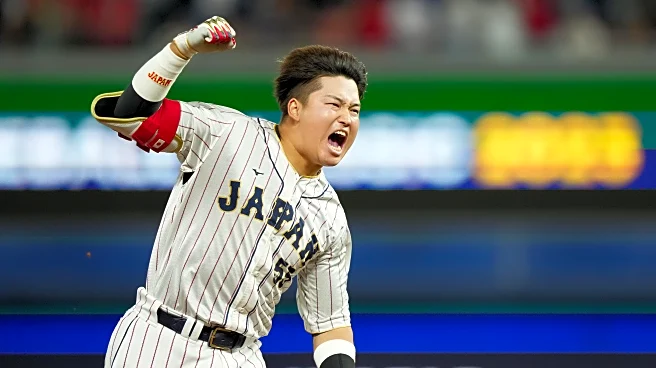
the Cardinals might get. It’s a short list and most of the list aren’t very interesting players or difference makers. But I think I can justify talking about Munetaka Murakami. Because if the Cardinals are believers in him, he should be a free agent target.
All due respect to Nolan Gorman, all due respect to Thomas Saggese, to Jose Fermin, maybe even to Alec Burleson, Murakami is the kind of guy who pushes them all to the side. Well let me rephrase that. Murakami at his potential is the kind of guy who can push all of them to to the side. Who Murakami actually is, well it’s up for debate. Let’s dig into his profile to see if it will make sense to try to sign Murakami.
The traditional stats and the basic advanced stats are eye-popping, but even these come with concerns. He batted .273/.379/.663 for a 211 wRC+ in the Nippon Professional Baseball league. He only played in 56 games however, but in those 56 games, he hit 22 homers. And lest you think this is a fluke, he hit 56 homers en route to a 225 wRC+ in the past. Had he been a free agent then, he probably would get $500 million in free agency, and I don’t think I’m exaggerating.
So what changed? Well, he strikes out a lot now and he didn’t then. Back in 2022, when he posted his career year, he struck out 20.9% of the time. Last year it was 28.6% of the time and again, it was a three-year trend, because he followed the 2022 season with a 28.1 K%. With this kind of power, that’s a strikeout rate that’s manageable. Except that wouldn’t be his K rate in the major leagues most likely. We’ll get back to that.
Scouting-wise, they don’t like his defense. He is widely expected to have to move to 1B. “Murakami’s a third baseman now with good enough hands for the position but limited range, and he’ll probably end up at first base when he signs,” says Keith Law. And that’s downright optimistic compared to what Baseball Prospectus wrote about his defense: “He’s also probably not a third baseman at the major-league level—Vlad Guerrero Jr. feels like a good comparison point for where he is on the defensive spectrum—and there’s only so many spots to put those guys, particularly if it takes him time to acclimate to MLB pitching.”
So right off the bat, we’re not starting at a very good place. Obviously, Willson Contreras will need to be traded for Murakami to sign with St. Louis, but that doesn’t seem like a huge roadblock anymore. It would be annoying to once again not allow Alec Burleson to play 1B, but you don’t not sign Murakami because Alec Burleson is in the way. That would be idiotic. If only defense were his only concern.
Bradley Woodrum, back in August, wrote an article looking for the next great NPB hitter. He used to work for the Marlins and was tasked with creating a model for east Asian players translating to the MLB. He was a big proponent of signing Yoshi Tsutsugo, but Tsutsugo had a very big flaw: he struck out a ton against high velocity pitches. It was not a large sample and he actually had a 147 wRC+ against 94 mph and up, but he struck out 43% of the time. So he adjusted his model to account for the fact that not being able to hit high velocity kind of makes it impossible to be a great hitter in the MLB.
As good as the competition level is in the NPB, they don’t throw hard. As Woodrum points out, this affects more than just fastballs. You’re not seeing 89 mph sliders in that league. He said that in the data set that the Marlins had at the time, your average position player in the NPB only saw 20 to 30 pitches that were 97 mph or more in an entire season – and it might have been from the same pitcher. It might be better now, but you’re still not seeing anywhere near the same amount of high velocity pitches.
From 2023 to 2025, 110 plate appearances ended with a high velocity pitch thrown to Murakami. He had a 196 wRC+… with a 40% K rate. This is a double-edged sword. The very nature of it being 110 plate appearances across three years makes it an untrustworthy sample size, so you could reasonably justify that he will adjust when high velocity is not a rare occurrence. At the same time, since all the pitchers will be faster on average, he’ll have less time to react. And he already strikes out a lot.
Back to the model Woodrun created, he created what he calls the simple model, which attempts to translate how they perform from the NPB to the MLB. He incorporated just two elements, hence the name, which was wRC+ and K%. Murakami’s MLE according to this is just a 94 wRC+ at the MLB level. As a comparison, Masataka Yoshida’s 176 wRC+ in the NPB was supposed to translate to a 115 wRC+. Which is close enough honestly, given that he had a 116 wRC+ in his 2nd year, his 3rd year was marred by injuries, and his career wRC+ is 109. Circumstances have caused him to perform worse, but I think it’s a fair assumption to think that when he signed, he was a 115 wRC+ hitter in the MLB.
And then he created a more complicated model, which incorporated K%, BB%, and slugging percentage, which apparently translated pretty well to their in-house model, DRC+. He was affected more negatively by this, with his stats translating to an 87 DRC+. Yoshida, by this same metric, had a 107 DRC+. But these stats were based on Murakami’s career, and when Woodrum focused more specifically on the past three seasons of data, the simple model produced a 108 wRC+ and what he calls the component model produced an 82 DRC+. He averaged them out and came up with a 95.
This whole profile feels like a good risk for a contract he will not be getting. Granted, every team can see the same thing we can see and maybe his contract will end up surprisingly low. But Ben Clemens projects 7 years, $154 million and the crowdsourced guess is 6 years, $132 million. It’s not my money, but the risk feels way out of proportion for that type of contract. He’s not going to add any value with his defense and because that, it’s all completely dependent on his offense. If I’m seeing a model that says he will have a 108 wRC+ with poor defense, that’s not a very valuable player, certainly not one worth $150 million.
In fact, I’d go as far as to say when you compare him to Nolan Gorman, why not just stick with Gorman? Admittedly, he doesn’t have the upside of Murakami, there’s no question about that, but Gorman will get paid roughly $3 million. Then you can move on from him if he fails. And it at least seems like he plays better defense than Murakami, at least if it’s true that he’s Vlad Guerrero at 3B. I’m guessing, just based on that comp, that Murakami won’t be adding any value on the basepaths either, probably costing a couple runs in fact. He has fairly poor success rates when attempting to steal in the NPB.
I’m making the Gorman comparison because… he kind of seems like Gorman to me. Perhaps a carbon copy. Murakami is fairly likely to run a K% in the 30s, there are questions about his defense at 3B, he will be 26, he is left-handed. Obviously, performing poorly at the MLB level and performing VERY well at the NPB make your hopes different, but the projections seem oddly similar. And anyway, I’m comparing him to Gorman even though he might be destined to play 1B, where he seems pretty easily trumped by Burleson.
Why would any team sign him for $150 million? Well Shohei Ohtani had some of these same concerns honestly. He struck out about 27% of the time before he got to the US and that has translated into a 25% K rate in the majors, though it did start at 27.8%. Ohtani was also 22 and this guy is 25. There’s going to be a team that thinks he’s a unicorn, that it will take a small tweak to his batting approach. As Law says, “I’m also concerned about his ability to get to hard stuff in, given where his hands begin, although I had that concern with Ohtani and he obliterated those pitches in MLB after a year or so of adjustments.”
However, I’m not taking that gamble myself. Chaim Bloom has a limited amount of money that Bill Dewitt will allow him to spend and taking it on this big of a gamble could backfire. And given how the Masataka Yoshida experience turned out – who had less red flags though similar defensive concerns – I don’t think Bloom will want to touch Murakami. On the one hand, this is the time for the Cardinals to take risks, but there are better risks than a 6-year risk and $100+ million contract risk. I’m easily out on Murakami.