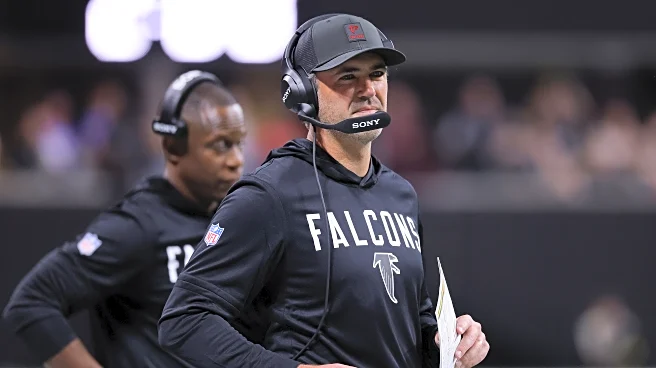




The Buccaneers moved quickly to secure their next offensive coordinator Wednesday night, tabbing former Atlanta Falcons OC Zac Robinson after a second interview in-person.
ESPN’s Adam Schefter reported the deal Thursday morning.
The Bucs forewent seeing through another second interview with former Titans head coach Brian
Callahan, as Todd Bowles and Co. seemed to come away impressed with a now-former division rival. The options began to dry up hastily, with perceived No. 1 option Mike McDaniel opting to join the Los Angeles Chargers and Todd Monken in ideal position for either the Giants offensive coordinator spot or even a head coaching role.
So the team opted against another first-time hire (like Cincinnati’s Dan Pitcher) and landed on experience with Robinson, who concluded a tumultuous two-year tenure with the Falcons. It both compares and contrasts in some key ways to the team’s last three coordinator hirings: Dave Canales, Liam Coen, and Josh Grizzard.
Generally, the McVay tree continues to ingrain roots in Tampa, as Robinson served as an assistant with the Rams in multiple capacities before the Falcons hired him under Raheem Morris. This matches up with Coen, who was on staff in L.A. with Robinson, and slightly so with Canales, who worked a good deal with former Rams staffer Shane Waldron in Seattle. Coen and Robinson also hold the key distinction of coaching Baker Mayfield during his brief, but important, career renaissance with L.A.
Where it differs is that Robinson now has actual NFL playcalling experience, which neither Canales, Grizzard nor Coen did — the latter did call plays in college for Kentucky.
Here’s the problem though: Robinson was not great for Atlanta.
Despite having an above-average offense line, an elite running back in Bijan Robinson, and a top-15 receiver in Drake London, the Falcons consistently ranked amongst the league’s worst in several metrics.
Last season, the Falcons ranked 23rd in points per game (20.8), 19th in total passing, 24th in passing touchdowns, 8th in overall rushing, and 11th in overall rushing touchdowns. With a peek under the hood of advanced metrics, it doesn’t paint a much prettier picture. Atlanta ranked 24th in total Expected Points Added (EPA) and EPA per play, with the passing EPA per play sitting just below average (18th overall) and rushing EPA per play (24th) in the bottom third.
So you might look at Bijan Robinson’s tremendous success and decent traditional rushing numbers overall and see some positives, but what the deeper analytics are saying is that the Falcons excelled at gaining yards and generating impact plays in low-leverage situations.
The passing game understandably withstood some major hurdles, with first-round QB Michael Penix Jr. struggling in limited action and then tearing his ACL, and Kirk Cousins then came in and did not perform particularly well either. London and other starting receiver Darnell Mooney also endured multi-game absences due to injuries.
Those excuses sound familiar?
The Falcons also performed horribly on third downs. With a conversion rate of just 33.8%, they ranked 30th out of 32 teams — ahead of only the Tennessee Titans and Minnesota Vikings. They struggled in basically every aspect, from short down in distance (-11.97 EPA on third downs between 1-3 yards) to third and long (-33.77 EPA on third downs 8+ yards).
The Bucs under Grizzard, who got plenty of flak for his third-down calls, performed much better in several key every areas than the Falcons did. What this tells is that Bowles thinks Robinson will have a much better chance of coaxing out the best in his offense with access to Tampa’s array of tools.
What have been some of the Falcons’ best offensive performances over the last two years? Against the Tampa Bay Buccaneers and Bowles’s defense.
The team’s best offensive output all year came in Week 15, the heartbreaking 29-28 affair that punctuated Tampa’s tailspin. Kirk Cousins went for 373 yards and three touchdowns, all to Kyle Pitts, the latter of whom can thank the Bucs for basically handing him second-team All-Pro this year. Their total EPA and EPA per play both easily cleared any other game they played.
And of course, many of us likely remember the 2024 Thursday Night Football matchup that ended in a 36-30 overtime defeat — the very one that saw Cousins throw for 509 yards and 4 touchdowns and their offense record 550 yards total.
So yeah, it sure feels like Bowles got taken out back behind the woodshed by Robinson, as is often the case when he faces McVay / Shanahan adjacent offenses, and saw bigger potential than statistics against the rest of the league proper would actually evidence. Logistically, Robinson showed very little to indicate he deserves a second chance at playcalling so soon, and it’s hard to generate much enthusiasm with this in mind.
Bowles’s lame duck status surely had a lot to do with this resolution, as his tenuous job standing simply is not going to be appealing to top-end names, just as it was three years ago. Maybe the Bucs turn it around and prove doubters wrong, but it’s hard to look at this marriage and see the potential for a top-tier football team in 2026.