



Before the season officially kicked off and after the Atlanta Falcons set their initial 53-man roster, I had three questions I felt could make or break the team’s season. As it turns out, these were the right questions to ask, as the Falcons answers to each of them had a major impact on their 2025 season. As you are aware, the season did not go as hoped.
Is the team done addressing RT? Answer: Yes
The decision to trade for Michael Jerrell felt like throwing a water balloon on a house fire at the time, and that’s essentially what it was. Jerrell was a healthy
scratch nearly the entire season, minus one game against the Bills. According to PFF, he was the worst-performing Falcons offensive lineman this season, by at least 40 points. These grading systems are subjective, but that’s a pretty wide margin.
The team would elect to roll with Elijah Wilkinson, and while Wilkinson did a good job for someone who had to fill in at the last moment and was signed to play in the interior, he was not close to being considered good enough. Per PFF, Wilkinson led the team in surrendered pressures (46), sacks (6), QB hits (9), and penalties (12). Wilkinson’s penchant for collecting false starts has been a trademark of his career, and it killed multiple drives this season. The right side of the offensive line also struggled to generate the push it has in years past. Bijan Robison covered up a lot of these issues with his sensational play.
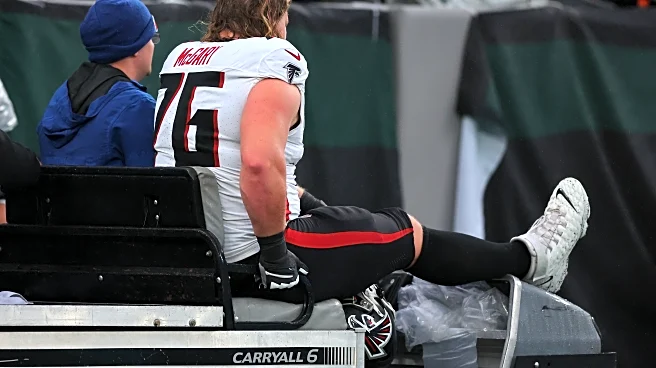
It’s hard to be overly critical of this situation, given the timing of the Kaleb McGary and Storm Norton injuries, plus Norton’s recovery worsening, a factor they didn’t anticipate. You can argue that Wilkinson was still good enough for the team to make the playoffs. However, he still created too many negative plays on his own and ultimately played a key role in the Falcons volatile offensive performance.
Can this LB room be relied on? Answer: No
The keyword in this question is “room.” The Falcons had their best starting pair of linebackers in years this season, but their depth and management of the overall room cost them multiple games. My worry that Divine Deablo wouldn’t stay healthy for the entire season and that Kaden Elliss would get stretched too thin came to fruition in the second quarter of the season.
Second-year linebacker JD Bertrand was a disaster in the preseason, and that carried over to the regular season. The former Fighting Irish defender looked outmatched physically in the run game, but also mentally, as he was a step late on nearly every play. The results in coverage were even worse, most notably against a Miami Dolphins team that was 2-6 heading into the matchup.
Josh Woods would end up being nothing more than a special teamer this season, but he also dealt with nagging injuries of his own. The one bright spot, late camp signing Ronnie Harrison, was inserted into the lineup too late. Harrison still had his faults as a player, but he did a better job of filling in and was one of the least expensive players on the roster.
We’ll never know what went so wrong with Troy Andersen’s knee, but considering the player missed all of camp and entered the season on the PUP list, it was foolish to believe the depth players the Falcons had would be enough. Lack of depth and ineffective Day 3 picks (Bertand cost a 5th) became a theme of Fontenot’s tenure and ultimately cost the former GM his job.
Will prioritizing special teams pay off? Answer: No
The Falcons took a unique approach in the offseason, dedicating significant resources to their special teams unit through multiple free-agent signings and 53-man roster decisions aimed at improving the group. The result was the worst special teams performance in recent memory.
While Mike Ford was a hit, others like Felipe Franks, Jamal Agnew, and former ace KhaDarel Hodge didn’t move the needle for the Falcons. Agnew would be cut in December; Franks had four penalties on special teams (holding, illegal formation, taunting, and unnecessary roughness), and Hodge would be a healthy scratch multiple times before hitting IR on December 19th. It’s worth noting that Hodge was one of the few players called out in a presser by Raheem Morris for bad play, but it came after one of the few weeks where no special teams mishaps took place, and the special teams unit looked worse without him as the season rolled on.
None of these players contributed to the offense or defense in a meaningful way. The “Franks Tank” was a nice wrinkle, but was rarely utilized. Instead of focusing on amassing the best football players, the Falcons overthought this process and believed they were bringing in specialists who would give them an edge with the new rules. It was an approach that backfired almost immediately.
The team boasted about its signing of international player Lenny Krieg. Krieg was seen as “competition” for Younghoe Koo, but when it was time to compete and move one from the kicker, it was clear Krieg was a project, and after thought, he is now a New York Jet. This approach to the kicker position would cost the Falcons games for the second year in a row. The Falcons would sign Parker Romo before finally landing on Zane Gonzalez, who was on the market since late April.
The Atlanta Falcons answers to these questions did not produce the results any of us had hoped for, and it’s easy to see why Fontenot and Morris are no longer employed.