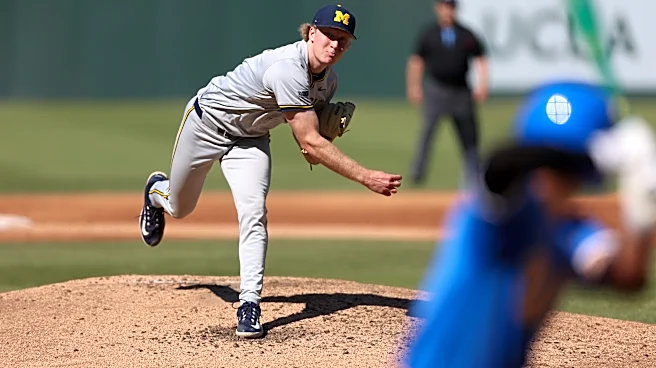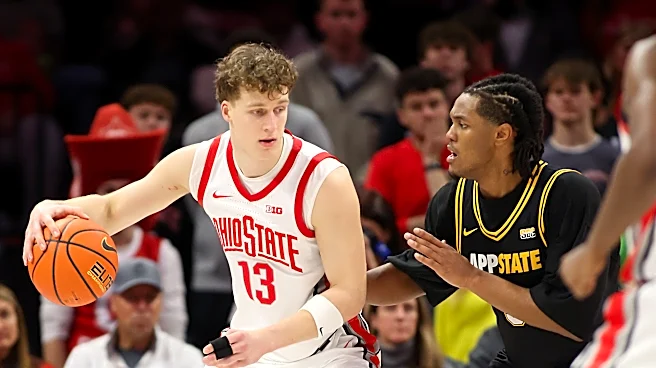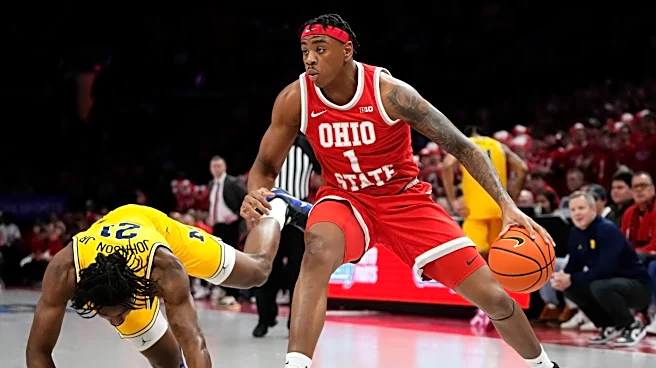


As the calendar now flips to May, the 2026-27 Ohio State men’s basketball team is still over five months away from playing meaningful games, but the roster for next season has mostly settled into place. The last three weeks have been a whirlwind of rumors and reports about which players were transferring where and for how much money, but the chaos the transfer portal brings every spring has settled down to a much slower, duller hum, and we can finally start assessing many teams’ rosters.
Ohio State
broke a three-year NCAA Tournament drought this past season, earning an at-large bid to the dance thanks in large part to a late-season surge that saw the Buckeyes win four of their final six regular season games, including ranked wins over Wisconsin and Purdue. They then fell behind TCU by a boatload of points early on in that first-round NCAA Tournament game, stormed all the way back, and ultimately lost in the final five seconds. Season over, just like that.
Several players graduated and ran out of collegiate eligibility, including the program’s all-time leading scorer, Bruce Thornton. Several others, including three former Ohio Mr. Basketball Award winners — Gabe Cupps, Colin White, and Devin Royal — opted to transfer out of the program.
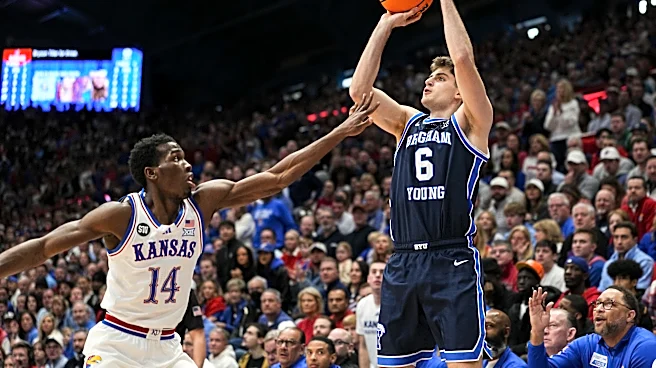
To replenish the roster, head coach Jake Diebler and his staff — which, as of today still has a vacancy — brought in four players via the transfer portal as well as two freshmen in the 2026 recruiting class. While it remains possible that Ohio State could bring in an additional player before the team reports, it seems more likely that the group currently assembled will be the group we see on the floor against BYU on November 2 in Salt Lake City.
With that said, here’s my current prediction for Ohio State’s depth chart next season, which (obviously) includes a starting lineup.
Something to note: Several players will play multiple positions this year. Versatility and flexibility are good qualities to have. I will list a player in multiple positions if I think they will play multiple positions with some amount of regularity.
Point Guard
Starter: Justin Pippen
Other options: Curtis Givens, John Mobley Jr.
Analysis:
Pippen led Cal in both assists and assist rate by a large margin last season and now will be surrounded by even more talent than he was out west. Improving on poor shooting numbers last season (37% FG, 32.7% 3PT) is a non-negotiable for Pippen to remain the starting point guard all year long. He should also be one of the better on-ball defenders in the Big Ten this year.
Givens had the second-best assist rate and assist total on the team last year playing for Memphis, despite primarily being used as an off-ball guard. Givens was recruited out of high school as a point guard, and he will be the primary backup behind Pippen. His shooting numbers (43.1% FG, 36.5% 3PT) were more efficient than Pippen last season, and he will have every opportunity to push Pippen for minutes as the season progresses. Givens faced a lower level of competition last year at Memphis than he did as a freshman at LSU, so it’ll be worth monitoring how capable he looks against Big Ten teams.
Mobley showed some chops as a floor general last season. He was more willing to push a faster pace than Bruce Thornton was, which also came with more of those high risk, high reward passes that either turned into a flashy assist or a head-scratching turnover. Mobley has been a better shooter in catch and shoot situations than off the dribble, but he will be used to bring the ball up the floor plenty even if he is not the de-facto point guard.
Shooting Guard
Starter – John Mobley Jr.
Other options – Jimmie Williams, Curtis Givens
Analysis:
Mobley finished last season 26th in the country with 3.1 three-point makes per game. Of those 26 players, he was one of just 11 guys to also shoot 41% or better from long range. Mobley’s reputation for burning defenses from essentially any spot on the floor makes him someone who is irreplaceable and his specific skillset is not something that could have just been replaced with a plug-and-play transfer. Mobley is currently working out for teams in anticipation of the 2026 NBA Draft, but he is not projected to be selected in either round. The most likely outcome is his return to Ohio State prior to the May 27 deadline.
Williams is the biggest, bulkiest guard on Ohio State’s roster at 6-foot-5 and 210 pounds. He shot 57.7% on two-point shots last season and was 62.4% at the rim, which is far better than anyone else in the Ohio State backcourt. Because of his size, I expect Williams to see plenty of time on the floor at different positions.
Givens was primarily used in an off-ball role at Memphis while Penny Hardaway had Dug McDaniel running point for nearly 35 minutes per game. He will play both guard positions for Ohio State, but if Mobley plays 30+ minutes as expected, Givens may not play at this spot as much.
Small Forward
Starter – Anthony Thompson
Other options – Jimmie Williams
Analysis:
Thompson will play as many minutes as he is physically able to, considering small forward is probably the thinnest spot on Ohio State’s roster. Diebler and the coaching staff expect his three-point shooting and rebounding to immediately translate to the collegiate level, and although he’s not going to be a crazy shot blocker, that is also an area where they feel he will contribute. Thompson has the highest individual ceiling of any player on the 2026-27 roster — he will be one of the favorites for Big Ten Freshman of the Year and will be in the conversation for All-Big Ten honors as well.
Williams is really the only other player on the roster who I realistically see gobbling up some minutes at small forward, other than Thompson. His size would hypothetically allow the Buckeyes to play some three-guard lineups with some combination of two of Pippen, Mobley, and Givens at the two traditional guard spots, with Williams at the third guard/traditional small forward position.Ohio State wasn’t able to do that at all last year because they simply did not have the size to do it.
Power Forward
Starter – Amare Bynum
Other options – Andrija Jelavic, Anthony Thompson, Alex Smith
Analysis:
Bynum was a rock star down the stretch for Ohio State last season, and will be on every “breakout candidates” list you read when we get closer to November. In Ohio State’s final six games, starting with its upset win over No. 8 Purdue on March 1, Bynum averaged 12.3 points and 6.5 rebounds per game. He also averaged just over 32 minutes per game during that stretch. Unlocking his three-point shot, which did get better as the season progressed, is the final key for Bynum to blossom into a star.
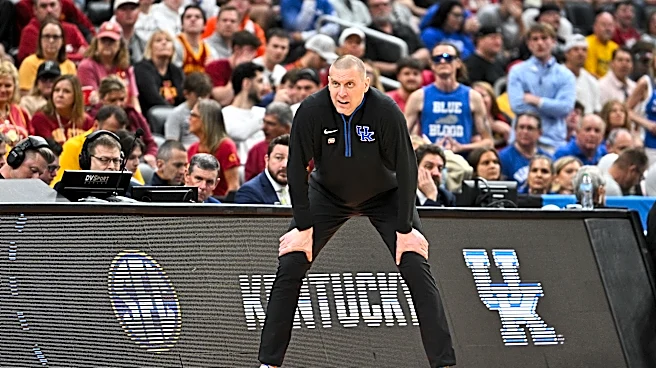
Jelavic moves more like a small forward or power forward than a center, but his size (6-foot-11, 225 pounds) makes him look more like a center. The Kentucky transfer will also have an opportunity to earn the starting center role, but if he winds up coming off the bench, I think he will also play a decent amount of power forward alongside Josh Ojianwuna. Plus, if Bynum is playing 30+ minutes per game, the “backup power forward” spot won’t be too terribly relevant.
Thompson might not have the size or physicality to play power forward at the collegiate level, but if injuries happen or Dibler is put in a pinch, I could see the freshman, who isn’t tiny at 6-foot-9 and 205, playing power forward.
Smith will probably find a few minutes here and there during his freshman season, but like Thompson, he needs to put on a bit of muscle and prove he can match the level of physicality required at the collegiate level. He’s got a rock-solid jump shot, but that alone won’t buy him a substantial role.
Center
Starter – Josh Ojianwuna
Other options – Andrija Jelavic, Ivan Njegovan, Amare Bynum
Analysis:
This is the murkiest, most vulnerable position for Ohio State. The leading candidates to start at center against BYU on opening night are two guys with huge question marks tied to them.
Josh Ojianwuna was absurdly efficient at Baylor two seasons ago, shooting 77% overall, but has not played in a game since February 2025 and spent all of last season rehabbing from knee surgery. By the time the season rolls around, he will not have played in a college game in 20 months. Ohio State would love for him to be able to jump right back in and average 25 minutes per game like he did two years ago at Baylor, but it’s highly doubtful he is able to just plunge right back in and carry that much of the workload right away.
As noted above, Jelavic is a guy who will probably play a bit at both power forward and center this season. He was super efficient on two-point field goals last season, shooting 67.5% and splitting his shot attempts pretty evenly between 2’s and 3’s. Not totally unlike Christoph Tilly, Jelavic was more a driver and slasher than a back-to-the-basket center who you dump the ball down to.
Njegovan feels like the odd man out here, with the starting center spot going to either Ojianwuna or Jelavic, and the other taking up a good chunk of the minutes that do not go to the other guy. Njegovan had a few games where his rebounding was critical for Ohio State, including six each in wins over Purdue and Wisconsin that were critical to the Buckeyes making the NCAA Tournament. At the same time, Njegovan is very vulnerable on defense because he’s basically unswitchable, and does not convert at a high enough rate when he does get the ball near the basket.
Bynum has shown the ability to play small-ball center if needed, and that need will inevitably come up at some point this season in very small bursts. However, there is something very, very wrong if the season gets to a point where Bynum becomes the starting center over the three actual centers on this roster.
Unlikely to play
Myles Herro, Braylen Nash