
Whisper it quietly, but in recent weeks there have been clear signs the 49er defense is improving as the regular season approaches its business end.
Indeed, the 49ers rank seventh in EPA per play on defense
over the last three weeks as they have reeled off a hat-trick of wins to move to 9-4. While EPA as a metric does not encompass a unit’s entire performance — it is most closely linked to how often an offense or defense creates or prevents explosive plays — the fact the 49ers rank so highly over the last three weeks in a category in which they are 24th for the season as a whole is indicative of a marked improvement from Robert Saleh’s group.
Of course, some of the strides can be tied to the opponents faced. The Arizona Cardinals, Carolina Panthers and Cleveland Browns aren’t blessed with high-powered offenses, though the Rams may beg to differ in the case of Carolina, and San Francisco has taken advantage of favorable matchups in that sense.
But it would be unfair to discount the progress that has been made. It’s no surprise that Deommodore Lenoir has once again played at a very high level at corner, but Renardo Green’s success in avoiding a sophomore slump and the increasingly strong play from Malik Mustapha and Ji’Ayir Brown at safety have each helped the secondary a much greater air of reliability.
The improvements made in the secondary have greatly aided those playing in front of them, and a defensive line that has for so long been anaemic in sack production since the season-ending injury to Nick Bosa has shown signs of life as a pass-rushing force.
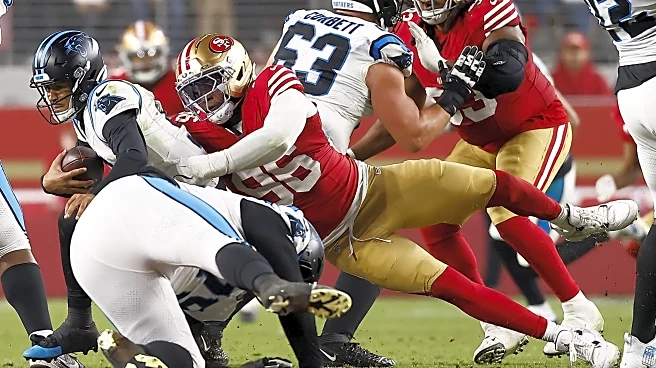
San Francisco still has the worst pressure rate in the NFL, 14.4%, per Pro Football Reference, but the 49ers’ three sacks in the Week 13 win over the Cleveland Browns were the most they have had in a game since Week 2, when Bosa was still healthy.
Shedeur Sanders’ average time to throw of 3.2 seconds (per Sumer Sports) was clearly a contributing factor in the 49ers’ success in getting home against him. A rookie quarterback who struggled with decisiveness in college going against an improving secondary in difficult conditions is a combination always likely to lead to a profitable afternoon for a pass rush. However, there have been enough encouraging signs from the 49ers’ defensive linemen to indicate they could continue to produce down the stretch and into the postseason.
New additions hitting their stride
The 49ers are not going to be as good as they would be if Bosa were available but, by adding Clelin Ferrell and Keion White, they have removed some of the burden from Bryce Huff and added depth to the pass rush rotation.
Ferrell’s two sack performance against the Browns took him to four in as many games since rejoining the 49ers, while White has looked more at home with each week following his trade from the New England Patriots. White, per NextGen Stats, posted a pressure rate of 28.6% in Week 13, the second-highest of his career.
Though the 49ers have made no secret of their satisfaction with the all-round game of second-round rookie to Alfred Collins to this point, it is clear it is on the interior where their pass rush is most lacking, despite some impressive showings from Kalia Davis.
Yet, with their depth seemingly set to grow even stronger after the bye week, there is reason for optimism the 49ers can have a more impactful interior rush in the coming weeks.
The Niners are hopeful they will get both Yetur Gross-Matos (hamstring) and Sam Okuyainonu (ankle) back after the bye.
Okuayinonu has been one of the 49ers’ most dependable rushers since Bosa went down, his pass rush win rate of 11%, per Pro Football Focus, topped only by Huff (16,7%) among healthy San Francisco edge rushers. Both he and Gross-Matos have the ability to rush inside and out, though it is the latter who has shown tremendous promise in that area in limited action.
The fact Gross-Matos’ win rate of 23.4% still ranks first among all interior rushers will make him being limited to just five games because of injury even more frustrating. However, that number illustrates the impact Gross-Matos could have in jump-starting the 49ers’ interior pass rush, at least on true passing downs, when he does get back on the field.
A variety of pass-rush avenues
Huff, Ferrell, White, Okuayinonu and Gross-Matos is not the most formidable stable of pass rushers, but it is one that would give the 49ers several different means through which to create pressure.
In years gone by the 49ers have won up front through having the depth to be able to throw waves of pass rushers at opponents. The quintet they may have after the bye has a high enough floor for the Niners to be able to employ a similar tactic, while the positional versatility of their pass rushers gives Saleh and defensive line coach Kris Kocurek greater scope to create mismatches by mixing up alignments and employing a variety of stunts.
Perhaps most pertinently, the prospective return of Gross-Matos should provide the 49ers with a more potent NASCAR package for use on third down, decreasing the burden on the defensive tackles to step up in true passing situations.
The 49er pass rush is a long way from where it wants to be, and the reality is that will likely take more clever play-calling from Saleh to get the most from the San Francisco defensive front for the remainder of the season. Still, between the positive signs in recent weeks and the players set to return to the fray, the 49ers can afford to have hope their pass rush can get close to its Bosa-less ceiling at the ideal point in the calendar.