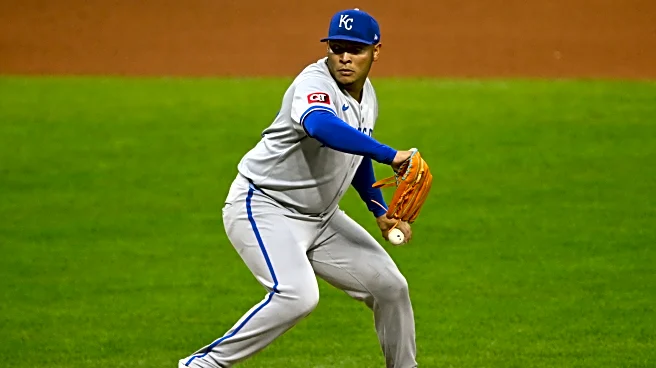

Before reading this article, you should check out Paul’s coverage of the Ángel Zerpa trade and Harrison’s article on what to expect from Zerpa.
Last week, the Brewers traded Isaac Collins and Nick Mears
to the Royals in exchange for lefty reliever Ángel Zerpa, who had a 4.18 ERA last season. This is a trade that, to the casual fan, initially looks somewhere between confusing and bad.
First, the Brewers already have a ton of lefties. The 40-man roster alone features Aaron Ashby, Jared Koenig, Robert Gasser, DL Hall, and Rob Zastryzny — all of whom should be considered legitimate bullpen options for next year’s team. I wouldn’t consider major-league ready left-handed relievers to be a need for the Brewers right now, and I don’t think GM Matt Arnold does either. (For more on the lefty “issue”, check out Paul’s article from yesterday).
Milwaukee clearly thinks acquiring Zerpa is worth trading an outfielder (Collins) who just finished fourth in Rookie of the Year voting with an OPS near .800 and a reliever (Mears) who had an ERA over half a run lower than Zerpa’s last year.
But I don’t think Arnold made this trade simply to acquire left-handed pitching depth. Instead, he made this trade for two reasons.
- Milwaukee thinks Zerpa could be something special
- Milwaukee wants to sell high on Mears/Collins
Let’s tackle Reason #2 first. Collins did indeed finish fourth in 2025 Rookie of the Year voting, but there are a couple things about his profile that could give the Brewers pause. Collins’ season stats are buoyed by a two-ish month stretch between mid-June and mid-August. He didn’t post an OPS above .681 in April, May, or September, and struggled so badly down the stretch that he barely played in the postseason. He’s also already 28. That’s the negative way of framing Collins’ season; the positive way would be that Collins broke out halfway through his rookie season and had a rough stretch in late August/September after welcoming his first child.
Mears, like Collins, started off the season impressively but struggled down the stretch. Apart from a great month of June, he didn’t post a monthly ERA below 3.27 after April, His September (9.00) and July (7.11) marks were particularly abysmal, although he only pitched five innings in September. Ultimately, Mears ended up being left off of the NLCS roster altogether. His season could be explained by a proclivity to give up home runs or by overuse. To be fair, he did only pitch 56 2/3 innings last year (though, if you watched the games, it felt like he was perpetually loosening in the bullpen). Regardless, Milwaukee was willing to burn Collins to essentially swap Zerpa with Mears — they clearly weren’t all that high on Mears in the long term.
As for Reason #1? Milwaukee is clearly confident that they’ll survive the losses of Collins and Mears, but they don’t do this trade if they’re not excited about Zerpa turning into a weapon out of the bullpen. Why are they so excited to acquire Zerpa?
Zerpa’s sinker-slider combo
Zerpa’s best pitch is his sinker, which averaged 96.6 mph last season. That’s elite velocity for a sinker. For reference, Shohei Ohtani throws his sinker at an average of 96.2 mph. Aroldis Chapman throws his at an average of 99.4. Here’s what a 97-mph sinker looks like coming from a couple other extremely talented pitchers:
Now, here’s what Zerpa’s sinker looks like at 98 mph:
And here’s his second-best pitch, his slider:
Zerpa’s changeup is pretty ineffective, but his slider serves as an off-speed pitch itself. As detailed in my article on Rockies reliever Seth Halvorsen, the Brewers have had success acquiring pitchers and simplifying their arsenal. Mears, Trevor Megill, and Abner Uribe are all mainly two-pitch guys. Not only that, but the Brewers organization has also had success in the past with increasing their pitchers’ spin rates. If Milwaukee follows this blueprint with Zerpa, it isn’t hard to see how Zerpa could benefit from a) almost exclusively throwing his best two pitches and b) getting more break on those two pitches.
Zerpa’s ground-ball rate
Another stat that stands out when looking at Zerpa’s profile is his 99th percentile ground-ball rate. Zerpa has been a mediocre pitcher so far throughout his career, but he’s been one of the best pitchers in the league at getting ground balls. Ground ball pitchers do better when paired with a good defense (see: Quinn Priester). Brice Turang and Joey Ortiz are two of the best defensive middle infielders in baseball, and Caleb Durbin isn’t a slouch either. Like Paul said, I won’t be surprised if Zerpa’s ERA drops half a run or so (closer to Mears’ 3.49 ERA in 2025) just as a result of the Brewers’ infield defense. After all, Zerpa did have the same exact FIP (3.86) as Mears last season.
Zerpa’s vertical approach angle (VAA)
Vertical approach angle, as mentioned in the Halvorsen article, refers to the angle of the ball as it approaches home plate. Milwaukee tends to like pitchers who release the ball at a flatter-than-average angle, which causes hitters to misjudge the trajectory of the pitch. More deceptive = more effective. The best example of this is early-career Freddy Peralta, who for years had one of the flattest VAAs in the major leagues.
Zerpa doesn’t have a super flat VAA on his slider (-8.2 degrees), but his fastball and sinker average -4.2 degrees and -5.4 degrees, respectively. Those are roughly in line with Mears’ (-4.9 degrees) and Megill’s (-5.0 degrees) VAAs. Increasing a pitcher’s extension can also lower their VAA, which leads me to my final reason for the Brewers to be excited about Zerpa:
Zerpa’s extension
Extension, in reference to pitchers, measures the distance between a pitcher’s release point and the rubber. If a pitcher has longer-than-average extension, that means they’re releasing the ball closer to the plate than the average pitcher does. Longer extension allows a pitch to play faster and closer to the hitter, but it also makes pitches flatter (read: lower VAA). If a pitcher releases the ball closer to the plate, it gives the ball less time to drop due to gravity (while still being released from the exact same arm angle).
If you want an example of a Brewer with freakishly long extension, Jacob Misiorowski ranks in the 100th percentile league-wide with an average of 7.6 feet. Zerpa is exactly the opposite of Misiorowski. His average extension of 5.5 feet is good for the first percentile. This isn’t a good stat, but it does show that Zerpa’s stuff has some room for improvement if the Brewers can manage to lengthen his delivery. If Zerpa can get his extension to even the 20th percentile without sacrificing command, his pitches will play faster and flatter (read: nastier) than they did last year.
———————————————————————————————————————————————————————
I’d argue that this trade has the Brewers taking on more risk than the Royals. I’d also argue that over the last few years, the Brewers’ front office has more than earned the benefit of the doubt when it comes to acquiring and developing pitchers. Zerpa is already a serviceable pitcher, but his sinker, slider, ground-ball rate, VAA, and extension all suggest there’s meaningful untapped upside. It’s up to Milwaukee to unlock him.