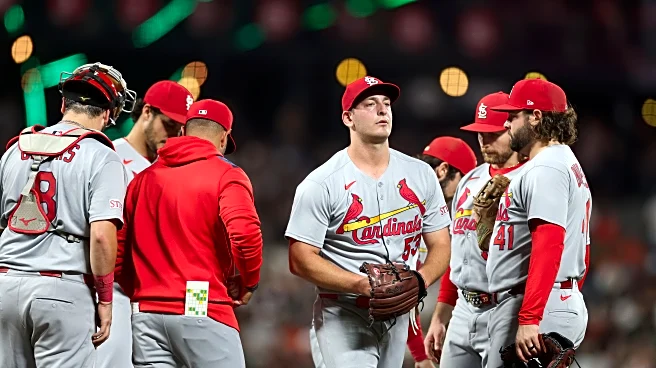

For the 2026 version of the St. Louis Cardinals, I will call Saturday’s signing of Dustin May a “splash” move for the organization. Until this point, their biggest transaction was trading away from the rotation
but the newest member of the Cardinals does provide some stability to a rotation full of question marks. Of course, stability is also a tough word when discussing the oft-mentioned May, but he is the team’s version of a front-of-the-rotation pitcher that they needed. Even in a rebuild, a $15 million contract comes with expectations of performing like a big league arm.
May’s signing makes him a candidate for the Opening Day rotation, and Cardinal Nation apparently anticipates May becoming the team’s ace. For the current state of the Cardinals’ staff, I believe that is fair to ask of the 28-year-old who has shown flashes of electric stuff the team has sorely needed. Last week, my article was wondering out loud if a six-man rotation could be something the Cardinals could try, and signing May keeps that question alive for me. I apologize ahead of time for the quickly constructed nature of this week’s article, but my initial scheduled post was pretty much rendered useless after Saturday’s signing. That being said, the move brought up how I think he can impact the 2026 pitching rotation, with the understanding and expectation that this could change, and potentially quickly. I don’t see the Cardinals being finished with their rotation transactions, but here is how I see May impacting the pitching staff as things currently stand.
I still believe in a potential six-man rotation
Like I mentioned, last week’s question of a six-man rotation remains for me, even though there has been no organizational chatter about it. Since May threw 132 innings last season and will be entering his second year since Tommy John surgery, I don’t expect him to be under any significant innings restriction, even with his injury history. Since it is a one-year deal, the Cardinals surely want to get as much value for him this season, and he does that by pitching as much as possible to show his health.
In a six-man rotation, starters would still be on pace for about 27 starts and with May averaging 5.42 innings per start last year, that would put him at just under 150 innings, still a career-high. Rather than a full-time expanded staff, using the extra starter a time or two per month could increase those numbers, if desired. His addition is welcomed by me, even though I mentioned how the entire rotation had a chance to set a new high in season innings and May also has that potential with a 27 start season.
While I admit this type of setup for the staff is unlikely, I still think it can be a useful strategy if it were used with purpose.
Who does this impact most?
Without anything stated publicly, I will say simply Andre Pallante. While his second-half performance maybe wasn’t as bad as his winless record shows, this move could put some pressure on the former reliever. If the team opts to forgo my six-man suggestion, someone from the current setup will have to be moved. With Liberatore, McGreevy, and Leahy openly ticketed for the rotation, I still assume Fitts has claim to a 26-man spot come Opening Day. Maybe this means the team sees him as more of a Steven Matz instead of a starter, but I think they prefer Fitts in the rotation.
So, I believe that leaves the most logical “odd man out” to be Pallante. His overall numbers are similar enough when looking at his career splits between starting and relieving, so it is not like the Cardinals are losing or gaining anything significant with the simple role change. The order in which the pitchers start is anyone’s guess and will surely be sorted out in Spring Training, but my early prediction is Matthew Liberatore is the de facto number one starter due to seniority in the organization with May slotting in at number two. From there, I see Michael McGreevy, then Fitts, and Leahy taking up the fifth spot to ease him into a starter’s workload. Pallante could then become my desired sixth-starter, but I would much rather prefer a prospect with upside or an additional major league acquisition taking that improbable role.
What’s left for the pitching staff this offseason?
The number one thing the Cardinals will have to do before Dustin May officially joins the organization is to clear up a 40-man roster spot. With the selection of Matt Pushard in the Rule-5 draft, the roster is full so the team will either have to remove someone. If this is simply done by removing someone like Zak Kent, we might hear the signing become official in the next day. If we don’t hear anything tomorrow, it could mean a deal involving someone on the current roster is in the works. The timing of any official announcement will tell us a lot, I think.
Beyond figuring out who is left out of the five-man rotation, Chaim Bloom has to make a decision on JoJo Romero’s future before Spring Training. The current speculation is that a move involving Brendan Donovan is gaining traction, but a Romero trade could also clear up the 40-man spot needed to add May. Right now, I guess Romero would slot in as the team’s closer, so dealing him would allow Matt Svanson to slot into the ninth inning role. However, Derrick Goold reported that both Svanson and Gordon Graceffo are on a multi-inning reliever offseason plan with the potential of filling the fireman role left by Leahy’s move to the rotation.
I expect a Romero trade to happen relatively soon with a Donovan trade to follow, and each of those deals could provide some clarity on the big league pitching staff. I still believe the Cardinals will target major league or upper minors arms in trade returns. A move involving JoJo would leave the Cardinals without a lefty in the bullpen and Liberatore and Brycen Mautz as the only southpaws on the 40-man roster. This could cause St. Louis to also prefer a lefty arm or two in trade talks.
Overall, I am a fan of signing Dustin May to a one-year deal with the understanding that the mutual option is basically a formality. I had mentioned him as a target at multiple times throughout the last year, and even with his struggles, signing May shows a continued commitment to an organizational pitching revamp. While he is exactly the type of arm a team in this stage of a rebuild needed, it should not be the final move the team makes in regards to the major league pitching staff.