

I am a believer in precise and specific communication. If it takes a few more words to reduce or eliminate the opportunity for a misunderstanding, we should take it. And part of that belief comes with a specific affinity for communication structure. And in communication structure, it’s very important to draw a distinction between “I was wrong” and “I’m sorry”. All correctly structured apologies contain a “I was wrong” segment, but not all “I was wrong” communications are an apology, just like all squares
are rectangles but not all rectangles are squares.
An apology contains three main pieces:
- Recognition
- of wrong
- of harm
- Reasoning
- Response
Recognition is the “I was wrong” part of the apology. You note that not only were you were incorrect in a statement, thought, or action, but you also caused a moral wrong, injury, or insult or some sort through this statement, thought, or action. Reasoning isn’t an excuse as some would note, but instead a communication to the other party that you have been introspective and understand why you were incorrect and what led you to that incorrect conclusion. Response is a call to self-action; a specific behavior that you will or will not do differently in the future.
So I don’t have to say I’m sorry for being wrong about Deone Walker (because I didn’t cause a moral wrong, injury, or insult), but I was wrong, so we should talk about it.
For starters, let’s pull the exact wording of my reaction to the Deone Walker draft pick in 2025:
“I am not a huge Deone Walker guy. Especially relative to the other players at his position that were available. It feels like he brought all the negatives of massive size to his scouting report (conditioning, motor worries, playing upright) without the positives (great use of extension, leverage). Bills are likely hoping they can coach rare size traits, because they simply don’t make many humans like Walker. Rooting for the ceiling.”
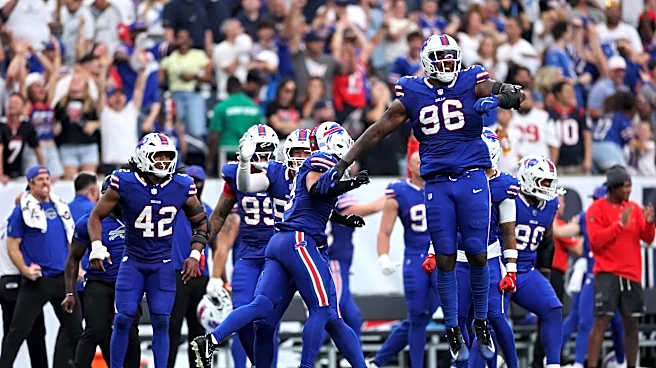
In his second year, Walker has become a high-level disruptor alongside veteran OLB Gregory Rousseau. The two have arguably been the best players on a Buffalo defense that has looked porous against the pass through two weeks. Walker had 13 pressures on 214 pass rush snaps in 2025, per NFL Pro. He has 7 pressures in 53 pass rush snaps in 2026. His 2026 pressure rate of 17.9% is over double his 2025 mark (8.0%). He has splash plays all over the tape. His impact has been notable and his presence has been felt.
I never bought into the “he would have been a top 10 pick if not for the back injury” talk. I was well-aware of the back injury and specifically watched through the prior year tape, but my concerns remained. My comparison was to former Bills defensive tackle Jordan Phillips: a player capable of splash plays to help your team, but one who would balance those plays with enough negatives to make you hesitant to throw a bag at it (I once famously advocated for the Bills to not-resign Phillips on this site, an article that attracted a less-than-stellar reaction from the defensive tackle himself). I had a mid-day three grade on Walker (slightly behind where they took him) but, as noted above, liked other defensive tackles on the board more. But at the risk of being hyperbolic, Walker is trending much more towards being a heavier DeForest Buckner than Jordan Phillips at this point.
So what did I get wrong?
First off, Walker is playing with exceptional leverage when necessary. Gone is the phenomenon where if his upper body quickness doesn’t get him past an offensive lineman in the first 0.5 seconds of a rep, he’s lost for the remainder of the play pretty much as a rule. Walker is showing the ability to utilize his length as needed: against a second quarter screen pass in Houston, he was first to touch against Texans center Evan Brown, peeked in the backfield to spot running back Woody Marks leaking out to the offensive left, rode and controlled Brown with length and he maneuvered toward the pass placement, and then discarded the block and made the tackle for a -2 yard loss. Right before the first half two-minute warning against Detroit, Walker stacked up Lions left guard Juice Scruggs on a one-on-one on first and 10 before throwing Scruggs to the side and closing on Jared Goff, forcing an incomplete pass short left to wide receiver Jameson Williams.
Nobody will or should ever confuse Walker’s playstyle as a “stack and shed” defensive lineman. He’s still primarily focused on utilizing his upper body quickness to win the rep fast and create havoc rather than displacement, but the fact that he shows the ability to win reps with proper use of one of his great gifts (length) is something beyond what I had predicted during scouting. It’s akin to a big wide receiver who has the knock of “doesn’t play big” suddenly starting to play big. Walker’s ability to win different ways (even if one of them occurs far less frequently than the other) is a massive contributor to his long-term outlook in the league because it let’s him keep the high-level reps he always had without bringing with him the lowlights.
The second item that jumps off the film with Walker is his body composition and conditioning. Even prior to his back injury, Walker’s conditioning contributed to him playing higher and higher the longer the game went on, exacerbating the downsides of his height and leading to leverage issues. Coming into the 2026 season, Walker shed about 10 pounds and looks to be in excellent shape (see the Buckner comp above), leading to more energetic reps later in the game for a Bills defensive line that lacks depth and more ability to exert the bursts of strength necessary to pull off the plays like the two “stack and shed” examples listed above.
Better conditioning and playing with better extension have allowed the best traits of Walker to shine while minimizing some of his biggest downsides from this college scouting report.
Evaluation is distinct from projection when discussing NFL Draft prospects. Just because Walker didn’t do it with enough frequency for me to feel comfortable assigning a high grade to him prior to the draft, doesn’t mean he couldn’t do it at the NFL level. He had the tools, but being able to parse out players who have the tools and will use them differently in the NFL versus players who have the tools and will not use them differently in the NFL is a matter of evaluating coaching and the player on a football character level. If Walker continues on this trajectory, he’ll join Josh Allen on my personal “sure glad I missed on them” list of Bills draft picks over the last decade.
I’m not sorry, but it sure looks like I was wrong.
You absolutely love to see it.
…and that’s the way the cookie crumbles. I’m Bruce Nolan with Buffalo Rumblings. You can find me on Twitter and Instagram @BruceExclusive and look for new episodes of “The Bruce Exclusive” every Thursday on the Rumblings Cast Network — see more in my LinkTree!