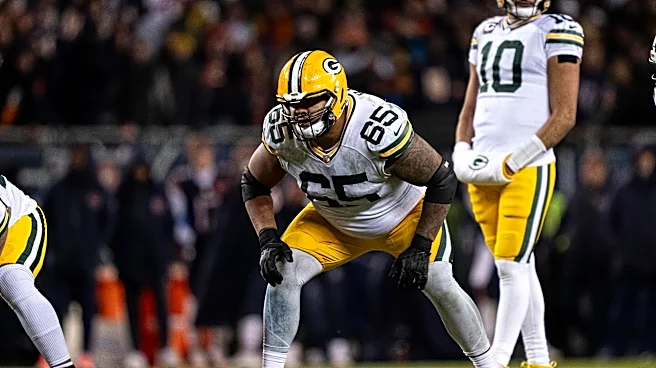







The Packers have made a conscious effort over the past couple of years to get bigger on their offensive line.
It seemed obvious at a glance: they signed the generously proportioned Aaron Banks last spring, then spent a second round pick in the 2025 NFL Draft on Anthony Belton, who didn’t get the nickname “Escalade” because it’s his vehicle of choice.
But in February, Packers’ general manager Brian Gutekunst confirmed this was a conscious choice on his part. The Packers weren’t changing how they scouted
linemen, necessarily. They were just looking for bigger ones.
“I wouldn’t say we changed our evaluation process [for offensive linemen], but it was intentional,” Gutekunst said after an excellent question by APC’s Tyler Brooke. “We did want to get bigger, a little bit more stout up front to be able to move people in the run game if we can.”
And if getting bigger was the only goal, it worked. The Packers fielded their heaviest offensive line of the Matt LaFleur era in 2025, adjusted for snaps. On average, a Packers lineman tipped the scales at 318.99 pounds, up from 313.86 pounds in 2024 and just 310.27 in 2019, LaFleur’s first year on the job.
Did it work? In a word, no. In a few more words, not really, but it’s not clear if the size of the line had anything to do with its performance in 2025.
Broadly speaking, the Packers didn’t accomplish Gutekunst’s goal of pushing people around in the ground game. By just about any measurable stat, their ground game was worse in 2025 than in 2024. The team’s yards per carry average dropped from 4.7 in 2024 to 4.1 in 2025, and their EPA/rushing play and DVOA both dropped as well. By traditional or advanced metrics, their ground game was just worse.
Size, it seems, was not a factor, but it may be more accurate to say that size was just consistently not as available as the Packers would have liked. They dealt with injuries up and down the line last year, resulting in a pretty incoherent line across the board. The Packers’ preferred offensive line of Rasheed Walker, Aaron Banks, Elgton Jenkins, Sean Rhyan, and Zach Tom played barely a handful of snaps together last season. It was far more likely to find players switching from spot to spot in a given game than the Packers’ top five lineman blocking together.
And that doesn’t look like it’s going to change in 2026, at least in the early going. Zach Tom is still in the rehab group at OTAs and minicamp after a knee injury late last season, and Aaron Banks has given way to Jager Burton due to injury issues cropping up again.
Where does that leave the offensive line, size-wise? A bit all over the place. Jordan Morgan was already going to replace Rasheed Walker in the starting lineup, yielding about 13 pounds, but Sean Rhyan made up for that by taking over for Elgton Jenkins at center, whom he outweighs by 10 pounds. If Banks can’t go, it looks like fifth round pick Jager Burton will get first crack at the left guard job, but he’s considerably smaller than his hefty counterpart.
It leaves me thinking that just trying to get bigger is not necessarily a coherent strategy, especially if you can’t reliably depend on the availability of certain players. It’s one thing to want to get bigger, but it’s another to follow LaFleur’s long-publicized maxim of getting the best five linemen on the field.
Coherence may be the best word to describe what the Packers currently lack. I understand the idea of wanting to be bigger, but the Packers made plenty of hay over the years with a particular offensive line archetype: they wanted converted tackles at pretty much every spot on the line, giving them a long, lean, and athletic front, usually made up of players who were pretty similar physically. In 2019, LaFleur’s line had a pretty narrow range of weights; the Packers’ five most-used linemen ranged in weight from 310 to 314 pounds, and their performance was strong.
But in 2025, the Packers top five linemen had a much wider range, stretching from 304 to 325 pounds, and I think it’s fair to call their performance scattershot. Getting bigger might be a good goal, but getting there all at once was going to be a challenge, and it doesn’t seem like the Packers have been able to pull it off, and they ended up with a physically scattered and incoherent line last season, to say nothing of injuries. Playing just their best five, regardless of five (or in Banks’ case, salary) might be their best option.