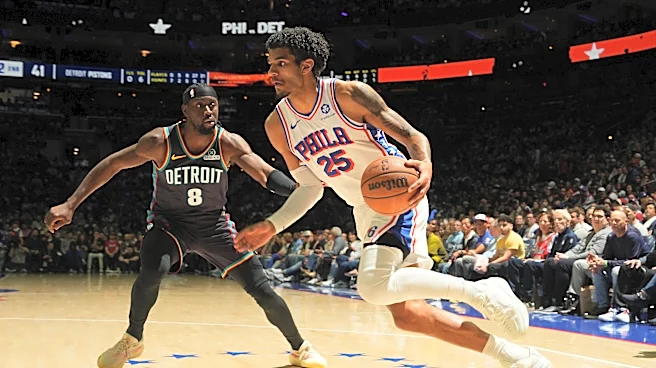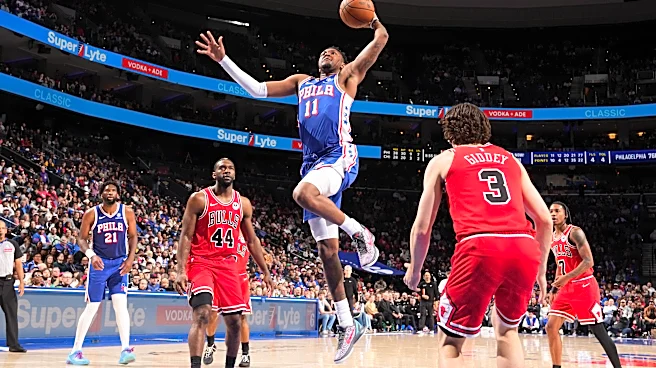







Throughout this season, Philadelphia 76ers’ young forward Justin Edwards struggled to maintain a meaningful spot in the team’s rotation.
Edwards, in his sophomore season, featured in 64 contests for the Sixers, starting in 12, for 15.3 minutes per night — with those minutes varying wildly from night to night. Some games, Nick Nurse went to him early and often, racking up some serious minutes off the bench for Edwards. When the team struggled with injuries, he even started some contests. But other
times, Edwards seemingly disappeared, playing little or no time at all. He ended up averaging 6.0 points, 1.5 rebounds and 1.3 assists throughout 2025-26.
These numbers represent some slight statistical regressions compared to his rookie year, but context surrounding those numbers is important, as Edwards’ opportunities this season were much different than those of last season.
Let’s look back. Edwards was originally brought to Philly in the summer preceding the 2024-25 season as an undrafted free agent. A few months later, the Philadelphia-native was thrust into basically a regular starting role for a Sixers squad absolutely desperate for bodies to simply play out the rest of the campaign. After playing in just two of the first 30 games of that season (and for nine minutes total), Edwards then played in 42 of the last 52, starting in 26 of those, for 27.2 minutes per night. His rookie season ended with him averaging 10.1 points, 3.4 rebounds, 1.6 assists and 1.0 steals per game.
In February of that year, Edwards was converted from his original two-way contract to a standard NBA deal. From undrafted to some guaranteed millions of dollars. Talk about a jump-start.
This season, things were different. Though the Sixers still dealt with a number of availability issues, the desperation level was never quite as high as 2024-25. This meant a much smaller role for Edwards as a sophomore, with the vast majority of his time coming off the bench and totaling 178 less minutes played than his rookie campaign throughout the course of the season.
Nevertheless, Edwards found ways to really shine in spots. His best game of the season came on March 19, when Edwards posted a career-high 32 points on 11-for-18 field goal and 7-for-11 long-range shooting in 33 minutes. The Sixers defeated the Sacramento Kings 139-118.
That game was part of a stretch in mid-March within which Edwards started seven straight contests for the Sixers, who were without four of their usual starters at the time (Joel Embiid, Tyrese Maxey, Paul George and Kelly Oubre Jr.). In those seven contests, Edwards fared relatively well overall, averaging 15.9 points, 3.0 rebounds, 2.7 assists and 2.0 steals in 27.6 minutes per game. He shot 40.5% from long range on 5.3 attempts during that time.
That impact, and where it was made, reflects something Edwards needs to hone in on to become a fully viable rotation player: three-point shooting. It has been one of the most promising things about his game, with Edwards hitting 37.2% from long range in his sophomore season, a slight improvement over the 36.3% he posted his rookie year. He always seems confident about it, with zero hesitation when the opportunity presents itself for him to pull up from long range. It wasn’t always perfect by any means, but it’s noteworthy that Edwards was much better from beyond the arc with more volume shooting. In the 12 games this season he attempted at least five three-pointers, he shot 50.6% from behind the arc (40-for-79). In the 52 games he shot 4 or less attempts, he sank just 26.7% (27-for-101).
He already has a decent feel or awareness in the game and is a solid defender, but he’s not the best rebounder for his size nor does he have much of an aggressive dribble-drive game. Sincerely honing in on becoming a consistent, accurate volume three-point shooter is what could make it possible to somewhat overlook some of those weaknesses enough to get him in the regular rotation. The Sixers desperately need perimeter threats that opposing defenses can’t just leave wide open inconsequentially, leaving a role prime for the taking for Edwards if he can take that step forward.
And at just 22 years old, there’s still time to develop. If there is one coach that will let Edwards develop with meaningful NBA minutes, it’s Nick Nurse, who clearly has confidence in the young forward as evidenced by his willingness to keep calling upon him off the bench. But, as he enters his third NBA season, one can imagine the expectations for Edwards will be higher than ever, and patience for rough performances could be much lower.
And it’s not like he won’t have motivation. Edwards will be playing to earn the next step of his NBA career, as he is entering season two of his three-year deal with the Sixers, but with the 2027-28 season being a team option. So, in 2026-27, Edwards needs to play at a level that either convinces Philadelphia to pick up that option, or convinces another team to take a chance on him should the Sixers decline.
A lot on the line for the young forward in the coming season.