
The old adage says, “It’s hard to beat a team twice,” and so far, that statement is holding up this year. There have been seven FBS rematches — including six on conference championship weekend — and the
team that lost the first meeting won the rematch five times. We saw Virginia destroy Duke in mid-November, yet when the ACC championship was on the line, the Blue Devils eked out an overtime victory. We saw Alabama sneak past Georgia on the road in September, but in an SEC Championship Game setting, the Bulldogs rolled the Crimson Tide commandingly.
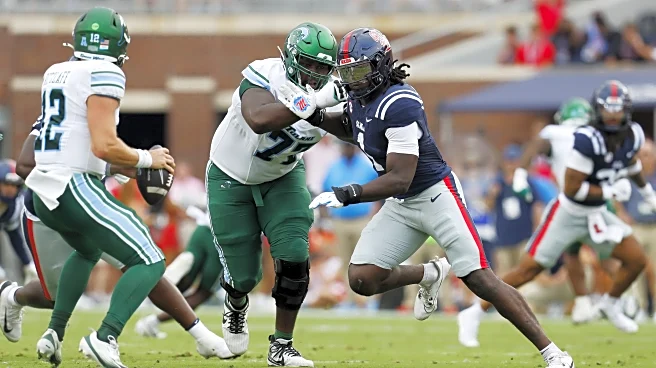
There are two rematches in the first round of the 2025 College Football Playoff — 8-seed Oklahoma hosts 9-seed Alabama and 6-seed Ole Miss hosts 11-seed Tulane. The latter of those games, Ole Miss vs. Tulane, was decided in extremely lopsided fashion in Week 4. The Rebels defended their homefield in Oxford, MS with a seamless 45-10 victory over the Green Wave, but little did we know at the time that would be a CFP preview.
To Tulane’s benefit, teams can be very different from September to December. There are injuries, lineup changes, gameplan shifts, and Ole Miss doesn’t even have Lane Kiffin on staff anymore, as defensive coordinator Pete Golding moved into the full-time head coach role. Amidst all the changes, that Sept. 20 showdown is still quite revealing when previewing this game.
As Pete Golding and the Rebels prepare to host Jon Sumrall and the Green Wave on Saturday, Dec. 20 at Vaught-Hemingway Stadium, here are takeaways from film study in the first game — explaining why Tulane fell 35 points short of Ole Miss during its last trip to Oxford:

Tulane left tackle Derrick Graham missed this game. It was the only contest the two-time All-American Conference tackle missed all season, and it was a vital one. Tulane won the American Conference due to its dominance in the trenches, as evidenced in the conference title game vs. North Texas. Not having Graham for the Ole Miss game was noticeable back on film, and Ole Miss feasted on the Green Wave’s glaring vacancy. Two-time first team all-conference guard Shadre Hurst shift to left tackle while Elijah Baker stepped into the left guard spot for the majority of the game. The restructured line didn’t allow a single sack, but it didn’t exactly allow time for routes to develop either. Ole Miss recorded 11 QB hurries with edge rushers Kam Franklin and Princewill Umanmielen combining for seven. The run blocking was fine, but pass protection was alarming from start to finish.
Tulane’s passing game was disastrous. From a passing standpoint, Tulane approached this game with a strategy of quick screens to the outside, likely a result of expected QB pressures. The idea was to get Bryce Bohanon and Shazz Preston the ball toward the sideline with a few blockers to assist, and those receivers could make a man or two miss for fruitful gains. This gameplan didn’t really get anywhere. Starting quarterback Jake Retzlaff finished 5-of-17 for 56 yards, while backup Brendan Sullivan went 5-of-12 for 48 yards. Once the score ballooned, Tulane entered a desperation mode and slightly leaned off the run in favor of the air, to no avail. Also, the Green Wave were still using somewhat of a two-QB system at the time (Sullivan entered occasionally for gadget plays in the first four weeks), but this was essentially ditched after this debacle, in favor of Retzlaff as the No. 1 option.
Ole Miss’ biggest advantage was the wide receiver corps. This stood out on film maybe more than anything else. Ole Miss’ wide receivers absolutely dominated this game, whether they were pass-catchers or blockers. Anything the Rebels ran to the perimeter was a hit thanks to the blocking of outside receivers De’Zhaun Stribling and Harrison Wallace III. Those two didn’t exactly stuff the stat sheet, but the inside receivers — Deuce Alexander and tight end Dae’Quan Wright — exploited some mismatches. Alexander made several tremendous downfield catches, some through solid coverage, and exited with 94 yards and a touchdown on four catches. Wright only caught three passes for 71 yards, but he managed to get open on nearly every seam he ran, as his defender often crashed toward the quarterback. Also, Ole Miss schemed up its routes really well, redirecting safeties and throwing in eye candy to create one-on-one matchups.
Trinidad Chambliss designed runs were Tulane’s kryptonite. Ole Miss quarterback Trinidad Chambliss only crossed 75 rushing yards once all season, and it was in this 112-yard explosion vs. the Green Wave. This was his second start at Ole Miss, and the Rebels were still figuring out how to best use the two-time Division II national champion quarterback. Designed QB runs worked tremendously against Arkansas’ struggling run defense the week prior, and the Rebels employed a similar gameplan against Tulane. Chambliss proved extremely shifty, and the Green Wave’s front had a very difficult time bringing down the quarterback, even though they tackled Doak Walker Award finalist running back Kewan Lacy without issue. Chambliss’ twitchiness and jukes caused many evaded tackles, and with Ole Miss blocking at a high level, the Green Wave had no answer for the quarterback’s mobility.
Tulane’s fourth down execution was bad. The Green Wave didn’t score their lone touchdown until 3:42 remained in the contest, but there were opportunities throughout. Tulane committed three-consecutive turnovers on downs to start the second half — all in Ole Miss territory. The first one involved a misfire on 4th and goal from the 5, and that was due to outstanding coverage by Kapena Gushiken and the Rebel secondary. The other two were 4th and shorts just before field goal range, and Ole Miss stuffed two rushing attempts. Some silver lining: Tulane wasn’t abysmal on third down and kept moving the sticks with an okay 6-of-15 showing. The team just couldn’t finish possessions upon crossing the 50.
The score was worse than the game looked. It wasn’t like Tulane finished three-and-out and punted every possession. It only lost the first down battle 23-18 and didn’t face its first three-and-out until the fourth quarter, down 38-3. The Green Wave moved the ball okay through the run game, racking up 178 yards at 4.6 yards per carry. Even down Derrick Graham, the o-line got some decent push on Ole Miss at times, allowing Arnold Barnes III and Javin Gordon to record a few solid runs. However, the Green Wave never really broke the big one. Jake Retzlaff improvised exceptionally well with 51 rushing yards, constantly escaping backfield pressure and turning would-be-sacks into commendable pickups. But defensively, the Green Wave didn’t do their job in limiting explosives. They contained the running backs very well, but the secondary’s coverage on intermediate passes was severely lacking, leading to the 45-10 ingrained on the final scoreboard.