





If you’re a fan of Christopher Nolan films, ancient Greek mythology, or that weird Hollywood genre where we spend lots and lots of money to rescue Matt Damon (see: Saving Private Ryan, The Martian, Interstellar, Elysium), then you already know that today, Nolan’s latest film, The Odyssey premiers in theaters. And if you didn’t already know…well, now you do.
“But wait,” you’re probably saying right now. “What does The Odyssey have to do with baseball?” And the answer is…quite a lot, actually. And no,
I’m not talking about that time during the COVID shutdown when I spent two days writing a parody of The Odyssey about Gerrit Cole’s free agency in dactylic hexameter, the first of several Classics-related parodies I have written about the Yankees on this site. Instead, today, I want to talk about arguably the most important characters in the entire epic, the bards Phemius and Demodocus — or, rather, what Phemius and Demodocus represent: storytelling.
Most people tend to think of The Odyssey as the story of Odysseus — after all, in the original Greek, the first word of the epic is ἄνδρα, “man,” and the opening line announces its subject matter as “the many-turned man who wandered.” But that only tells us who the story is about, not what it’s about. At the risk of massive oversimplification, the most important theme in ancient epic is storytelling. When most people think of the tale of Odysseus, they envision the Trojan Horse and the Sack of Troy, a ten-year journey home in which he battles a Cyclops, giants, the god Poseidon, and a witch, is enslaved by a goddess, and finally returns home with the help of the goddess Athena to slay the suitors who sought his wife and throne.
A great narrative, but that’s not how it plays out in the epic, at all. The story starts ten years after the fact, and the only thing that takes place within the narrative space of the epic is Odysseus returning home and slaying the suitors. Everything else — the Trojan Horse, the ten years of wandering — appear as stories narrated by Odysseus, Menelaus, and Nestor. Did they actually happen? In truth, within the text themselves, there’s actually no way of knowing — we have no choice but to trust the storytellers, as they ensure that the great deeds of their past get remembered for generations to come.
In the context of ancient Greece, this makes The Odyssey a metanarrative. Although the epic is attributed to the blind poet Homer, he’s just as much a mythical figure as Odysseus and Achilles (if you didn’t already know that, well, I’m sorry for bursting your bubble). Rather, The Odyssey evolved in a society that was, if not completely illiterate, then at least existed before the development of the Greek alphabet made literature feasible in the ancient Greek language. It was an oral tradition, passed down from traveling bard to traveling bard, a story that evolved and was shaped by the singers and the audience alike. These stories persisted, not because they were some “high art,” but because they continued to resonate with audiences generation after generation.
So how does this tie back to baseball? Well, whether we realize it or not, the way we interact with sports — the way we have always interacted with sports — is through storytelling. The games themselves, they last but a moment. Let’s take another quick detour, this through the basketball world for a second, to a moment that felt for Villanova fans much the same ten years ago as the OG tip did for Knicks fans a month ago: the 2016 NCAA Men’s Championship game. It took just 4.7 seconds on April 4, 2016, for Ryan Arcidiacano to cross the length of the court, flip the ball back to Kris Jenkins, and watch him sink a three at the buzzer to make Villanova National Champions. And yet, those 4.7 seconds have lasted an eternity. More than a decade later, alumni share stories about where they were that night, and what was going through their minds when Marcus Paige hit an unbelievable shot to complete the comeback and tie the game up for UNC, and how the campus went nuts when Jenkins called game. Through these shared experiences, these stories that get told and retold, we bond, and the history remains alive.
Sports does not need its help to create these stories, these shared experiences that create comradery and bring people together. We don’t even need to be sharing the same experience: I can talk about the time in middle school when I was the emergency pitcher, my defense committed four errors in one inning behind me, and we blew a six-run lead in the final inning, my friend can talk about the time her point guard in high school went down with an injury and her team lost a playoff game on a buzzer beater because of it, and we can bond over the shared sorrow and heartbreak of a disastrous, last-second defeat. Real, living and breathing circumstances drive this bond, not something artificial.
And yet, Major League Baseball, in recent years, has fallen in love with artificial storytelling, trying to create narratives, rather than wait for new ones and amplify existing ones. In each of the last two years, they’ve hosted “Rivalry Weekend,” designating rivals fo r teams and forcing them to play each other, and while some of them have some juice (at least the Subway Series has city bragging rights, even if it’s weird the Yankees and Red Sox — baseball’s capital-R Rivalry — don’t play on Rivalry Weekend), others seem created in a lab, and required teams and fanbases to get creative to give it some life (the “Vedder Cup” between the Mariners and Padres is about as artificial as you can get).
This year’s All-Star Game represents a perfect example. Four years ago, when Nestor Cortes and Jose Trevino were both mic’ed up during the All-Star Game, we got to bear witness to one of the coolest innings of exhibition baseball of all time. Repeatedly since then, FOX has tried mic’ing up a pitcher and a catcher at the same time, only for it to fail miserably because the two players did not play together, had never played together, and barely knew each other; the original dynamic only worked because the two players knew and trusted each other.
And this year’s attempt to recreate The Sandlot’s famous Fourth of July scene with fireworks, Ray Charles’ performance of “America the Beautiful” from the 2001 World Series, and kids on bikes, was incredibly cool spectacle. It rings a tad hollow, though, in a world where The Sandlot can’t exist anymore; between summer travel ball and bar leagues hogging up the fields, the incessant need to have middle schoolers participate in summer programs to prepare them for the college admissions process, and the death of third spaces, the idea of a group of kids coming together to just play baseball all day, no matter the weather, all summer long, seems downright laughable. As a fan of the movie, I appreciated the reference, but the intended nostalgia for what the movie represents fell flat — as, I suspect, it did for most people who grew up in the 2000s and 2010s.
I wish I could say it was just the weirdness of the All-Star Game, and in particular the All-Star Game during the 250th anniversary of the United States, but, well, I would be lying if I said that. Almost every national broadcast over the last few years has had this same artificiality, where it felt like, rather than let the story of the game come to them, the broadcast entered the game with a story it intended to tell. This is how you end up with, for example, John Smoltz praising a young pitcher as he gets lit up, a circumstance which I remember (usually happily, because he rarely speaks positively of the Yankees) quite a few times in recent years. There’s talking points, there’s a narrative, and it has to be stuck to, no matter what happens.
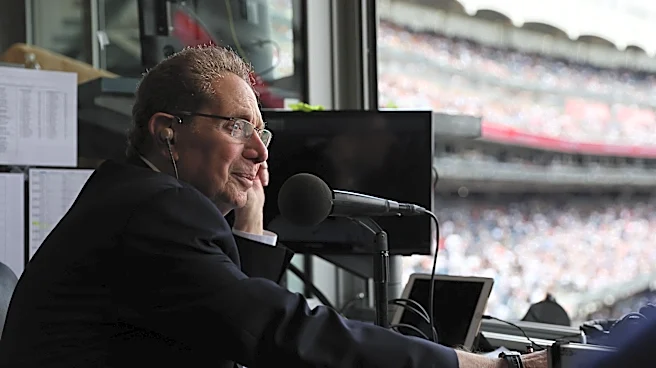
And that’s the real shame of it. Among modern American sports, baseball has arguably the greatest tradition of storytelling. Legendary broadcasters like Vin Scully, Bob Uecker, and John Sterling brought the league to a standstill when they passed, because all felt the loss of their shadow over the game. Their stories made them a presence in our homes, and they shaped the way that fans of their teams talk about their teams, even after their deaths. They were not mere broadcasters; they were the bards of baseball.