



This six-part Colts What If series looks back at some of the biggest turning points in franchise history, from the Peyton Manning draft decision to playoff heartbreak, quarterback pivots and coaching chaos, while revisiting what happened, what could have changed, and how different the Colts might look if one major moment had gone the other way.
There are bad draft picks, there are franchise-altering draft picks, and then there is the 1998 NFL Draft.
The Indianapolis Colts had the No. 1 pick and a choice
between two quarterbacks: Peyton Manning and Ryan Leaf. At the time, it was a legitimate debate. Manning was the polished, prepared, NFL-ready quarterback from Tennessee. Leaf was the bigger arm, bigger personality, bigger swing quarterback from Washington State. There were people who believed Leaf had the higher ceiling. There were people who believed Manning was the safer choice. The Colts had to decide which one would lead their franchise into the future.
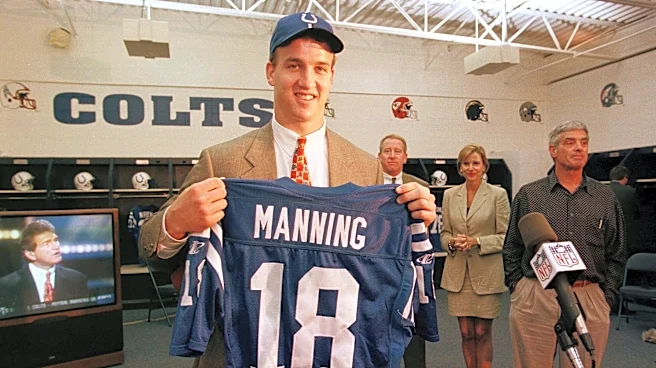
They chose Manning.
That decision changed everything.
Manning became the greatest player in franchise history, one of the best quarterbacks ever (in my opinion the greatest ever), a Super Bowl champion in Indianapolis, and the face of the most successful era the Colts have ever had. Leaf became one of the biggest busts in NFL history. It is easy to look back now and treat the decision like it was obvious, but the better question is what would have happened if the Colts got it wrong.
What if they drafted Ryan Leaf instead of Peyton Manning?
The answer is not just that the Colts would have missed on a quarterback. The answer is that the entire modern history of the franchise probably changes.
Leaf likely starts right away, and it likely goes badly
If the Colts drafted Leaf first overall, he almost certainly would have started early. Teams do not take a quarterback No. 1 overall to sit him for long, especially not a team that had just gone 3-13 and needed a new face of the franchise. Leaf would have been given the job, the offense, and the pressure that came with being the first overall pick.
The problem is that Leaf’s issues were not simply about San Diego.
It is fair to wonder whether a different organization could have helped him more. Maybe Indianapolis gives him better structure. Maybe Bill Polian handles him differently and maybe Jim Mora’s staff creates a different environment. To me, Leaf’s problems were deeper than fit. The maturity issues, the lack of preparation, the emotional volatility and the inability to handle the demands of being a franchise quarterback followed him quickly in the NFL. There is no strong reason to believe Indianapolis magically fixes that.
Maybe the Colts get a slightly better version of Leaf than the Chargers did. Maybe Marvin Harrison and Marshall Faulk early, then Edgerrin James later, help him look more functional at times. But the broader outcome is probably the same. Leaf struggles, the offense becomes unstable, and the Colts are back near the top of the draft.
In his actual career, Leaf went 4-12 as a starter over three seasons. If anything close to that happens in Indianapolis, the Colts are not building a contender. They are trying to survive a quarterback mistake that hit them at the worst possible time.
The Colts probably still build a talented roster
This is where the alternate history gets interesting.
The Colts would not necessarily become a talentless disaster. In fact, missing on Leaf might have given them more high draft picks and a chance to build a stronger roster in other areas.
They already had a top-five pick in 1999 and took Edgerrin James. That likely still happens, or at least something close to it does. James was an excellent pick and became one of the most important offensive players in franchise history. If Leaf is struggling and the Colts remain bad, they are probably picking near the top again in 2000 and 2001.
That could have put them in range for players like LaVar Arrington, Chris Samuels or Corey Simon in 2000. In 2001, they could have had a shot at another major talent like Leonard Davis, Justin Smith or Richard Seymour.
So this alternate version of the Colts may not be hopeless on paper. They could have Marvin Harrison, Edgerrin James, a strong offensive line, and another premium defensive or trench player. In some areas, the roster might even look better than the early Manning teams.
That is the cruel part of this what-if.
The Colts could have built a decent football team. Maybe even a damn good one in certain spots. But without Manning, the ceiling changes completely.
A good roster without a quarterback is not a contender. It is usually a tease… something that we are seeing today in Indianapolis.
By 2001, the Colts are probably done with Leaf
By the time the 2001 season arrives, Leaf would likely either be done in Indianapolis or entering his final chance with the organization. That would have been Year 4 and at that point, the Colts would have seen enough.
The physical tools would not have mattered anymore. The draft-day debate would have been over. If Leaf had followed anything close to his actual career path, the Colts would be forced to admit the pick failed.
Then comes the real problem: where do they go next?
That is the part that makes the Manning decision even more important. The Colts did not just pick the right quarterback. They picked the right quarterback before entering a stretch where finding another one would have been extremely difficult.
The 2001 quarterback market was not saving them. The free agent class was headlined by names like Trent Dilfer, Jon Kitna and Brad Johnson. Those were respectable NFL quarterbacks, and both Dilfer and Johnson won Super Bowls in perfect situations. Those situations were built around elite, all-time caliber defenses. That would not have been Indianapolis.
Dilfer was not coming in and turning the Colts into a contender. Johnson could stabilize a team, but he was not changing the direction of the franchise by himself. Kitna was the definition of a respectable middle-class starter with a consistent 500 record wherever he landed. He could keep you competitive, but he was not lifting a team into the AFC’s elite.
That is probably where the Colts land.
Somewhere around 7-9, 8-8, maybe 9-7 in the right year. Good enough to avoid a full collapse. Not good enough to seriously contend. Good enough to talk yourself into the roster. Not good enough to escape the quarterback problem.
That is quarterback purgatory. Sound familiar?
The draft would not have offered many clean answers
If the Colts missed on Manning, the obvious hope would be that they could find another quarterback in the draft. But that is easier to say than to do.
The early-2000s quarterback window was rough. There were good players in that stretch, but there were not many easy, obvious, clean franchise-saving answers.
From 2000 through 2007, the quarterback draft landscape was not exactly loaded with sure things. The Colts would have had to be in the right draft, at the right spot, with the right conviction, and then they still would have needed the quarterback to develop properly.
The cleanest first-round escape route probably comes in 2004 with Ben Roethlisberger or Philip Rivers. Either one would have changed the conversation. But that means the Colts would have had to wander through several years of failed quarterback play before getting there. It also assumes they would have been bad enough, aggressive enough, or lucky enough to land one of them.
Aaron Rodgers in 2005 is another fascinating possibility, but that is a massive hindsight argument. Rodgers fell deep into the first round because the league did not view him the way it should have. Would the Colts have been in position? Would Polian have pulled the trigger? Would they have already talked themselves into another veteran or another young quarterback before then? It is impossible to know.
The bigger point is simple: if the Colts whiffed on Manning, the draft probably does not hand them an easy replacement.
That is what makes the Leaf pick so terrifying in hindsight. It would not have been a one-year mistake. It would have pushed the Colts into one of the worst possible quarterback-search windows.
Free agency and trades probably do not save them either
Maybe the Colts could have fixed the problem with a veteran. That sounds reasonable until you look at the actual quarterback movement in that era.
There were not many major quarterback trades from 2000 to 2007 that would have clearly saved the Colts. Drew Bledsoe going to Buffalo in 2002 is probably the most realistic early option. Daunte Culpepper to Miami came later in 2006. Matt Schaub went to Houston in 2007. By then, the Colts would have already spent years trying to dig themselves out of the Leaf decision.
Bledsoe is the most interesting name because the timing fits. He was a proven quarterback, he had won in New England, and he could have given the Colts competence. But competence is not the same as transformation. Bledsoe would have helped, but it’s also worth noting that he was nearly a 500 quarterback his entire career and had that type of record after New England, so it’s safe to say he would not have been anything close to Peyton Manning.
The Colts did not just need a quarterback who could function. They needed a quarterback who could define the franchise. Manning gave them that. Bledsoe, Kitna, Johnson, Dilfer or any other stopgap option would have been trying to manage a roster instead of elevating it.
There is also the Bill Polian factor. Polian was a brilliant roster builder, but he was not known for reckless splash moves. He was more likely to build through the draft, trust his evaluations, and avoid desperate swings unless he had to. If the Colts missed on Leaf, Polian probably tries to fix the team with more draft picks, cheaper veterans, and gradual roster building. That’s also assuming he’s still around after picking Leaf over Manning.
That might create a decent team, but it probably doesn’t create a championship team.
Marvin Harrison and Edgerrin James become the stars of a limited offense
One of the strangest parts of this alternate timeline is what happens to the Colts’ great offensive players.
Marvin Harrison still would have been elite and Edgerrin James still would have been excellent. Those players were too good to disappear, but their careers in Indianapolis would be viewed completely differently.
Harrison without Manning is still a great receiver, but he does not become the same statistical force. He does not have the same yearly production, the same chemistry, or the same place in NFL history. Instead of being half of one of the greatest quarterback-receiver partnerships ever, he becomes a great player stuck in a less stable offense.
James might have been even more important in this version of the Colts. Without Manning, the offense likely leans on him heavily. He becomes the centerpiece. He carries the identity of the team. But that also makes his 2001 ACL injury even more devastating. In the actual timeline, Manning helped the Colts survive and eventually evolve. Without Manning, losing James’ peak could have wrecked the entire offense.
That is another reason the Manning pick mattered so much. He gave the Colts margin for error. He allowed them to survive roster flaws, defensive issues, injuries and coaching changes. Without him, everything becomes more fragile.
A great receiver and a great running back can make you dangerous. A great quarterback makes you sustainable.
The 2006 Super Bowl disappears
This is the easiest part of the alternate history.
The Colts do not win the 2006 Super Bowl without Peyton Manning.
That does not mean Manning carried a perfect team. The 2006 Colts had major pieces around him. Harrison, Reggie Wayne, Dallas Clark, Jeff Saturday, Tarik Glenn, Dwight Freeney, Robert Mathis, Bob Sanders and Adam Vinatieri all mattered. The defense got hot at the perfect time.
But the entire operation was built around Manning.
The offense, the tempo, the line changes and audibles, the precision, the weekly problem-solving, the ability to win 12 games even when the roster had flaws. That was ALL on Manning.
Without him, the Colts are not a yearly contender waiting for the defense to hold up just enough. They are probably a team trying to find its next quarterback while wasting pieces around him.
The 2006 title was not just a great moment. It validated the entire era. It changed the way the franchise was viewed. It changed Manning’s legacy. It changed Dungy’s legacy. It changed Indianapolis sports history.
Drafting Leaf likely erases all of it.
The rivalry with Tom Brady never becomes the same
Another major part of the Manning era disappears too: the Colts-Patriots rivalry.
The NFL in the 2000s was shaped by Manning vs. Brady. To me, it’s the greatest player rivalry of all time. It became one of the league’s defining matchups.
Without Manning, the Colts are not that team.
Maybe the Patriots still become a dynasty. They probably do. Maybe the Steelers, Ravens and Chargers become bigger AFC obstacles. But Indianapolis is not a yearly national game. The Colts are not the team everyone circles on New England’s schedule. The AFC does not run through the Manning-Brady debate.
That’s important because Manning made Indianapolis relevant beyond its market size. The Colts became a national franchise because they had a national superstar. They were on prime time. They were in the biggest games. They were a yearly measuring stick.
Ryan Leaf does not create that. Neither does a veteran stopgap. A decent roster with a few blue-chip players does not create that.
Manning did.
The stadium and franchise stability question becomes uncomfortable
This is the part that is harder to say, but it has to be considered.
If the Colts draft Leaf and spend the next decade in quarterback purgatory, what happens to the franchise’s long-term stability in Indianapolis?
Indianapolis was not Los Angeles, New York, Chicago or Dallas. It was a smaller football market with a franchise that was still relatively young in the city compared to other NFL teams. Manning gave the Colts an identity. He gave the city a football era. He helped turn the franchise into a civic institution.
He literally built a new stadium for the city!
If the Colts instead spend 20 years (including the years before Peyton) drifting around .500, missing the playoffs, cycling through quarterbacks and never becoming nationally relevant, the entire perception of the franchise changes.
Maybe they still stay. Maybe the stadium still happens (probably not). Maybe Indianapolis still supports the team through mediocrity (I doubt it), but it is impossible to separate Manning from the stability, relevance and growth of the Colts in that era.
Peyton helped make the Colts feel permanent.
The Colts probably become the team they spent decades avoiding
The more you look at this what-if, the more the likely outcome becomes clear.
The Colts would not necessarily become the worst franchise in football. That is not the point. In fact, with Polian running the front office, they probably still find good players. Harrison and James are already there or likely still arrive. High draft picks could build the trenches and defense.
However, they probably become one of those teams that is always searching.
Searching for the quarterback. Searching for the final piece. Searching for the right guy. Searching for the next draft answer. Searching for the moment when a talented roster finally turns into something more.
That is a painful place to live in the NFL. In fact it’s the worst place and it’s a place the current Colts are in.
It is not hopeless enough to guarantee the No. 1 pick every year. It is not good enough to win championships. It is the middle. And the middle is where franchises can get stuck for a decade. Again… sound familiar?
That is probably the Colts without Peyton Manning.
They are not automatically a 2-14 disaster every season. They are more likely a team with enough talent to tease people, enough bad quarterback play to hold them back, and enough organizational competence to avoid a full reset.
A team with good players and no answer at the most important position.
In other words, a team with a ceiling.
The final verdict
If the Colts drafted Ryan Leaf over Peyton Manning, the franchise spends the next several years trying to recover from it.
Leaf likely starts right away. He likely struggles. By 2001, the Colts are probably looking for another quarterback. The problem is that the free agent market, trade market and draft classes of that era do not provide an easy solution. The Chargers got away with it landing Drew Brees in the draft, but it’s tough to say if the Colts would be as lucky.
The Colts may still build talent. They may still have Marvin Harrison. They may still take Edgerrin James. They may still add high draft picks in 2000 and 2001. They may even build a stronger roster in certain areas than the early Manning teams had.
But none of it matters the same way without the quarterback.
Manning gave the Colts more than production. He gave them direction. He gave them credibility. He gave them a weekly advantage. He gave them a decade of relevance. He gave them a Super Bowl. He gave Indianapolis a football identity.
Leaf over Manning would have changed all of that.
The Colts could have survived missing on Manning. Good organizations survive bad picks all the time, but they almost certainly would not have become the Colts we know now.