
The imperfect man pitched a perfect game yesterday.
So read Joe Trimble’s lead on October 9, 1956 in the New York Daily News. The day prior, a man who was an afterthought on a team in the midst of winning its seventh championship in 10 years, a man known more for his carousing off the field than his performance on it, had achieved the unthinkable. He’d held a Brooklyn Dodgers lineup stacked with five Hall of Famers to 27 plate appearances, permitting none to reach base safely in the first and last
perfect game in World Series history.
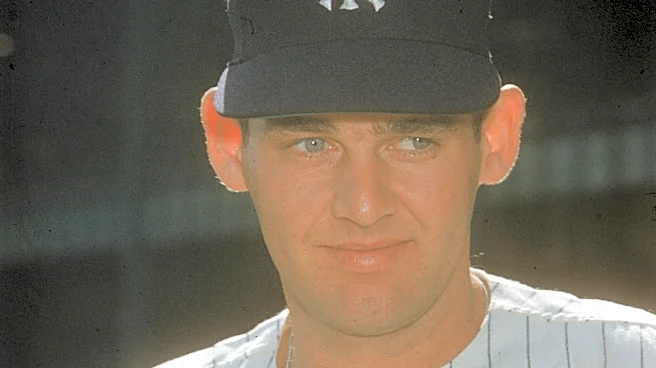
Don James Larsen
Born: August 7, 1929 (Michigan City, IN)
Died: January 1, 2020 (Coeur d’Alene, ID)
Yankees Tenure: 1955-59
Don Larsen grew up on the Indiana side of Lake Michigan. His father, James, played sandlot baseball and passed along the game to young Don, who began playing ball with his father at the age of four. While he was in high school, the family moved to San Diego, where Larsen made the All-Metro Conference basketball team and garnered several college basketball scholarships. The fun-loving Larsen declined. “I was never much with studies, and I didn’t really have an interest in going to college and studying my life away,” he would later say of his decision.
Instead, Larsen signed a contract with the St. Louis Browns, spending four seasons in their minor-league system before he was drafted into the Army in 1951. He played baseball for an Army team at Fort Shafter on Oahu for two years, returning to the mainland in time for spring training in 1953. The 23-year-old pitched well enough to earn a spot out of camp, an achievement he likened to “Christmas in springtime.”
Larsen was a bright spot on the 100-loss Browns as a rookie, tossing a team-high 192.2 innings with a 4.16 ERA. His teammates gave him a delightfully ’50s nickname that would stick with him throughout his career: Gooney Bird. Depending who you ask, the origin of the moniker was either Larsen’s gangly appearance or his outside-the-lines antics.
The Browns moved to Baltimore for the ‘54 season. The newly christened Orioles once again lost 100 games, with Larsen taking the decision in an MLB-high 21 of them. He won only three games but two came against the mighty Yankees, drawing the attention of the team’s manager, Casey Stengel.
Following the season, he was traded to New York in a mammoth 17-player deal that also netted the Yankees future Cy Young Award winner Bob Turley. Larsen was injured to start the year but pitched well once recalled, going 9-2 in 19 games (13 starts) to help his new team to the pennant. He drew the start in Game 4 of the World Series against the Dodgers. With the Yankees up two games to one and the chance to stake them to a commanding series lead, Larsen faltered, allowing five runs — including two long balls — in four innings as the Dodgers coasted to victory. After the Yankees lost to their chief NL rivals in Game 7, Larsen remained positive about his experience. “I had stretched beyond my childhood dreams by playing for the Yankees in the World Series,” he would later recount. “Even though we lost the championship to the Dodgers, I was thankful to have been even been there in the first place.”
The next year shaped up similarly. An 11-5 record in the regular season as the Yankees repeated as AL champs, followed by an even more frustrating World Series outing against the Dodgers in which he walked four in 1.2 innings as the Yankees coughed up an early six-run lead.
This is where reality and myth start to become inextricable. There’s as much lore around Larsen’s perfect game as any event in Yankees history. New York Daily Mirror writer Arthur Richman later relayed that Larsen told him the night before on the way back from the bars that he would pitch a no-hitter. This was likely impossible given Stengel’s habit of informing pitchers whether they would start on game day, employing his coach, Frank Crosetti, to place a baseball in the starter’s shoe. Much like David Wells, the next Yankee to reach perfection, there’s been much written about the extent of Larsen’s hangover that game day as well.
Whatever the merit of these stories, Larsen took the mound at Yankee Stadium on October 8 prepared to face a lineup that had twice torn him to shreds. The outcome would be different that day, with the 27-year-old needing just 97 pitches to carve up one of the most potent lineups ever assembled. After throwing his improbable perfecto, Larsen jogged off the mound and was intercepted by a euphoric Yogi Berra, the catcher who he hadn’t shaken off a single time all day. Yogi jumped into Larsen’s arms, and a piece of Americana was born.
Larsen would pitch for 10 more seasons but, naturally, never match the majesty of his finest achievement. He embraced the narrow scope of his baseball legacy. “I have thought about that perfect game, more than once a day, every day of my life since the day I threw it,” he said in 2012.
Larsen spent three more years in New York, mostly serving as a mediocre swingman but making four more October outings. In the ‘58 Fall Classic, he held Milwaukee off the board for seven innings in an eventual 4-0 victory and pitched 2.1 more innings of one-run ball in the decisive Game 7 to earn his second ring. He’d pitch for six more teams after departing New York at the conclusion of the ‘59 season, including a return to the World Series as a member of the Giants in 1962, pitching back at Yankee Stadium in Games 3 and 4. Larsen made his last appearance with the Cubs in 1967, weeks before his 38th birthday.
After the conclusion of his playing career, Larsen moved to San Jose, where he worked for many years as a paper salesman. After retiring, he moved to Idaho, though he was always a safe bet to return to the site of his former glory each Old-Timers’ Day.
Larsen died in 2020 at the age of 90. Please join us in remembering perhaps the most unlikely of Yankee legends, the everyman who for one day was perfect.
See more of the “Yankees Birthday of the Day” series here.