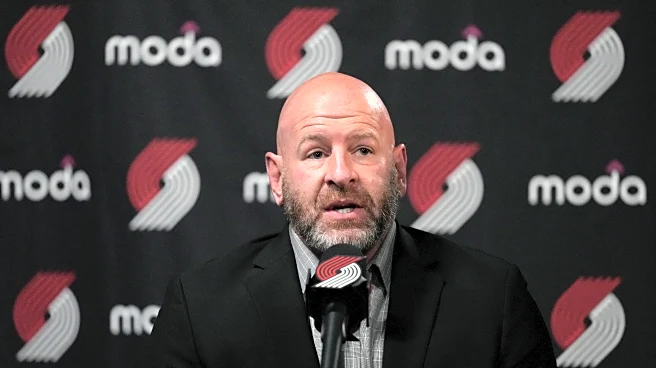

Joe Cronin has worn several hats over his 20 years with the Portland Trail Blazers organization. Originally hired in 2006 as a Basketball Operations intern, Cronin worked his way up the sports executive
ladder. He held the titles of Pro Scout, Salary Capologist, Director of Player Personnel, and Assistant General Manager before being appointed the General Manager under tumultuous conditions in December 2021. This week we’re going to examine Cronin’s tenure as the Blazers’ chief architect over two articles because there’s a lot to unpack.
When critiquing the job Cronin has done, we have to look at the cards he was dealt when his boss was fired and he inherited the job. Back in 2021 the organization, while in the midst of making the playoffs for eight consecutive seasons, was still in the aftermath of the death of passionate long-time owner, Paul Allen three years prior. His sister Jodi and longtime business associate Bert Kolde, sat atop the Paul Allen Family Trust as its stewards. Following Allen’s death, the pair placed their trust in President of Basketball Operations Neil Olshey. But during that 2021 season, claims against Olshey came to light.
Things weren’t going well on the court at the time either. After orchestrating an incredible Western Conference Finals run in 2019, Olshey continued to tinker, adding different role-playing talent around superstar Damian Lillard and his sidekick, CJ McCollum. The result was a declining, expensive, veteran-heavy roster that did not mesh. Many fans argued for splitting up the dynamic backcourt duo. However, Olshey staunchly kept them together, in the process making the roster smaller, less physical, and a trainwreck on defense. Rip City had a superstar, but couldn’t get out of its own way.
Olshey eventually used his last trick in the bag of self preservation. He fired long-time head coach Terry Stotts, who had arrived back in 2012. He then made a controversial hire in first-time head coach Chauncey Billups. To pour gas on the situation, Olshey conducted Billups’ introductory press conference without tact, brushing aside questions of suitability and background checks.
Fast forward into December, the Blazers were 11-18, starting 3 guards who stood at 6’3” making a combined $90M. That’s before we get to the youngest 6’3” guard, Anfernee Simons, in need of minutes and a rookie extension after the season. The roster was facing a dreaded and punitive Repeater Salary Tax by the end of the season. Damian Lillard had to be shut down with an abdominal issue. The team was playing discombobulated basketball under Billups, seemingly on-the-job training as a NBA head coach.
Then the other shoe dropped. Olshey was found to be in violation of the team’s Code of Conduct policies by an independent investigation, suggesting his guilt in the allegations of creating a “toxic work environment”. The disgraced exec immediately vanished from Portland.
The final tally of what Joe Cronin inherited:
- A broken, imbalanced roster facing huge tax penalties.
- A broken culture under Olshey.
- A hobbled 32-year-old superstar, who was growing impatient with the team being reactive instead of proactive.
- The pressure to “win now” with Billups, Dame, and veterans while having an empty cupboard in terms of assets to move the existing team forward.
- A first time head coach with very little coaching experience, who was struggling to keep his head above water.
- Two interesting, but significantly flawed young prospects in Simons and Nassir Little.
- Locked control of its own first round draft pick until it conveyed to the Chicago Bulls by 2028, making further trades more complicated.
Stepping into the Blazers’ General Manager position would have been a challenge for Sam Presti or Jerry West, let alone a first-timer who many associated with the Olshey regime to begin with. Was Cronin going to be an extension of Olshey, and keep chasing the dream of building around Lillard? Or would he look to chart a new course?
While he flirted with the former, he has leaned hard into the latter.
The terms “retool” and “rebuild” get used a lot, but we often don’t give the tear down phase of the process enough weight. This is the messy dismantling stage of moving tenured vets and/or coaches, while trying to get your salary cap in order and add the best possible assets to start your rebuild with. While the retool might begin immediately in theory, the tear down of the Cronin led Blazers really only finished this past offseason by trading Simons and waiving Deandre Ayton.
In these articles, I’m going to grade Joe Cronin’s 5 seasons of being GM on 5 categories: Trades, Draft, Free Agency, Cap Management, and Culture. These grades will reflect where the Blazers started in January 2022 up to where they are now in January 2026.
Since it’s the most extensive subject, today I’ll simply focus on trades.
Joe Cronin has made 11 trades during his GM tenure, but three (technically four) stand out above the rest in terms of their importance.
Breaking up the Backcourt
When Cronin took over as GM, many fans wanted to see immediate action and questioned if he had the same loyalty to CJ McCollum as Neil Olshey did. After a month on the job, Cronin answered by dealing McCollum to the New Orleans Pelicans. The returning assets coming in were highlighted by ideal role player Josh Hart. The 6’5” swingman was known for being the league’s leading rebounding guard, a scrappy defender and competitor, and a consummate “glue guy”. In terms of creating a different fit in the backcourt next to Lillard, Hart represented a more ideal fit than CJ, who had several overlapping skills with Dame. Hart provided better defense, elite rebounding, similar playmaking, and less of a need to dominate the ball than McCollum.
When acquiring Hart, Cronin had this quote that gave a glimpse into the kind of roster he wanted to start building.
“Josh embodies what we are trying to build here. The talent level, the skillset, the competitiveness, the IQ, the defensive-minded, guard-anyone approach. His ability to make others better, to make shots, and push the ball.”
Hart would play in 19 games for the Blazers the rest of that season and average 20 points, 5 rebounds and 5 assists, while showing some interesting chops when being asked to score. One could envision the fit with Lillard, expected to return the following season 100% healthy. The lopsided-salary trade also allowed Portland to create a $21 million trade exception, which was designed to fit the salary slot of Detroit’s Jerami Grant who was making a little south of $21 million. The plan was to acquire both Hart and Grant at in a retooled starting lineup around Lillard. The Grant acquisition had to wait until a few days before the 2022 NBA Draft due to the nature of the first-round pick involved.
The CJ, Larry Nance Jr, Tony Snell trade brought back New Orleans’ 2022 first round draft pick if it fell between the 5th and 14th slots. It seemed like a solid gamble at the time of the trade, as NOP was hovering in mid to late lottery territory, similar to the Blazers. The Pelicans responded with an unlikely Play In run that put them into the playoffs as the 8 seed. The Blazers lost the chance to add a second lottery pick in the fold, and because the NOP pick didn’t convey, it was replaced by a Top 4 protected 2025 first round pick from Milwaukee. That pick turned out to be good enough to send as the primary piece in acquiring Grant from Detroit that June.
The other piece of the CJ trade that deserves mentioning is the Blazers acquiring young wing Nickeil Alexander-Walker from New Orleans, and then immediately flipping him to Utah for wily, yet injured Joe Ingles. “NAW” has evolved into a steady, role playing 3&D wing, who would be great for the current Blazers roster. He’s in Atlanta now scoring 21 points a game on 38% shooting from downtown. Ingles never suited up for Portland.
Overall, the Hart trade and ensuing set up to acquire Grant for CJ McCollum and parts gave the Blazers more size, more defense, and positional versatility. It would represent the Blazers’ best effort to retool around Dame with the assets they had to work with, demonstrating a level of creativity to turn CJ into two viable starters. It also showed the fanbase that Cronin was serious about taking risks that his predecessor flat out refused to do.
TRADE GRADE: B
Dame Makes a Trade Request
After coming back from his abdominal injury, Lillard was excited to play with his new teammates: Grant, Hart, Justice Winslow, the newly-promoted Anfernee Simons, and Portland’s talented new lottery pick, Shaedon Sharpe. Dame put in a career year scoring 32.2 points per game in the 2022-23 season, including a career- and franchise-game-high of 71 points. After a promising 10-4 start to the season, the whole thing began to unravel. By the trade deadline, Hart had been traded to New York for reclamation project Cam Reddish and the Knicks’ 2023 first round pick (Kris Murray). Simons looked like a lesser CJ McCollum. Winslow surprisingly provided the tough grittiness that tied the Blazers hot start together, alas, his fragile body did what most chronically-injured athletes do. It quit on him.
The starters would be shut down shortly after the trade deadline and the team limped to a 33-49 finish. 6 wins better than the previous season. The prize for that suffering was the Blazers landing the Number 3 Pick in a very top heavy 2023 draft class. It was reported that Portland looked to shop that pick along with Simons to see if a star upgrade was available on the trade market. Rumors had the Brooklyn Nets turning up their nose to that offer when approached about defensive ace Mikal Bridges. The Toronto Raptors were supposedly also contacted about OG Anunoby and Pascal Siakim. The response was “what else you got to add?”
When Cronin announced that the team would be using the 3rd pick, supposed generational point guard prospect Scoot Henderson fell into the team’s lap. Excitement began to buzz around the Henderson hype, but for the team’s superstar it was the last straw to draft his replacement instead of finding him immediate help. It had been 28 years since Portland had a superstar request a trade, but that’s what Damian Lillard did on July 1st, 2023. Dame made Cronin’s task more difficult by demanding he be traded to the Miami Heat only.
The summer of 2023 will be remembered as the great stalemate, as public pressure mounted on Cronin to just cave in and give Dame away for the scraps Miami was offering. Lillard’s demand appeared to corner Cronin’s ability to negotiate a fair deal. When Lillard was still on the roster going into training camp, he said he would show up as normal.
Just a few days before the season started, Dame was dealt to the Milwaukee Bucks to join with Giannis Antetokounmpo. Cronin served up a curveball in the tricky trade of a superstar. It was only the first part of a huge windfall that has continued to pay dividends for where the Blazers stand today.
The trade: Damian Lillard to Milwaukee. Jrue Holiday, first round pick swaps in 2028 and 2030, and an unprotected 2029 first round pick to Portland. To make the entire thing happen, it required the Phoenix Suns to enter the deal. Portland sent Jusuf Nurkic, Nas Little, and Keon Johnson to the Suns, while Milwaukee sent wing Grayson Allen to Phoenix. Portland received mercurial but talented center Deandre Ayton and late second-round rookie Toumani Camara.
The Blazers had made a trade that garnered them significant future draft capital. While the pick swaps are currently just theoretical, the current climate in Milwaukee suggests the Giannis era is winding down, and a major rebuild is on the horizon just as the first pick swap option becomes available two drafts from now.
Obtaining the valuable Jrue Holiday, whom no one thought would be available, was a coup by Cronin, as he immediately saw the additional value he could get by moving Holiday. A few days later, Holiday was sent to Boston for Malcolm Brogdon, Robert Williams III, Golden State’s 2024 first round pick (14), and Boston’s unprotected 2029 first round pick.
The entire Dame trade was a masterclass in GMing. When it appeared throughout the summer Portland was perhaps going to settle for Tyler Herro, Nicola Jovic, salary filler, and one Miami first round pick, they turned their disgruntled and aging one-way superstar into three first round picks, two attractive pick swaps, a young former #1 overall pick in need of a fresh start, plus oft injured vets, who were valuable mentors and backups in Brogdon and Williams III. The final piece, insisting on Camara, really pushes this trade to the best grade possible.
TRADE GRADE: A+
Draft Night 2024
The Blazers entered the 2024 NBA Draft holding the 7th pick (their own from tanking), and the 14th pick (the Golden State pick acquired by sending Holiday to Boston.) This draft was getting panned by every draft expert as being one of the worst in memory. Before the draft started, it was announced the Blazers traded the 14th pick, along with Brogdon, the second-best pick of the three 2029 firsts Portland held (theirs, Milwaukee’s, and Boston’s), and two second round picks to the Washington Wizards for young Deni Avdija.
Avdija had long been a favorite of assistant general manager Mike Schmitz, going back to his teen years. He saw Deni as a player who was being misused, but possessed ideal size and skillset to have a chance to breakout in the right situation. Many thought the trade was an overpay at the time, sending 2 first round picks for a guy averaging 15 and 7. I think we can safely say…the rest is history. Whenever you start a rebuild, you stay in that phase until you find your next star that provides a solid blueprint to build around.
TRADE GRADE: A
Trades Final Grade
It’s clear that Cronin has done well for the Blazers in his major moves. His final grade for trading is a B+, but it could move to a solid A if the Bucks’ swaps pay dividends.
Before that, though, I’ll touch on other major trades in the next article that focuses on Cronin’s drafts, free agency, cap management, and culture before assigning an overall grade. Until then, how would you grade Joe Cronin in the trade market? Share in the comments section below.