



THIS IS A GUEST ROCKPILE BY CORY COHEN (@cocomajobo.bsky.social)
A lot has been written about the many ways in which the 2025 Colorado Rockies were not very good at baseball.
Most of the reasons come down to the usual suspect of poor talent that cannot easily be fixed. There is, however, one aspect of the team’s terrible performance last year that can, theoretically, be addressed without needing to overhaul the roster: good ol’ thievery.
Last year, the Rockies did steal 87 bases, which ranked a totally
forgettable 23rd in the league. The problem is, they were caught a whopping 39 times en route to that total. That comes out to an abysmal 68.5% success rate, which ranked dead last. The second worst were the Kansas City Royals — a full 4% above them. Meanwhile, the New York Mets led the league all the way with an 88.4% success rate (more on them later).
The first instinct when seeing these numbers is to assume that the team was just slow.
In fact, the ‘25 Rox were pretty darn fast. All six players who got at least 100 opportunities had a sprint speed above the league average mark of 27.0 ft/sec. As a team, they ranked third in terms of average sprint speed at 27.9 feet per second behind only the Milwaukee Brewers (28.0 ft/sec) and Philadelphia Phillies (28.1 ft./sec).

So, if they’re fast, what makes them so bad at stealing bases?
There’s a ton of factors that contribute to something as messy as this, but let’s take a look at one that’s surprisingly simple.
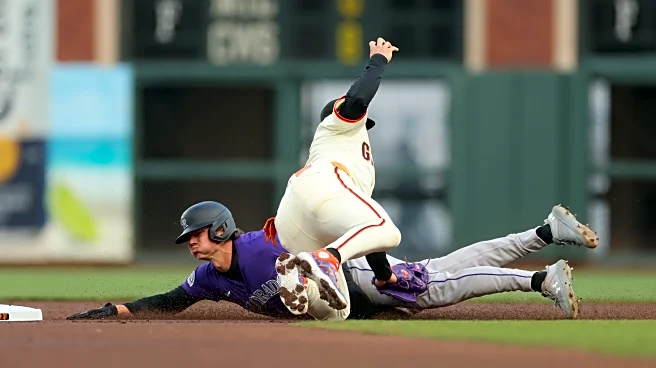
Here’s Tyler Freeman attempting to run on Merrill Kelly:
Now compare that with Francisco Lindor against Quinn Priester:
Before the pitch, Lindor is already in motion, but Freeman remains static. By the time of the pitcher’s first move, Freeman only has a 10.7-foot lead while Lindor has already achieved a 15.5-foot one. That’s not even getting into how Lindor’s momentum lends itself to an easier time committing to the sprint.
Granted, Lindor is pretty fast (only 1.1 ft/sec slower than Freeman), so he’s perhaps an imperfect example, but you know who isn’t? Juan Soto.
After joining Lindor’s Mets, Soto started practicing an approximation of his patented home plate shuffle at first base. He proceeded to steal 38 bases in only 42 attempts despite sporting only the 549th sprint speed in the majors. The Mets as a whole had an average lead of 13.1 feet on stolen base attempts, which was comfortably the highest in the league, to go along with being last in sprint speed. That combination of furthest lead but slowest speed led to, as mentioned above, the best stolen base success rate in the game.
The Rockies average lead of 10.6 feet, on the other hand, was down at 24th — only 0.2 feet further than the league-worst Chicago White Sox.
Baseball Savant’s clip archive is full of stolen base attempts similar to the Freeman example above. Sometimes the pure speed of someone like Doyle allowed them to get away with it. Far too often, though, nearly everyone on the team from Ezequiel Tovar, to Jordan Beck, to even Zac Veen just ran themselves into an out using this technique.
What’s more, that lack of aggression does not actually appear to have saved the Rockies from being picked off. In ‘25, the New York Yankees (who Soto does not appear to have shuffled for at first base for in ‘24) were the only team to suffer more pickoffs than the Rockies while having a longer average lead on stolen base attempts. This is, perhaps, indicative of the runners having enough information on the pitcher to know when it’s safe to commit but the main point is that the formula isn’t as simple as: more lead distance equals more pickoffs.
What does this mean for this year’s Rockies?
Simply that their base stealing problems are solvable with the current roster. The foot speed is in place. With a few tweaks to their plan of attack and, dare I say, a little bit more confidence, they have the ability to turn at least this one weakness into a possible strength.
Come Opening Day, I know I’ll be watching first for any hints of Soto-esque shuffling.
Keith Law’s take on the current state of the Rockies farm system is tepid but optimistic about the combination of raw talent and a new front office. In terms of individual players, he is high on both Roldy Brito (3rd) and Jackson Cox (4th). On the flipside, Law throws some cold water on the idea of Roc Riggio as more than “an emergency call-up” long term and appears to be lower than the consensus on Cole Carrigg (17th) because he “hasn’t really made any adjustments since the Rockies took him in the second round in 2023.”
Top Five Black Players in Spokane Indians History | MiLB.com
Part of a series MiLB is running in celebration of Black History Month that looks back at standout Black baseball players for minor league clubs. This is a fascinating group of names that places former RoY/Cy Young/MVP Don Newcombe alongside Curtis “Big Rig” Terry, who only had thirteen games in the majors but absolutely raked for Spokane in 2018 en route to Northwest League MVP. Most notably for this crowd, Jay Gainer, whose only big league time came as a member of the Rockies in their inaugural season, makes the honorable mentions.
The Rockies AA affiliate announced on Monday that they’ll be hosting a couple throwback games using one of their old team names on May 27th & 28th. The New Britain Rock Cats, as they will once again (briefly) be named, was far from the first identity of the club as Declan Walsh explains. With the now Yard Goats having had three team names, multiple major league affiliates, and many northeast cities as their home, it makes for a fun quick read.
Please keep in mind our Purple Row Community Guidelines when you’re commenting. Thanks!