









Welcome back to BCB After Dark: the coolest spot for night owls, early risers, new parents and Cubs fans abroad. Come on in and cool off with us. There’s no cover charge. The dress code is casual. We still have a few tables available. There’s a two-drink minimum, but it is bring your own beverage.
BCB After Dark is the place for you to talk baseball, music, movies, or anything else you need to get off your chest, as long as it is within the rules of the site. The late-nighters are encouraged to get the party
started, but everyone else is invited to join in as you wake up the next morning and into the afternoon.
Last night, I asked you if you would be like to see the Cubs trade for Aroldis Chapman again. The last time the Cubs did that, they won the World Series. This time, 55 percent of you would like to deal for the older (and hopefully wiser) Chapman.
Here’s the part with the music and the movies. You’re free to skip that if you want. You won’t hurt my feelings.
Tonight we have the great Chet Baker singing “Time After Time” in 1964. No, not the Cyndi Lauper song of the same name that Miles Davis covered. This is the Sammy Cahn and Jule Styne standard from 1947.
Sorry I don’t have any more information than that.
When I wrote about director Alex Cox’s Straight to Hell a couple of weeks ago, I gave it a “thumbs down” in Siskel & Ebert parlance and compared it unfavorably to Cox’s next film, Walker (1987), which I called a good movie. Well, one of you in the comments called Walker “unwatchable.” That made me realize I hadn’t seen Walker in 25 years or so and maybe I should check it out again to see if I was wrong. Having now re-watched Walker, I’m sticking to my guns. Walker is a good movie. It’s not a great movie. It’s definitely a flawed movie. But its strengths outweigh its weaknesses and that pushes it up into the “good” category.
Walker is the mostly true story of William Walker, who was an American “filibuster” who lead a group of 60 mostly American mercenaries down to Nicaragua in the 1850s. They overthrew the government and Walker was the de facto leader of Nicaragua from 1855 to 1857 until he got in trouble with his rich American backers, who wanted to control the overland passage from the Caribbean Sea to the Pacific. He was overthrown by the Nicaraguans and other Central American armies and eventually executed in 1860.
In this telling, William Walker (Ed Harris) is a noble man who is driven by a belief that he can do great things on earth. This belief in his divine providence is reinforced when his first attempt to conquer what is today Baja California in Mexico failed, but he was able to escape and was acquitted of criminal charges when he returned to the United States.
Walker’s messiah complex is tempered by his deaf fiancée Ellen (Marlee Maitlin), who wants him to give up his adventuring, marry her and do something positive with his life like abolish slavery in the United States. However, her sudden death from cholera causes him to accept Cornelius Vanderbilt’s (Peter Boyle) offer to support him in an effort to conquer Nicaragua.
Walker goes down to Nicaragua with noble intentions of bringing democracy and freedom to the people. But first, his American backers forced him to abandon his abolitionist positions. His men are far more interested in raping and pillaging the countryside than they are in spreading democracy. The longer Walker runs Nicaragua, the more he abandons his original noble ideas and becomes a tyrannical leader. He also becomes more and more mad with his own messiah complex. Meanwhile, Doña Yrena (Blanca Guerra) seduces him while secretly planning his demise.
Cox is clearly using the story of William Walker as a satire of the proxy war the United States was carrying out in Nicaragua during the 1980s. In case that wasn’t clear, there are copies of Time and Newsweek with Walker’s face on it. Commodore Vanderbilt has a personal computer. These anachronisms not only reinforce that connection between the events of the 1850s and the 1980s, but they also add to the anarchic “punk” sensibility of the film. That “punk” aesthetic is also reinforced by a pretty terrific score by former Clash frontman Joe Strummer.
The strongest part of Walker is the performances, with Ed Harris turning in a particularly good one as William Walker. He’s initially played as sympathetic if a little delusional, but by the end it’s all delusion, with little humanity left. The two main women in the film, Matlin and Guerra, are also voices of sanity that speak to Walker but he can’t hear. (OK, Matlin is the “sign” of sanity, but like the real William Walker, the film version learned sign language and understands everything she tells him.)
Walker is by no means subtle in its critique of American policy in Central America, either in the 1850s or 1980s, nor is it subtle about the way it portrays the rich as the puppet masters of everything that goes on. It’s up to you whether or not the anachronisms bother you. I find them to be an interesting approach to the film, but it’s not going to help you suspend your disbelief. The film also has an anarchic, disjointed edit that breaks the story’s natural flow. How much all this bothers you is for you to decide.
Walker was a huge flop when it came out in 1987 and it pretty much ended director Cox’s career in Hollywood just as it was starting. He was never asked to direct a studio picture again and even his independent films struggled to get American releases.
As I said, Walker isn’t a perfect film. It’s an interestingly flawed film. But I’d much rather watch something that swings for the fences than something that plays it safe and delivers a by-the-book film that I’ve seen many times before.
Here’s the original trailer for Walker.
Welcome back.
I don’t have to tell you how many problems the Cubs have gone through this year. This post points out that the team has lost an entire pitching staff and we’re not even to the All-Star Game yet.
Despite the carnage, the Cubs are now 11 games over .500 and in possession of the first Wild Card spot and home field in the first round of the playoffs. Yes, there were some dark times in May, but the team seems to have righted the ship and are now playing like one of the best teams in baseball.
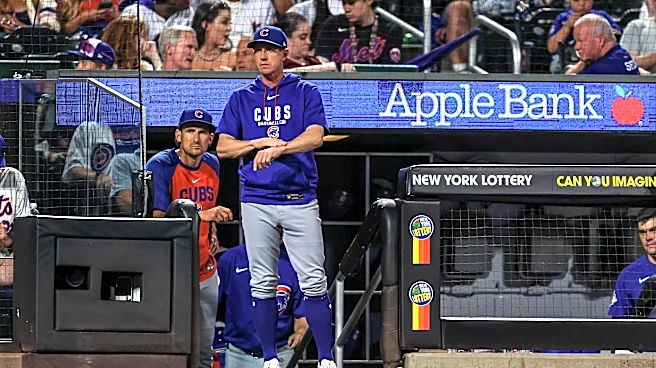
This brings up the question of who deserves the credit for this. The players, obviously. But I think you have to give a lot of credit to manager Craig Counsell. He’s had to find enough pitchers to get enough outs to get the wins.
So give Craig Counsell a grade for this season.
Thank you for stopping by. We’ve enjoyed seeing you here. Please get home safely. Recycle any cans and bottles. Tip your waitstaff. And join us again next week for more BCB After Dark.