






Hello All! After a busy summer, I am happy to return to Pounding the Rock with my first article of the 2026-2027 season. Although I won’t be writing my usual graded box score pieces for each game, I am excited to introduce a weekly power rankings series based on the average Four Factor Index (aFFI) that I first wrote about last year (interested readers can get a brief overview of the methodology behind this index here).
As noted last season, the basic idea behind aFFI is that it assesses a team’s
average performance during a defined period (e.g., the season to date, the most recent X-game period, etc.) based on the team-opponent differentials it has achieved with respect to Dean Oliver’s Four Factors of Basketball Success: effective field goal percentage (EFG%), turnover percentage (TOV%), offensive rebounding percentage (ORB%), and the ratio of free throws made to field goals attempted (FTM/FGA). Because aFFI focuses on team-opponent differentials, I add a delta symbol in front of each term (i.e., ∆EFG%, ∆TOV%, ∆ORB%, ∆FTM/FGA).
In contrast to the highly subjective and vaguely defined “rich tapestry” approach of many sports media pundits (looking at you Nick Wright), the aFFI ranks teams based on purely objective, observable statistics. Furthermore, over the course of a season, the relationship between aFFI and win percentage is exceptionally strong, with variation in the former accounting for just over 95% of variation in the latter in the 2025-2026 season, as shown in Figure 1 below. In short, over a sufficiently long period, a team’s aFFI is highly associated with it’s ability to win games.
As powerful a tool as aFFI can be, it is critical to note that the current NBA season remains extremely young, with the average team having only played 12-13 games thus far. As such, we are still firmly in territory where small sample sizes can generate anomalous patterns, sometimes resulting in a striking disconnect between any given team’s aFFI and observed wins. Although this means that we should take these early season rankings with a grain of salt, it does not necessarily mean that the more surprising results are purely statistical artifacts. In fact, some of these findings provide valuable insights about teams that are likely notably better or worse than their current record might suggest. Bearing all of this in mind, Figure 2 below provides the full aFFI power rankings for the 2026-2027 season to date, reflecting all games played through November 12th.
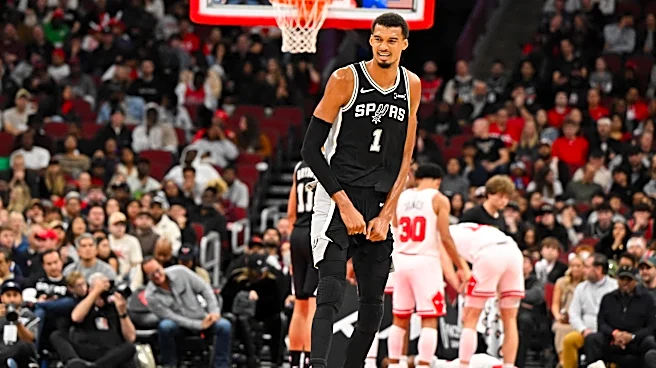
How are the Spurs looking so far this season? They currently rank fourth according to aFFI behind Minnesota, Boston, and Houston, although the range of scores between 2nd (Celtics) and 5th (Lakers) place is quite narrow. A deeper dive into the individual factors reveals that San Antonio’s current position stems from them being very good everywhere but not exceptional in one or two key areas that receive an outsized amount of weight in determining aFFI. In particular, the Silver and Black’s average ∆EFG% percentile (55.46) suggests that they’ve typically had a solid but unspectacular edge in shooting efficiency from the field over their opponents. Because the ∆EFG% average percentile receives a nearly 47% weight in calculating each team’s final aFFI, this plays a huge role in diminishing their overall ranking. San Antonio has performed better with respect to the other three factors, especially ∆ORB%, where they enjoy the second highest average percentile of any team in the league.
The importance of relative field goal shooting efficiency in driving aFFI is showcased especially well by first-ranked Minnesota, a team that is actually worse that the Spurs according to every average percentile outside of ∆EFG% (including a subpar ∆FTM/FGA average percentile value of just 46.17). However, the Timberwolves have been absolutely crushing their opponents in relative field goal efficiency through a combination of solid offensive efficiency and excellent defense. As a result, their ∆EFG% average percentile is 70.34, over two points higher than the second-ranked team in this area (the Blazers) and almost 15 points higher than San Antonio.
Examining the current set of aFFI rankings as a whole, one generally finds that each team’s ranking is highly correlated with its win percentage, as well as common assessments of team quality that exist across the sports media landscape. However, there are some notable exceptions worth discussing, as Figure 3 illustrates below. Chief among these is the Philadelphia 76ers, who currently rank just 15th in aFFI despite enjoying a 10-3 record and significant positive buzz about their status as a championship contender. In a vacuum, this outcome seems to cast doubt on the viability of aFFI; however, there are at least two key issues to consider:
- Philadelphia’s average ∆EFG% percentile (47.59) is solidly below average, which is extremely ominous in a sport where relative offensive efficiency is an overwhelming determinant of long-run success. This issue shines through across several of the most basic box score statistics. For example, the 76ers’ currently rank 21st in the league in points per game (111.1), have a PPG differential of just +1.8, and have a lower average FG% and eFG% than their opponents. Put simply, although Philly has managed to display an impressive aptitude for winning early in the season, their current statistical profile is much more aligned with that of an average NBA team.
- As mentioned above, the average team has only played about a dozen games so far this season. Consequently, it’s still too early to talk about aFFI scores as providing a truly rigorous, mature representation of team quality. Once again, the 76ers’ current situation is illustrative, as their schedule to date includes three bad losses and a number of close wins. Without many other games to look at, this small collection of events probably paints a bleaker statistical picture than the team truly deserves. In other words, it wouldn’t surprise me if Philly eventually emerges as a true contender according to aFFI over time, the limited data to date just aren’t consistent with that profile.
Given how much basketball remains, I cannot emphasize enough that this first entry in the aFFI power rankings for 2026-2027 should be treated with caution. Even so, the season to date has seen the emergence of a tentative set of front runners, including the surging Silver and Black (who could easily climb into second place with a good performance tonight). I expect that a few teams will rise steadily up the rankings over time, with Philly and Atlanta being especially likely candidates. In any case, I look forward to providing an update next week!