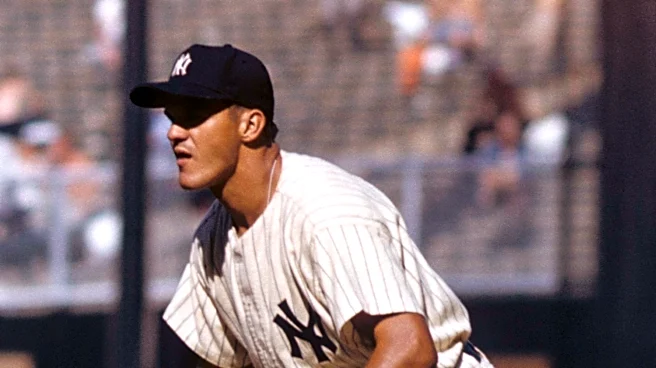


As we continue through the summer months of our illuminating Yankees birthday series, we are taken to every corner of baseball history. In the case of a day like today, we may dive into a career that was solid in one way or another, but only features a brief chapter with the Yankees. Joe Oliver played in over 1,000 big league games over the course of a 13-year career, won a World Series, and of course, made a brief stop with the New York Yankees as it was winding down. Today, the former world champ
turns 61.
Joe Oliver
Born: July 24, 1965 (Memphis, TN)
Yankees Tenure: 2001
Born in Tennessee in July of 1965, Joseph Melton Oliver developed his game in Florida, attending Boone High School in Orlando as a standout behind home plate. His time there was convincing enough for the Cincinnati Reds to select him in the second round of the 1983 draft.
Although Oliver first became a professional when he was just 17, it was a longer road through the minors, but he would finally make his big league debut in the 1989 season. Oliver registered a hit in his very first MLB at-bat, and his career was off and running. He’d play in 49 mostly fine games during the ‘89 season, but would begin to make a much bigger mark in the following year.
Oliver played in 121 games in 1990 for the Reds, coming to the plate more than 400 times as their primary catcher during the regular season as Cincinnati went wire-to-wire under new manager Lou Piniella to claim the NL West division title, their first since 1979. Most notably, the young catcher helped propel his club to a World Series upset over a stacked Oakland club led by the likes of Rickey Henderson and the Bash Brothers. In the Fall Classic, Oliver went an impressive 6-for-18, with no hit bigger than his walk-off knock down the left-field line against Hall of Fame closer Dennis Eckersley, securing Game 2 for the Reds. They soon swept away the shocked A’s.
It was the last World Series game ever played at Riverfront Stadium, the home of the “Big Red Machine,” which closed in 2002. To date, the Red have never made it back to host another Fall Classic.
Oliver continued to play a significant role with the Reds through the strike-shortened 1994 season, with perhaps the finest year of his career coming in ‘92, when he posted a 92 OPS+ in 143 games, part of a three-year stretch with double-digit homers as well.
From that point on, the veteran catcher followed a journeyman’s path over the next seven seasons. He made a one-year stop with the Brewers in ‘95 before returning to a fairly prominent role role with the Reds in the next two seasons, playing at roughly the same level the club was likely accustomed to. Oliver then spent the 1998 season splitting time between Detroit and Seattle (reuniting with his old Reds skipper Piniella), before spending ‘99 with the Pirates. Each of those stops were mostly a disappointment relative to the rest of his career, as he had a cumulative 51 OPS+ during the final two seasons of the 20th century.
Piniella brought Oliver back to the Mariners for a second time for the 2000 campaign, and he actually put up solid numbers in 69 games, posting a career-best 105 OPS+ with 10 homers in his limited time — though Piniella gave him a little more down the stretch due to the offensive struggles of longtime starter (and future M’s manager) Dan Wilson. Seattle won a Wild Card spot, and Oliver was finally back in the postseason for the second time in his career. Appearing in his first playoff game in a decade, Oliver celebrated with a homer off Jim Parque in the ALDS opener against the White Sox, the beginning of a sweep over the team that finished 2000 with the American League’s best record.
Oliver and Mariners fell to the Yankees in a six-game ALCS after the sweep, but that slight renaissance in his age-34 season likely helped to keep him around for a bit longer. In fact, in the early stages of that offseason, Oliver joined those same now-three-time defending champions who had just eliminated his team.
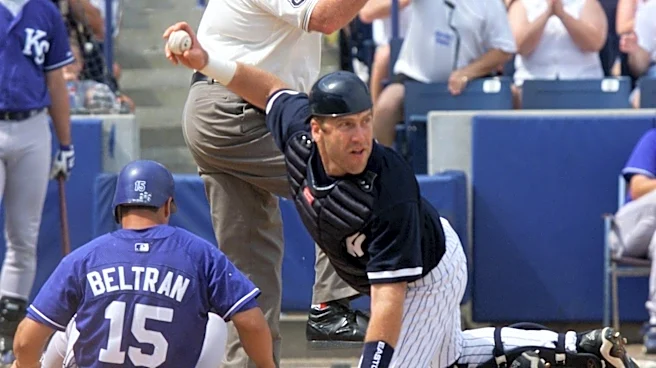
Signed as one of Jorge Posada’s many backups during the 2000s and donning his pal Piniella’s old No. 14, Oliver’s time in pinstripes ended up being largely unremarkable. Posada was in his prime and manager Joe Torre put him behind the plate as much as possible. So Oliver’s time in pinstripes ended up being largely unremarkable, as he mustered only a 62 OPS+ across 12 games and 40 plate appearances. One of those games led to a Yankees loss as well, as Oliver’s passed ball in extra innings on May 10th led to the Twins beating Mariano Rivera.
Posada suffered a minor thumb injury in early June that limited him to DH duty, and the Yankees had to call up another catcher to make sure they had a backup to Oliver in that time. That turned out to be Todd Greene, who was six years younger and hit the ground running with a 4-for-7 series in Baltimore. So when Posada returned to health and the Yankees made a trade to acquire infielder/future Pedro Martinez frenemy Enrique Wilson from Pittsburgh on June 13th, they had a decision to make on Posada’s backup. Although Oliver had hit his first Yankees homer on June 10th (a rare old Yankee Stadium “black seats” homer against Greg Maddux, no less), New York elected to keep Greene and designate Oliver for assignment.
As far as fill-in backup catchers go, teams could have gone far worse than with Oliver, even late in his career. And honestly, Greene didn’t really hit at all for the remainder of 2001. To put it lightly, Torre had good reason to lean on Posada.
Oliver got picked up by the Red Sox but only made into five MLB games. That split-season would ultimately prove to be his final action on a big league field, but just as he started it, Oliver managed to tally a hit in his final career at-bat.
After a hiatus from the game, Oliver once again became involved in affiliated ball, this time as a manger in the Red Sox minor league system. He served as a manager at various levels in the system from 2014-19.
On his 61st, we wish the former, albeit brief, Yankees backstop a happy birthday.
See more of the “Yankees Birthday of the Day” series here.