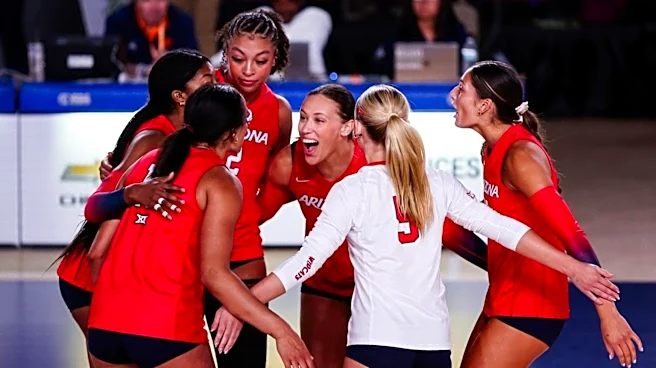








The first night of Big 12 play was anything but typical. Preseason favorite Arizona State went down to the team picked to finish 13th in the 15-team league when West Virginia pulled on the five-setter in Morgantown. It was the Sun Devils’ second head scratching loss this season after they dropped a match to UC Davis last month.
It is a concern since the conference is likely to have four teams outside the RPI top 100 when the first official RPI comes out next week. There was only one such team in the first RPI of 2025.
Arizona is one of those four teams on the outside this year. It currently brings up the rear in the league according to unofficial RPI and needs both wins and good competition to improve. Without both, the goal of reaching a second straight NCAA Tournament will be out of reach.
“It’s gonna be important to be in a good place in the conference, and who knows what’ll happen,” said Arizona head coach Rita Stubbs. “You know, this is just the first match, but when your projected top team loses to I think your projected 11th team, 12th team, it kind of sends some red flags up [about the conference RPI] a little bit. But at the end of the day we can’t control any of that. To me, I’m going to look at it as an opportunity for us to do some great things.”
Arizona could start seizing those opportunities immediately. Its first Big 12 match comes against another team that was upset on Friday night, although in a much less surprising result. Colorado welcomed Utah to Boulder. The Buffaloes were sporting a 9-1 record and a ranking of No. 21 in the AVCA poll. The Utes were 8-3 and unranked. They handled their hosts easily in a 3-0 win.
The Wildcats hope CU doesn’t have the upset bug out of its system. They travel to Boulder to face the Buffs on Sunday, Sept. 27 in their conference opener. It will be their last of eight straight matches played away from home, but the visitors will have one advantage. While the Buffs were playing on Friday, the Wildcats had the night off. They have not played since Tuesday when they traveled to UTEP.
When they get on the court, the Wildcats will face a high-powered offense that leans on 6-1 senior Ana Burilovic. She provides 4.23 kills per set, ranking 17th in the country.
“Everything is running through her,” Stubbs said. “They have a new setter, but other than that, they’re a pretty veteran team.”
Burilovic is supported by Lily Dwinell at 2.31 k/s and Cayla Payne at 2.15 k/s. As a team, the Buffs average 12.49 k/s.
“They have a veteran outside hitter and a veteran right side player,” Stubbs said. “I think that that goes a long way.”
The Buffs also block well. Four players who have at least 20 sets played average over a block per set. Payne leads the way at 1.51 b/s and Dwinell contributes 1.15 b/s.
Up next for Arizona volleyball
Arizona Wildcats (5-6, 0-0) @ Colorado Buffaloes (9-2, 0-1)
When: Sunday, Sept. 27 @ 12 p.m. MST
Where: CU Events Center in Boulder, Colo.
Streaming: ESPN+
Stats: Arizona Live Stats
If Arizona is going to be successful, floor defense will be critical. This is one advantage the Wildcats have over the Buffs. UA is good for 14.14 digs per set compared to CU’s 11.38. That is a change from many matches this season, when the Wildcats have regularly lost the dig stat by double digits.
“It’s a matter of us getting the ball to their side and then slowing them down, and just being able to play the long game,” Stubbs said. “So it means we got to be Steady Eddie the entire time.”
CU has successfully limited other teams’ efficiency even without big dig numbers. The Buffs hold opponents to just .145 hitting, a stat that leads the Big 12. This is a problem for Arizona, which has hit just .197 as a team this year, coming in last among the 15 teams in the league. Fortunately for the Wildcats, the Buffs are 13th in the league with a .228 hitting percentage, which is close to the .229 Arizona opponents’ have hit this season.
Serve receive is always important, but Stubbs sees it especially vital this week because of the approach employed by Colorado head coach Jesse Mahoney.
“I think that Jesse, in the past, has always been looking at numbers and just the value in what someone’s doing,” Stubbs said, adding that they “pinpoint” who they serve.
That inevitably means that the outside hitters will be targeted a lot, but particularly Destiny Ndam-Simpson. While she leads Arizona in kills per set, she has to be subbed out at times for passing. Based on the patterns this season, how well she rises to the occasion will determine how much she plays and if Stubbs opts to sub heavily once again.
Subbing will be a big part of what Arizona does all season to some extent, at outside hitter and elsewhere. It may not be typical, but Stubbs is not wedded to any particular lineup. While the same people generally start, that doesn’t mean they finish the match or even play for long. That has some advantages and disadvantages.
“I like having the opportunity to do that because there’s many people that no one knows anything about,” Stubbs said. “Got a new body out there, and it’s like, oh, I don’t have information on her.”
For the team, it means that players have to get used to different roles if they’re used to playing a lot or be ready at all times if they’re used to being reserves. Everyone on the team has been affected to some extent.
That has allowed some people to shine when they were needed, especially the freshmen. That group of Gigi Whann, Marina Vosloo, and Hayden Reeder were mentioned by Stubbs when asked who stood out as surprises in nonconference play.
It also means that reserves don’t get stuck in a mindset that they have no chance to get on the court. That has some advantages.
“It’s good for morale,” Stubbs said, noting that everyone really does have a chance to play depending on their strengths and the strengths of the given opponent. “My job is to keep them engaged the entire time. And so we talk about it in practice. It’s like you don’t know when your number is going to be called, so you got to be ready and alert and in a good head space because who knows when it can happen.”
It also means that some players must adapt after starting or playing a lot in previous years. That can take some adjustments and requires additional work by the coaches.
“Just constantly communicating with them,” Stubbs said. “You know, when they come out, I’m like, okay, I just need to change some things up. You haven’t done anything wrong. Or I’m doing this because I don’t have another timeout. You know, just talking to them about why you’re doing what you’re doing, and at the end of the day, they may not still like it, but they want to win more.”
Not everyone looks at is as unique, though. Some Wildcat players understand that no position is ever guaranteed.
“I haven’t felt like that since like my junior year high school or my senior year high school,” said sophomore middle blocker Kristen Dear. “I feel like once you get to the college level, no matter where you are, you’re always gonna have to compete for a spot. There’s always gonna be a new class coming in, or there’s people working to take the spot that you have now. So you always just have to be on your 10 and work to be better than you were yesterday.”