
There’s a particular kind of player who can walk into a gym, into a program, into a fan base starved for relevance, and in a matter of months, make everyone believe again.
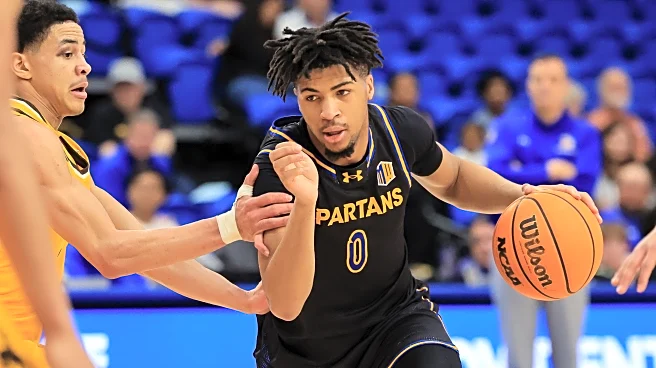
With the annual revolving door of this one-and-done season, Colby Garland was that player at San Jose State.
And, increasingly in modern college basketball, this is a more common example of a basketball trek that can vanish as quickly as it arrives.
Production that travels
No knock on Garland. His path isn’t unusual anymore. It’s just unusually revealing.
Garland began at Drake, a complementary piece as a freshman, 5.7 points, 2.3 assists in a bench role, efficient but still finding his footing.
Then came Longwood University, and then the leap.
Suddenly, Garland wasn’t just a contributor, he was a driver: 12.1 points, 4.4 assists, nearly 47% shooting, and one of the Big South’s most efficient playmakers.
By the time he landed in San Jose, he was no longer developing, he was arriving.
And what an arrival it was.
Garland didn’t just produce, he transformed the Spartans’ identity: 20.3 points per game, 4.6 assists, nearly 50% from the field, All-Mountain West honors and one of the top scorers in the entire conference.
For stretches, he was the offense. For fans, he was hope.
For a program like San Jose State that matters more than numbers.
Hope on borrowed time
But here’s the part that doesn’t show up in the box score.
Garland’s trajectory, Drake to Longwood to San Jose, isn’t just a climb. It’s a pattern and in the portal era, patterns matter more than promises.
Because when a player proves he can score 20 a night in the Mountain West, the next question isn’t “what’s next for the program?”
It’s more and more obvious — “who’s coming to take him?”
The transfer portal has turned breakout seasons into auditions. And mid-major programs into stepping stones, whether they want to be or not.
More than 40% of Division I players now enter the portal annually, a churn that has fundamentally reshaped roster building.
For schools like San Jose State, development is no longer a linear investment. It’s a gamble.
You don’t just recruit talent, you rent it.
The reality for “small” programs
So what does this mean for a program trying to matter?
It means you live in cycles measured in months, not years.
You find a Garland. You build around him. You hope the timing aligns to his breakout and your supporting cast also breaks your way. Of course, injuries decimated big portions of Tim Mile’s cast around Garland.
And just when it breaks or doesn’t?
You still brace for departure.
Because relevance, at this level, isn’t sustained anymore, it’s assembled. Temporarily.
These programs survive not by retaining stars, but by replacing them faster than they leave.
It’s less like building a house and more like running a relay: you just need the next runner ready before the baton drops.
Inside the athlete’s mind
Now comes the harder question, the one fans ask quietly, sometimes bitterly:
Do these players care?
The honest answer is complicated.
Short term, players are chasing three things:
- Opportunity (minutes, usage, visibility)
- Validation (can I prove I belong at a higher level?)
- Leverage (NIL, exposure, professional pathways)
Garland’s arc reflects that progression almost perfectly, each stop offering a bigger stage, a larger role, a clearer identity.
Long term, it’s about ceiling.
Players are asking: Where can I maximize my last year? My draft stock? My earning window?
And emotionally?
That’s where it gets murkier.
Most players actually do care; about teammates, coaches and moments. But the system doesn’t reward staying. It rewards ascending.
Loyalty, in this era, has an expiration date.
What gets left behind
For fans, what lingers isn’t just the points or assists.
It’s the feeling.
The nights where one player made a program feel bigger than it is.
The brief belief that something sustainable was forming.
And when that player leaves, what remains is both gratitude and a quiet question:
Was it ever really ours?
The new truth
Colby Garland’s story isn’t about leaving.
It’s about what his rise and potential departure represents.
In today’s college basketball world, players don’t just pass through programs.
They pass through phases.
And for schools like San Jose State, survival means accepting a difficult truth:
You may never keep the player who changes everything.
But you have to be ready to find the next one who can, while you’re finding and building all the other tangible resources that create a system and destination.