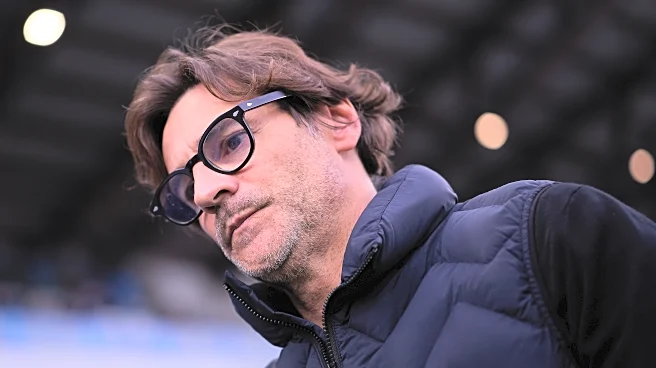

By now, you’ve probably seen the reporting on Fiorentina’s pre-Dynamo Kyiv press conference. It was the same old song and dance from Paolo Vanoli. The mister ran through his usual set list: “We’re all
aware of the situation,” “the result is what matters,” , “we have to show growth on the field,” “we have to come together and get out of this situation.” They’re all things he’s said before and will doubtless say again.
A number of media outlets are displeased with his comments, accusing him of not aligning his words with his actions. He’s saying all the right things but the team’s actions on the pitch don’t reflect those right things. He’s being disingenuous. A phony. A liar. The sort of rattine personality who could never pull the Viola out of their seemingly-terminal nosedive. He can’t be the solution.
That’s an opinion, and like any opinion, most people will cling to it despite any arguments to the contrary, regardless of evidence or context. I’d like to blame the internet and social media, which not only allow but encourage short-term thinking at the expense of intelligent humanity, but this is just how people’s brains work. Cognitive dissonance is unpleasant and we’re happy to resolve by simply ignoring anything and everything that prompts it, no matter the cost.
Getting mad at Vanoli’s comments in this or any presser feels like posturing, though. When everyone’s upset, being the most upset demonstrates how much you care, which grants you social capital. It’s why the outrage industry has never been stronger and why the default stance for every opinion is “personal aggrievement,” closely followed by “triggered lol.”
In Vanoli’s case, the animus is about his statements arises from how different audiences perceive those statements. There are 4 audiences he has to perform for: journalists, fans, players, and management. None of those audiences is monolithic: individual journalists have agendae, for example, and the stories about the divisions within the Viola squad and brass are too loud to be false.
First, the journalists. I don’t believe that every reporter is trying to make a reputation by tearing down the team, despite my previous statements about negativity selling. Folks like Niccolò Misul and Stefano del Corona are talented, conscientious, and professional. Unlike us fans, though, they don’t follow the team solely out of love. This is their career. And to do it well, they need information from the mister.
As fans, we crave information as well, and it’s our thirst that fuels the journalists. Both supporters and media want to know everything that’s happening at Fiorentina, and that means hearing about the club’s plans from its most public-facing employee, the one who’s most involved with the product on the pitch: the manager. And that’s the issue.
Because Vanoli’s primary job isn’t informing the media and the fans about what’s happening. He’s not a reporter. He’s a coach. His job is to win games. And he, like every coach who’s worked at this level for a very long time, knows that explaining everything behind the scenes is counterproductive. I hate the stock comparison of sports and warfare, but both do require a certain amount of subterfuge.
Vanoli, like every coach, doesn’t report to the fans and the media, and he isn’t tasked with getting the best out of them. He reports to management and works with the players. Those are his priorities. Certainly, getting the fans and media on his side can make his job easier. Stefano Pioli showed us just how quickly the axe can fall when the fans and the media turn on a coach; even Fiorentina’s famously tolerant management couldn’t tolerate the fury for more than a month or so.
Even so, Vanoli’s priority is the players, then his bosses. When he talks to the press, the press is only his secondary audience. The primary audience is his players. They, their agents, and their families keep a very close eye on what the mister says, and anything that looks like an attack is something he’ll have to deal with behind closed doors, and he’s already got enough to deal with back there if there’s any smoke to the little fires on the pitch.
Much better to repeat the same phrases until they’re worn with use, the ruts in a well-traveled road. When he reassures us for the thousandth time that the squad is united, for example, it’s not because the squad is united. I expect the opposite is true, partly because of reporting and partly because people get defensive and abrasive when things go wrong for them and professional athletes are people.
And he can’t do anything if everyone’s at loggerheads. His first, most important, only task is to get the whole squad pulling together. The players need to trust him and each other implicitly. That’s how autonomous parts form a cohesive whole, each knowing that the others will do their piece. The smallest crack in that trust can have disastrous results. Fiorentina right now is Exhibit A.
Not everything Vanoli says to the press is sound and fury. He informed us that Robin Gosens, Nicolò Fagioli, and Jacopo Fazzini are all out tomorrow. But anyone expecting honest answers about interpersonal relationships or emotional states from him is barking up the wrong tree. The answers are too messy, for one thing, existing in a social context into which we have no window, and any attempt to clue us in would only give us decontextualized shards of truth, so limited as to be more damaging than informative.
I keep hammering on the Julian Naglesmann quote: “30% of coaching is tactics, 70% is social competence.” Right now, Vanoli’s rightly focused on the latter. Getting a group of 28 people on the same page is difficult enough, but when those people are all professional athletes who’ve spent their entire lives forging self-confidence as emotional armor, the difficulty increases exponentially. Saying something to a reporter that could erode what little trust Vanoli’s built up with his players would be suicidal, so it’s better to say nothing at all if possible.