

Nobody gets to fire two managers in two years.
Jeff Passan went on the radio on Tuesday and placed the blame for the Mariners season at the feet of manager Dan Wilson. Passan heavily implied Wilson should be replaced, using logic I’ve seen plenty throughout the season: This roster is far too talented to be playing this poorly.
And, no, it’s not.
Let’s just look at some projections. There are plenty of models out there, and you should consider them all, but I use Steamer because it’s 1) easily accessible
through FanGraphs, 2) the most conservative on this iteration of the Mariners, and 3) disturbingly accurate at projecting their full-season fWAR. Here we can see how Steamer compares to the Mariners actual fWAR since 2016.

Now, WAR are not wins (we’ll get there), but projected WAR are still quite good at projecting the actual standings. In fact, at just about any point in the season, if you want to know how well a team will play the rest of the year, you’re about as well off trusting preseason projections as their performance to date. That’s why things like FanGraphs playoff odds can look skeptical of surges and collapses, and why the Mariners still have good odds to make the playoffs.
This makes projections an essential reference for assessing a team, pre-, mid- and post-season. Yes, I appreciate “um actually the forecast clearly states” sounds like the thing I say before getting shoved into a locker. But if you’re demanding someone get fired from a baseball team on the internet, well, I suppose I’ll find you in the locker with me.

We can see a few things from this plot. First, there’s a nice linear relationship between projected WAR and the final standings, but there’s clearly some variance. Lots of things determine how many games a team wins beyond their talent on Opening Day. Teams can play above, at, or below their talent level. They can get good, neutral, or poor luck. They can run up against injuries and schedules and umpires and God. Perhaps coaches matter, too.
We can also see the Mariners tend to get out of their seasons what they put in. In Jerry Dipoto’s tenure, the roster has either met or exceeded expectations every single season. They’ve been exceptionally predictable, a metronome set to 54 beats per minute — the perfect tempo for a dirge.
Let’s look at this another way. I created some buckets for preseason WAR and found the end-of-season outcomes for each. The table below shows the median win total, as well as the high- and low results:
From 2023 and to 2025, the Mariners began the season with the expectations of a “good” team. These teams typically win about 54% of their games and finish 12th in the majors overall. It’s the minimum threshold to enter a season with playoff expectations, generally as the Wild Card. That’s pretty much exactly what they got in those years.
This year, however, the Mariners took a tepid step forward, dipping a toe into great (on paper). This bucket contains a broad range of projected WAR, and the Mariners 43.5 WAR was at the very bottom end, bearing closer resemblance to “good” than “elite.” Maybe we could call this “very good.” Regardless, it’s fair to say this roster was a bit more than those of the past, and also not quite.
Even still, plenty of teams even at this level wind up with less than great results. If we look back up at the plot above, the 2026 Mariners are still within a typical range of outcomes given the quality of their roster. What’s happening this year isn’t weird or uncommon, even if it is disappointing.
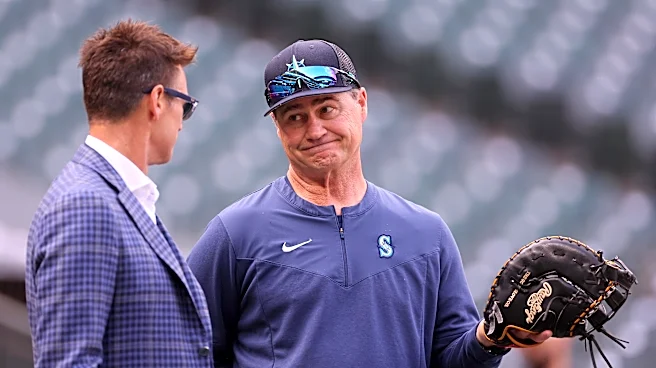
Now, from this perspective, I could see why some would point the finger at the coaching staff. It’s weird for this team to underperform. I also appreciate why some fans are willing to excoriate specifically Wilson. His predecessor, Scott Servais, was fired for delivering exactly what his rosters deserved, and Wilson was hired in his place with no managerial experience. The choice was seen as the latest evidence that the org is addicted to its memberberries and prioritizes image over substance. And in his time as manager, Wilson hasn’t made himself easy to like. He’s boring in press conferences, unwilling or unable to say… anything. He doesn’t explain his decisions, he doesn’t take accountability or say who should. He’s about as vacant publicly as his Funko Pop, the only difference being the one in the dugout comes with string-activated “ums” and “ahs” and “tough ones.”
But that Wilson is limiting this team doesn’t quite satisfy as a scapegoat. If we’re saying that coaching staffs matter, and perhaps they do, well, just last year Wilson led the Mariners to 90 wins and a deep playoff run. The year before, Wilson took over with roughly six weeks left in the season — having no managerial experience — and went 21-13, or a 100-win pace. Up until this latest slump, Wilson held the best record in team history, and one of the five best records among active managers overall. If the manager matters, and we’re dinging Wilson for this stretch, then we’re also giving him credit as one of the best managers in the majors before it. Maybe Wilson doesn’t do as well in the Cool Xiennial Podcasto Sphere as someone like Tony Vitello, and maybe his face isn’t nearly as red John Schneider’s. But he seems to be a kind, humble guy, sufficient in the minor art of field managing, and liked enough in the locker room for multiple players to say they want to play in Seattle forever. Ignore him or hate him, I don’t think you can blame him.
So who can you blame?
Well, there is a fairly obvious culprit for the Mariners struggles this year. As I wrote a few weeks ago, the Mariners entered 2025 with the best projected duo in the majors in Cal Raleigh and Julio Rodríguez. They are the sole reason this roster has expectations at all. Unfortunately, they’re on pace to post nearly 10 wins less than projected. It doesn’t quite work like this in reality, but it’s worth pointing out those 10 wins are roughly the difference between the Mariners current 78-win pace and the 88-win pace Steamer had them at in the preseason. No, I’m not “blaming” them. Injuries happen. Slumps happen. The season isn’t over. Et cetera. But if you take the two best players away from any team, they probably aren’t going to do as well as they should. It’s not a mystery.
If you insist on blaming anyone, I think it’s most appropriate to point the finger at the front office. Or rather, I think it’s most appropriate to point the finger at their plan. The team has been pretty direct in saying their goal is to win, roughly, 54% of their games over a long period of time. And as I’ve laid out above, they’ve done exactly that, on paper and on the field.
It’s a fine plan, to be clear. The justification is it allows them to hoard prospects, playing time, and ohhhhh if you insist a bit of cash in the outlook. By not committing to any one season, they spread their risk over a longer competitive window, allowing them to make targeted, timely maneuvers while growing a roster from within. The 2025 Mariners serve as proof of concept for this strategy. The team can absolutely win a World Series this way.
But 2026 is an inverse to that proof of concept. The governor they place on annual talent realistically caps them at 90 wins year over year. That’s a tenuous playoff position on its own, and any underperformance threatens to sink them out of contention. Sure, spreading risk over time helps avoid a scenario where a chock-full basket of eggs shatters into oblivion. And yes, there is no projected WAR threshold that might clear disaster on its own. But the closer you build a roster to a coin flip, the more likely you’ll be disappointed in its face.
That’s why I’m not willing to extend much grace despite the step forward in the projections. Like, hey, good on the Mariners for making legitimate progress on paper. I am one of the few people in the world admin-pilled enough to give them credit for something like theoretical wins. But they’re the ones setting the terms at 30,000 feet, and the view from up there isn’t particularly flattering. The Mariners are pacing for a 40% playoff rate, 20% division rate, and 0% World Series rate — and that’s if we start the clock in year seven of Jerry Dipoto’s tenure.
It’s worth looking at where the Mariners rank since 2022, when they started playing for real:
The relative strengths of the Mariners have been starting pitching and (gasp!) hitting. These are without a doubt the most valuable facets of the game, and good on them for their performance in these areas. It’s genuinely impressive that they’ve achieved this mostly through their farm system, and that alone makes them one of the best front offices in the majors.
But their weaknesses have been (and continue to be) the nooks and crannies of the roster. They can’t run the bases. They can’t field. They can’t maintain narrow deficits in the middle innings. Their teams tend to be lopsided and weirdly distributed. These have been consistent issues for years. Batting slumps and bullpen lumps get the headlines when the team struggles, but the Mariners issues historically are the little things — the things that can’t be found in three-team deals, shuffling value at the margins.
And that’s why I find it a bit rich that the team fired assistant hitting coach Bobby Magallanes last week. Yes, absolutely, the Mariners are losing right now because they’ve struggled to hit. But they finished last year second in the majors by wRC+ (113) with Magallanes in dugout. Every team slumps at the plate. The difference is the great teams have something else going for them, to keep them in games and avoid greatness-tanking skids.
There is a sort of competence in what the Mariners have done. They told us what their goal was, and they’ve achieved it with frustrating levels of precision. My first game was 2003. The two decades of Mariners baseball that followed were not fun. I didn’t take solace in the fact that the powers that be were earnestly trying to win World Series. I would have preferred this a million times over. Ticket sales suggest others do, too. It’s the most successful the Mariners have been in my lifetime. It’s good baseball.
But it’s worth thinking about where we’re at. In August 2024, the Mariners saw fit to fire a manager because they weren’t satisfied with the results of the team. Not quite two years later, there’s been another firing in the dugout and clamoring for more. Maybe it’s time for the good to get going.