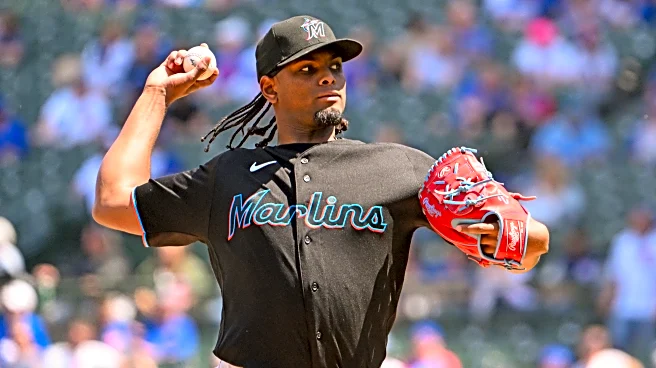

The Cubs were looking to bolster their starting rotation heading into next season, and they did so Wednesday, sending Owen Caissie, Cristian Hernandez and Edgardo De Leon to the Miami Marlins for a tantalizing
starting pitcher: Edward Cabrera. Al covered the specifics yesterday, including the fun trade tree note that Cabrera basically closes out the Yu Darvish and Victor Caratini for lottery tickets extremely young prospects, as Caissie was the last prospect remaining in the Cubs system from that December 2020 trade. Today let’s take a look at the numbers behind the Cabrera deal.
A quick aside, I know I still owe reliever Hunter Harvey a “by the numbers” article of his own. That will be out later this week. He’s an intriguing bullpen piece who really could shine for the Cubs, but big trades take priority over even high-leverage bullpen arms. So today, let’s focus on Cabrera, starting with this absurd stat from the always on point Sarah Langs (Bluesky link):
Yes, you read that right. Edward Cabrera is the only pitcher in baseball who has two pitch types with more than a 40 percent whiff rate. That is elite stuff. The problem is that elite stuff hasn’t exactly translated to elite results just yet. You can see some of Cabrera’s key stats since he made his major league debut in 2021 below:
Cabrera has a five pitches that he throws at least 10% of the time. In 2025 he tweaked how he used those pitches considerably as you can see below:

In addition to the 84 mile per hour curveball (24 percent) and 89 mile per hour slider (17 percent), he throws a power changeup at 94 miles per hour (26 percent). Actually, we need to do an aside on the changeup, because FanGraphs’ Michael Baumann absolutely nailed how special that pitch in his write-up of this trade:
Cabrera’s changeup is, simply put, unique. It averaged 94.2 mph last year, and 93.2 mph for his career. With less than three miles an hour’s worth of separation from the four-seamer, it’s barely a changeup at all. In the Statcast era, only two offspeed pitches have a higher average velocity than Cabrera’s changeup: the splinkers thrown by Jhoan Duran and Paul Skenes.
Except Cabrera’s changeup is extremely not a splitter. It doesn’t dip; it just steams in and veers right, like a mail truck going down a hill without its brakes or right rear tire. And the grip could not be less splittery.
Cabrera owns the four fastest changeups of the Statcast era, and 27 of the top 29. In his career, he’s thrown 272 changeups at 95.0 mph or more; all other pitchers put together have combined for 64. We call Cabrera’s changeup a changeup not because it resembles the other pitches that go by that name, but because of a failure in taxonomy.
Back to Cabrera’s pitch mix. He pairs those three offerings with both a 97 mile per hour four seam fastball (13 percent) and a 97 mile per hour sinker (21 percent). One of the things that jumps off the page during the 2025 season is how much more Cabrera threw his sinker and how much less he threw his four seam. Pitcher List founder Nick Pollack suggests that change is part of what helped Cabrera get the command issues that have plagued him in previous seasons under control:
That would be a welcome development for Cabrera. In 2025 he struck out 150 batters while walking 48 in 137.2 innings. It was far and away his most successful K-BB season. By contrast, in 2024 he struck out 107 batters while walking 50 in 96.1 innings, and in 2023 he struck out 118 batters while walking 66 in 99.2 innings.
While command is the obvious upside to using the sinker more, the downside to both fastballs is that opposing batters have done a much better job making contact against those pitches than Cabrera’s other offerings. In 2025 opposing batters had a .452 wOBA against Cabrera’s sinker and a .404 wOBA against his four seam. In 2024 the sinker had a .352 wOBA while the four seam had a .421 against it.
That said, the Cubs elite defense up the middle should mitigate some of the damage done against Cabrera’s fastballs. Cabrera’s home run to fly ball rate actually dropped 5 percent throwing the sinker more in 2025, and I have to believe if the ball isn’t over the fence (or in the basket) Pete Crow-Armstrong has a shot at it.
One way to measure the impact of a team’s defense is to compare pitchers’ ERA to their Fielding Independent Pitching (FIP). A team of pitchers whose ERAs consistently outperform their FIP is likely benefiting from something FIP doesn’t account for (ie, fielding, or defense). I looked at pitchers on the Cubs and the Marlins who threw at least 50 innings in 2025 to get a proxy for this. Last season the Marlins had 13 pitchers who threw at least 50 innings, eight, including Cabrera, had ERAs that outperformed their FIP. By contrast, the Cubs had nine pitchers who threw at least 50 innings, eight of nine had ERAs that outperformed their FIP (Ben Brown was the loan exception with a 5.92 ERA off a 4.08).
I also looked at Stuff+ on FanGraphs to get an idea of how Cabrera stacked up relative to other elite starting pitchers. Stuff+ measures each pitch relative to similar pitch types. It’s normed to 100 and is combined with Location+ (basically command) to create a combination Pitching+ measurement. Below you can see the top 22 (there’s basically a 6-way tie for 20th) pitchers by Pitching+ during the 2025 season:
This is elite company for Cabrera, who slots just between Dylan Cease and Ranger Suárez right at a 107 Pitching+. For reference, the highest 2025 Cubs starters on this list are Shōta Imanaga and Jameson Taillon, who both had a 101 Pitching+ last season and ranked 40th and 41st in MLB among pitchers with at least 120 innings last season. That highlights another advantage to the Cubs adding Cabrera: he gives the team a much different look than their other starters. If you’ve been begging for the Cubs to add more swing and miss since the Darvish days, Cabrera is your answer.
Speaking of Stuff+ and Pitching+, that particular model was developed and tweaked by Eno Sarris of The Athletic, who had some thoughts on this signing as well:
Pay particular attention to Eno’s note about the different arm slot potentially resulting in less stress on Cabrera’s arm. While command was certainly one of the limitations on Cabrera’s potentially very high ceiling, the other has been injury. In his young career he’s already dealt with multiple injured list stints for elbow and shoulder injuries.
It’s not all about velocity, location, ERA or FIP. One of the most important numbers behind the Cabrera trade (and the Cubs willingness to part with a top-100 prospect in Caissie) is certainly the cost of starting pitching these days and the fact that Cabrera will not be a free agent until 2029. As Andy McCullough wrote for The Athletic while grading this trade:
Cabrera profiles as closer to a No. 4 starter than a No. 2 starter, and he has dealt with injuries to his shoulder and his elbow in recent years. But in a market where two years of Adrian Houser costs $22 million and one year of Dustin May costs $12.5 million, the Cubs are betting that Cabrera can post every fifth or sixth day and maintain the command improvements he made in 2025. We’ll see how it goes.
Plus, the Cubs have a bit of a logjam at corner outfield with Ian Happ, Seiya Suzuki and Kevin Alcántara all projected to be on the active roster in 2026. Once you slot Moisés Ballesteros in at DH, the Cubs really didn’t have at-bats available for Caissie. Turning him (plus other prospects who are further away) into a cost-controlled starting pitcher for the next three seasons is exactly the type of move this front office should be making if they refuse to commit that money in free agency. In case you’re wondering what a starting pitcher with a 107 Pitching+ goes for on the free agent market, MLB Trade Rumors estimates that Ranger Suárez will land a five-year, $115 million deal this offseason.
To be clear, Cabrera cost the Cubs a lot, just not in AAV terms. MLB Pipeline ranked Caissie as their top prospect and may be one of the Marlins top hitters next season. Hernandez was signed for a $3 million signing bonus, and while he hasn’t quite lived up to those high expectations just yet, it really wouldn’t be surprising to see him break out in a year or two. De Leon has yet to play above the complex league, but any time an 18 year-old is popping 107 exit velocities, I’m paying attention. That said, all of the players above have big question marks.
One question the Cubs have answered, at least for now, is how they’ll round out their rotation in 2026. If Cabrera throws a league average 5+ innings every fifth day, this deal is worth it. If he maintains his growth from 2025 and unlocks the potentially elite upside his pitches suggest exists, this deal is a steal.