
When he was in the minor leagues, there were good indications that Joey Ortiz would be, at minimum, a decent offensive player. From his professional debut through his last substantive minor league season in 2023, Ortiz never had a wRC+ lower than 98, and even that low mark came in 2019 when he was 20 and had just finished his last college season. Ortiz’s offense in the minors ranged from slightly above average to excellent, particularly in his 2023 season, when (as a top-100 prospect) he hit .321/.378/.507
(a 124 wRC+) at Triple-A Norfolk and earned himself a late-season promotion to the Orioles.
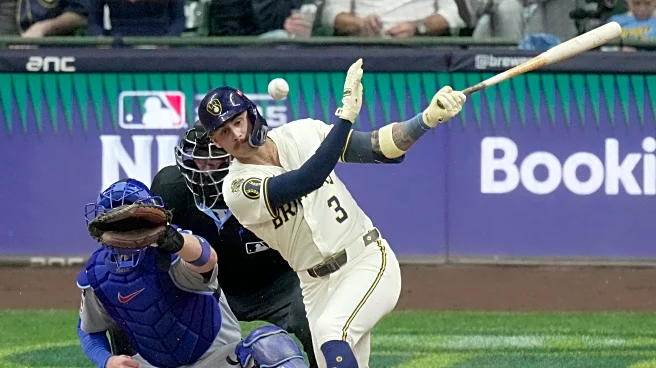
During his (official) rookie season with the Brewers in 2024, Ortiz largely performed the way his minor-league numbers suggested he might. In 142 games, he didn’t hit for much average but showed good patience and did a decent job driving the ball. His season was up and down—he started hot, cooled off, looked terrible in the weeks following an IL stint, and then recovered a bit over the last month-and-a-half. But Ortiz’s final line of .239/.329/.398 equated to a 102 OPS+ and 105 wRC+, more than acceptable for a glove-first rookie. He earned 2.7 bWAR and 3.2 fWAR, and looked like he was on the way to a long, productive career as a Brewer.
Then, in 2025, Ortiz’s offense abandoned him completely. After a hot spring training, Ortiz started dreadfully and never really pulled himself out of it. After going 2-for-4 on the first day of the season, Ortiz didn’t finish with an OPS over .600 again until August 12. He finished the season at .230/.276/.317 for a dreadful 66 OPS+/67 wRC+ in 506 plate appearances.
It is rare for players to be given that kind of playing time when they are that bad at the plate. Since 2000, there have been only 58 instances of a player receiving at least 500 plate appearances with an OPS+ of 66 or lower.* As a rookie, Ortiz showed some strengths: a good walk percentage, good bat speed, a good chase percentage. But in 2025, almost everything nose-dived, his chase percentage went way up, and he didn’t do any damage on pitches he made contact with.
*A quick “fun” fact: there are three other Brewer seasons on this list: Orlando Arcia in 2019 (546 PA, 64 OPS+), Alcides Escobar in 2010 (552 PA, 66 OPS+), and Marquis Grissom in 2000 (640 PA, 63 OPS+). Brice Turang just misses this list: he had a 61 OPS+ in 2023, but in only 448 PA. I should also draw attention to another BCB favorite on the list, who did this before arriving in Milwaukee: Yuniesky Betancourt had a 66 OPS+ in 508 PA in 2009, split between Kansas City and Seattle.
According to Statcast, the only thing Ortiz did well in 2025 was that he didn’t miss much when he swung at the ball—he had a 90th percentile whiff percentage and 86th percentile strikeout rate. But if you’re never doing damage when contacting the ball, it doesn’t matter a whole lot if you’re putting the ball in play; we all remember the 19,000 (or thereabouts) infield pop-ups we saw from Ortiz last season.
Looking to history
What I was most curious about here was not necessarily a diagnosis of Ortiz’s issues but sort of hopes for recovery he has.
So, I started in 1969, when the league expanded to 24 teams, and searched for players who, within the first three years of their career, had a season of at least 500 plate appearances with an OPS+ of 70 or less. Then I combed through the players on that list (56 players, a handful of whom appeared twice) to see if any finished with a career OPS+ of 95 or better. Here’s who I found:
- Jean Segura (26.3 career WAR, 97 OPS+)
- Dansby Swanson (28.4 WAR, 97 OPS+, still active)
- Geraldo Perdomo (13.5 WAR, 101 OPS+, still active)
That’s it. And that’s the bad news: there are very few players in modern baseball history who’ve been as bad as was Ortiz in 2025 was that’ve gone on to good offensive careers. Let’s quickly cover these three players—and it’s nice that we have couple of active guys, because we can check out the same Statcast data for them that we have for Ortiz.
First, Segura. After he debuted for one game with the Angels in 2012, he was included in Los Angeles’ trade deadline package that they sent to Milwaukee for Zack Greinke. The Brewers put Segura right into their starting lineup, and he was good enough to earn himself the starting shortstop job in 2013. At 23 years old that season, Segura was great: he hit .294/.329/.423, stole 44 bases, and made the All-Star team.
But in 2014, Segura’s offense disappeared completely, and it didn’t come back in 2015, either. After back-to-back seasons of a 70 and 68 OPS+ in 146 and 142 games, the Brewers traded Segura to Arizona… where he promptly hit .319/.368/.499, led the league in hits, and had a 6.6 WAR season.
The second half of Segura’s career was less up and down, but he was never a super consistent player. After looking good in his early 30s in Philadelphia, he was so bad in 85 games with the Marlins in 2023 that he never played in the majors again, despite being just 33 years old in his final season in 2023.
Swanson was the first overall pick in the 2015 draft and was in the majors the following season; he looked great in 38 games in 2016, so the Braves made him their starting shortstop in 2017 when he was less than two years removed from college ball. It went badly. In 144 games and 551 plate appearances, Swanson hit .232/.312/.324 (68 OPS+).
While Swanson struggled in 2017, his available Statcast numbers aren’t nearly as badly as Ortiz’s in 2025; most of his numbers fell in the 20-35 range, percentile-wise, while many of Ortiz’s are below the 10th percentile. Swanson’s career also followed a more traditional arc: he was good in 2016, but it was only a 38-game sample, so 2017 was his rookie year. His OPS+ numbers are then basically a straight line, if you throw out the shortened 2020 season: 87 in 2018, 89 in 2019, 99 in 2021, 114 in 2022. Over the last six years, Swanson has a 105 OPS+ in 837 games, which he pairs with excellent defense at shortstop, and has made himself a valuable player.
Perdomo was thrust into the starting job for the Diamondbacks before he was really ready; he played 11 games in a brief debut in 2021 then played 148 games as a 22-year-old regular in 2022, in which he hit just .195/.285/.262. Perdomo’s 2022 season actually looks somewhat similar to Ortiz’s 2025; Both players didn’t swing and miss much, and both had above-average strikeout percentages, but both did nothing when they made contact: both players ranked in the 13th percentile or worse in all of xwOBA, xSLG, average exit velocity, barrel percentage, hard-hit percentage, and launch angle sweet-spot percentage.
The thing that’s different is that Perdomo didn’t chase anything, and his ability to draw walks has always been a strength. He improved to a 95 OPS+ in 2023 (and made the All-Star team), then to a 100 OPS+ in 2024, and then he broke out in 2025 and became one of the best players in the league (.290/.389/.462, 136 OPS+, 20 homers, 33 doubles, 27 stolen bases, 94 walks, NL leading 7.0 WAR).
Judging the career arc is tricky. Swanson and Perdomo both followed paths where they struggled early and then rose in a straight line, and the cynic would say that’s an indication that Ortiz hasn’t been able to make the necessary adjustments as the league’s pitchers figured him out. But Segura’s early career shows the sometimes random nature of player development, so it could go either way.
I’d also just like to briefly discuss Turang, who technically doesn’t fit the criteria, as his bad season was in fewer than 500 PA and his career OPS+ is currently 93. Turang’s early career resembles Perdomo and Swanson more than Ortiz, in that he was awful in his first real shot and has since shown steady improvement. But Turang in 2023 was even worse than Ortiz in 2025, so that should give some encouragement that someone in Milwaukee might know how to help.
Other Pathways
There are several other players who fit the “bad early season” criteria who did go on to have good, or at least notable, careers:
- Ozzie Smith (76.9 WAR) is by far the best player of all those who fit the “bad early-career offensive season” criteria. He is, of course, the greatest defensive player in the history of baseball; his 44.2 dWAR are the most all time by a comfortable margin. While Smith was never a good offensive player, he did figure things out as he went along: after posting an OPS+ of 74 over his first seven seasons, Smith had an OPS+ of 99 over the next eight years (1985-1992). Combine that with his all-time good defense and it makes him an obvious Hall of Fame choice.
- It’d be a little crazy, but I could, for fun, make an argument that Jim Sundberg (40.5 WAR, 90 OPS+) is the best defensive catcher of all time. He’s got the best dWAR rate of any catcher with substantial playing time in league history, just ahead of Yadier Molina and comfortably ahead of the next three, Iván Rodríguez, Bob Boone, and Gary Carter. Sundberg was a really good player who won six Gold Gloves (consecutively from 1976-81) and made three All-Star Games, one of which was in his lone season in Milwaukee in 1984.
- Terry Pendleton (28.4 WAR, 92 OPS+) was a solid player who peaked in the early ‘90s when he won an MVP in 1991 and finished second in the voting in 1992. Pendleton probably doesn’t win those awards nowadays, but it’s still impressive. He finished with three Gold Gloves and one All-Star appearance.
- Bob Boone (27.4 WAR, 79 OPS+), as noted, was a great defensive catcher, but aside from a four-year stretch in the late ‘70s when he was slightly above average, he was always a bad offensive player. Boone played 19 years and finished with seven Gold Gloves and four All-Star appearances.
- Jack Wilson (23.5 WAR, 76 OPS+) is well known to fans of the NL Central; the first nine-and-a-half years of his 12-year career came in Pittsburgh. Wilson had a couple seasons in which he hit for solid average, but he was a low-OBP, low-power hitter. In 2004, he was an All-Star and won the Silver Slugger when he hit .308/.335/.459 with a league-leading 12 triples. His son, Jacob, was second in 2025 AL Rookie of the Year voting.
- Michael Bourn (22.8 WAR, 87 OPS+) was a defensive standout in center field who won two Gold Gloves, made a couple of All-Star teams (one with Houston, one with Atlanta), and led the league in stolen bases every year from 2009-2011.
- Larry Bowa (22.8 WAR, 71 OPS+) collected over 2100 hits in his 16-year career, but they were about as empty as they come; he was a lifetime .260/.300/.320 hitter. But Bowa was considered a star: he finished as high as third in MVP voting, won two Gold Gloves, and made five All-Star Games.
- Juan Uribe (22.6 WAR, 87 OPS+) played for 16 years as a good defensive infielder who occasionally hit a bit, especially later in his career. He started on World Series winners in Chicago (2005) and San Francisco (2010), and while he didn’t make any All-Star Games or win any awards, he had a solid career.
- Ozzie Guillén (21 WAR, 69 OPS+) was a no-bat, all-glove shortstop who is now known more for his career as a manager than as a player. He made three All-Star Games, all between 1988 and 1991, and won AL Rookie of the Year in 1985 and a Gold Glove in 1990.
- Juan Pierre (17.3 career WAR, 84 career OPS+) played 14 years, led the league in hits twice, triples once, and stolen bases three times, but he was a player with zero power (18 career homers) in an era when a guy hit 73 homers in a season.
- Vince Coleman (12.5 WAR, 83 OPS+) came into the league and looked destined to challenge the slightly older Rickey Henderson as history’s greatest base stealer: in his first three seasons, Coleman stole 110, 107, and 109 stolen bases, a run which even Henderson cannot boast. But unlike Henderson, Coleman couldn’t hit, and he couldn’t get on base enough to sustain a meaningful run at Henderson. His 13-year career included two All-Star appearances, the 1985 NL Rookie of the Year, and 752 stolen bases, sixth all time.
Conclusion
It’s going to be a big year for Ortiz. If he can get his bat back near the levels of 2024, his combination of “good enough” offense and excellent defense at shortstop would make him a valuable contributor. If he can’t, though, the Brewers have a bevy of options nearing the top of the minor leagues that could theoretically replace him, sooner than you might think.
Cooper Pratt and Jett Williams are likely to start the season at Triple-A Nashville, and Jesús Made is going to be right behind them at Double-A Biloxi. It’s a little early for Made, who doesn’t turn 19 until May. But if Ortiz’s struggles show no signs of correction and Pratt or Williams open the season swinging the bat, either could replace Ortiz this summer. Williams may not be the long-term answer at shortstop—by all accounts his defense there might be a little questionable (at least compared to Pratt and Made), and most think he ends up in center field.
That doesn’t mean he couldn’t be a short-term replacement, though, manning the position until Pratt or Made are ready. The point is, Ortiz shouldn’t feel exactly threatened, but I feel confident that the Brewers are not about to let their everyday shortstop hold an OPS below .600 for a full season again.