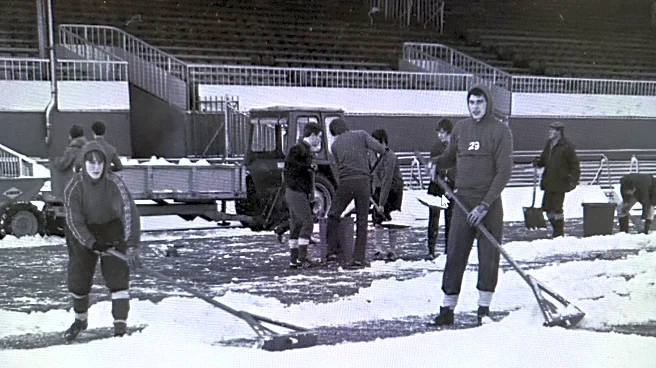

Having drawn 1-1 at Millmoor first time around Sunderland needed to get an FA Cup 3rd round replay with Rotherham United lined up, but with the country in the midst of a ‘big freeze’ it was proving to be
much easier said than done
The fixture had been due to take place on the evening of the 13th but by 10:30 that morning the plan had been scrapped – local referee George Tyson needing less than ten minutes to confirm that the playing surface was not in a safe enough condition for the match to be able to take place. The speed in which he made up his mind was appreciated by the Millers who had been holding back from setting off on the team bus and had requested that the check was brought forward from its original scheduled time of noon yet this was the third time such an inspection had seen the game called off since the original clash in Yorkshire on the 2nd, and whilst club staff had spent the previous 48 hours working hard there were few arguments when the latest decision was made.
A fourth attempt was pencilled in for the 18th and the tie was indeed settled that evening, with Sunderland edging past the Millers 1-0 courtesy of a strike from Mick Buckley, but the fact that the rematch was the first time the Lads had been able to play since Gary Rowell’s leveller kept hopes alive over two weeks earlier underlined just how much the freezing temperatures had been impacting the calendar. Prior to taking on Emlyn Hughes’ second division outfit, who had also met the Rokerites in the League Cup earlier in the season, the last league game had been a 3-2 win at Manchester City on the 19th of December 1981, whilst the last time Roker had staged any action was against West Bromwich Albion on the 28th of November!
Home fixtures against Southampton and Stoke City had since been postponed too, and with large swathes of Britain facing bitter cold snaps, football was one of many areas to suffer. Without spectators coming through the gates, neighbours Newcastle United and Hartlepool United, for example, were both reported to be experiencing severe cash flow problems, whilst the latter had been forced to cancel training because the pipes at the Victoria Ground had frozen, as their players would not have been able to wash afterwards. Colchester United had been due to host Newcastle in the cup at the same time as Sunderland were playing Rotherham, whilst a League Cup quarter-final between Ipswich Town and Watford set for the same night was another one to fall foul of the weather. Carlisle United meanwhile, under the stewardship of Bob Stokoe, were forced to play a friendly against Workington in order to try and keep in shape.
The money worries at St James’ Park had been one of the reasons Alan Brown’s proposed transfer from the Black Cats to the Magpies had recently fallen through and the forward was expected to be back on the bench had the replay gone ahead that Wednesday. Another story taking up column inches in the north east whilst there was a dearth of action to report on was that Brown’s ex-teammate Barry Dunn was looking to return to the area having struggled to settle since moving to Preston North End in October.
Like Brown, Sunderland boss Alan Durban was also at a loose end now and so quickly arranged to go on a scouting mission to Ewood Park where he took in Blackburn Rovers versus Charlton Athletic, whose scorers in a 0-2 win were ironically enough (Derek) Hales and (Steve) Gritt. It seems as if the north west region was doing better than everywhere else, as the only other senior games able to take place then were at Blackpool and Rochdale, although before setting off Durban was asked for his thoughts on the weather situation.

Despite furious efforts to clear the snow and the placing of protective sheeting at the ground there was serious frost underneath the Fulwell and Roker End goalmouth covers when they were lifted for Tyson, with the gaffer stating that “We have got to concentrate on getting the pitch fit…but we need a thaw. The air temperature has got to rise to get games played.” He then went on to look at the longer-term impacts, and how he felt the sport should approach the colder months:
I am a traditionalist, but I would like to see football played in better conditions.
We are the best country when in the world when it comes to adapting to different conditions, but I have always felt we were so far behind other countries in terms of the conditions in which we have to play.
Take training for instance. We have to concentrate on running and keep on the move just to stay warm.
One of the most important things is to get out on to a pitch and work with the kids. Overall, there would be more chance of developing their skills to the full if we worked more with kids in the summer.
The national press had some chilling news for football clubs on the 13th of January, with the Daily Mirror claiming that top banks were not willing to prop them up during this difficult time. Fears had already been growing that were one club to go bankrupt it would cause a domino effect that that take others with them – and that was before the arctic conditions had eaten further into resources. More postponements were expected in the coming days and weeks but Peter Dodds, a regional director for the National Westminster Bank and their expert on football finances, was frank about the view they were taking; “Clubs must realise the situation and not look on banks as having a bottomless pit of money”.
“Football has suffered considerably from the rise in popularity of other sports and has not seemed to react to the challenge.
“Twenty years ago, who would have thought that gold, snooker and darts would have such appeal?
“What has been done in football? To what extent can soccer fans say their comfort has improved? In most cases, they still stand on the terraces, in all kinds of weather.
“The customer should be the important person as we in the banking business try to show. We have to look at the situation more critically in these times of depression when the risk of failure is so much greater.”
Alongside Barclays, the Nat-West were thought to be the biggest lenders to League, with around £40 million in total being lent to the game. It was clear though that they would be unlikely to throw out any more lifelines to clubs that were not being ran properly, regardless of outside factors such as the weather.
Darts, one of the sports that was growing, and was doing particularly well during the freeze due to being indoors, was not without its own headaches though. The game was also facing a crisis on this day following an incident at the British Darts Organisation’s premier event. The World Professional Darts Championship was in progress at Jollees Cabaret Club in Stoke-On-Trent and following several unsavoury on-stage confrontations players were being asked to clean up their act. The latest clash had seen eventual tournament winner Jocky Wilson leaving his game in tears after being accused of cheating by his opponent Alan Evans, who then threatened to knock him out if he continued. Huge Sunderland fan and former world champion John Lowe, who was a respected figure on the circuit, responded on behalf of his counterparts and suggested that they would be looking to police themselves rather than risk more formal sanctions.