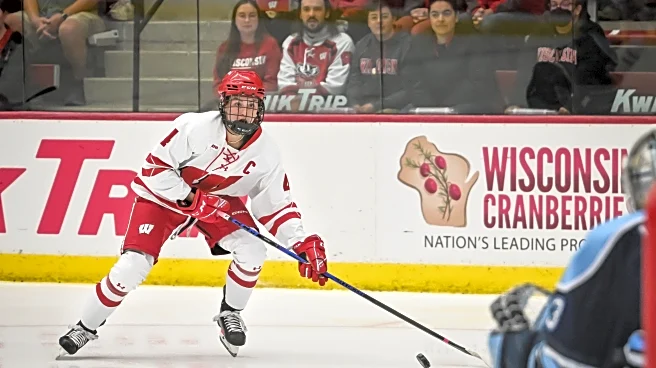




The Wisconsin women’s hockey team held onto the top ranking heading into the break following a hard-earned sweep over the No. 2 Ohio State Buckeyes. The Badgers are now two weeks into their five-week break, having maintained their No. 1 USCHO ranking since the season started and now holding a five-point lead over Ohio State in the WCHA standings.
This type of success at the midway point of the season is not foreign to Wisconsin, although this season has been anything but conventional. Injuries to star
players Kirsten Simms and Laila Edwards threw a wrench in the learning curve as the team adjusted to newcomer Adéla Šapovalivová running point for the top line.
In addition to the injuries, a good chunk of the team are vying for spots on the Team USA Olympic roster, expected to be announced in early January. Caroline Harvey, Lacey Eden, and Ava McNaughton, as well as Simms and Edwards, have been rostered for the Rivalry Series with Team Canada. Players selected will be absent for the stretch run but are expected to return in time for the WCHA tournament.
In the meantime, the Badgers have been on a tear, managing plenty of landmines on the way to the midpoint to post an 18-1-1 record, 12-1-1 in WCHA play. In six games against top-five teams, Wisconsin is 5-1, dropping one contest to No. 3 Minnesota. They are 8-1-1 overall against ranked teams to this point.
Cassie Hall emerged as an early leader to keep the ship afloat, scoring 11 goals in the team’s first 11 games, while Kelly Gorbatenko now leads the team with 15 goals after a bit of a slow start.
Caroline Harvey is playing some of her best hockey yet, which seems like a ridiculous thing to say after watching her over the past few years. She leads the NCAA in points (41) and assists (30), and she helps build the wall that allows Ava McNaughton to surrender only 1.267 goals per game, trailing only Penn State’s Katie DeSa.
If I didn’t know any better, I’d say Harvey is putting together a very strong argument for the Patty Kazmaier award—provided the voters are comfortable with back-to-back winners from Wisconsin. She is a game changer on both sides of the ice, the most dominant defender in women’s hockey, and a gifted goal scorer in her own right.
While it felt like there were some growing pains early in the year, this year’s team is averaging 5.8 goals per game, outpacing the 5.4 goals per game from last year’s championship team. As a general rule, scoring nearly six goals a game and giving up just over one is a great recipe to win a lot of hockey games.
A big factor in Wisconsin’s staggering goal differential is special teams. The Badgers have the third-ranked power play and are getting it on the ice as much as any team in the country. Lacey Eden has been one of the best power-play specialists in hockey, tied for the most power-play goals with five.
Wisconsin is not just scoring on the power play; they are squeezing the life out of opponents with the penalty kill. They are allowing opponents to convert at just a .091 clip and have surrendered only five power-play goals. It’s hard enough to compete with the Badgers’ five-on-five, but the skill throughout this roster really shows when there is more room to operate, regardless of who is in the penalty box.
After winning the SMASHVILLE Women’s Collegiate Hockey Showcase over Thanksgiving break, the Badgers do not have any winter holiday tournaments on the schedule. They will instead return to action in 2026, kicking off the second half with a two-game stint in Duluth on January 9th.
As mentioned, the second half of the season will feature a markedly different roster. Wisconsin may be without some key players in the upcoming series against both Minnesota and Ohio State. The question in March will be how the Badger can reacclimate after a grueling season of both collegiate and international play, but that’s a question for a later date. For the time being, it’s hard to ask for a better start for the defending champs.